Clear Sky Science · en
An evaluation of machine learning for soil analysis in internet of things-enabled smart farming
Why Smarter Soil Matters for Our Food
Every loaf of bread, bowl of rice, and plate of vegetables begins in the soil. Yet most farms still check soil health using slow, expensive lab tests that offer only a blurry snapshot in time. This paper explores how networks of cheap sensors and clever computer programs can turn soil into a continuously measured resource, helping farmers grow more food with less water and fertilizer while protecting the environment.
Soil as the Hidden Engine of Life
Soil is far more than dirt under our feet. It is a living, three‑phase mixture of minerals, water, air, and countless organisms that together feed about 95% of the world’s food. Its properties—such as texture, acidity, nutrient content, and the activity of microbes—shift from place to place and over time. Traditional testing collects a small number of samples, sends them to a lab, and returns results days or weeks later. For many farmers, especially in developing regions, this process is too costly, too slow, and too limited to guide everyday choices about what to plant, how much fertilizer to use, or when to irrigate.
From Clipboards to Connected Fields
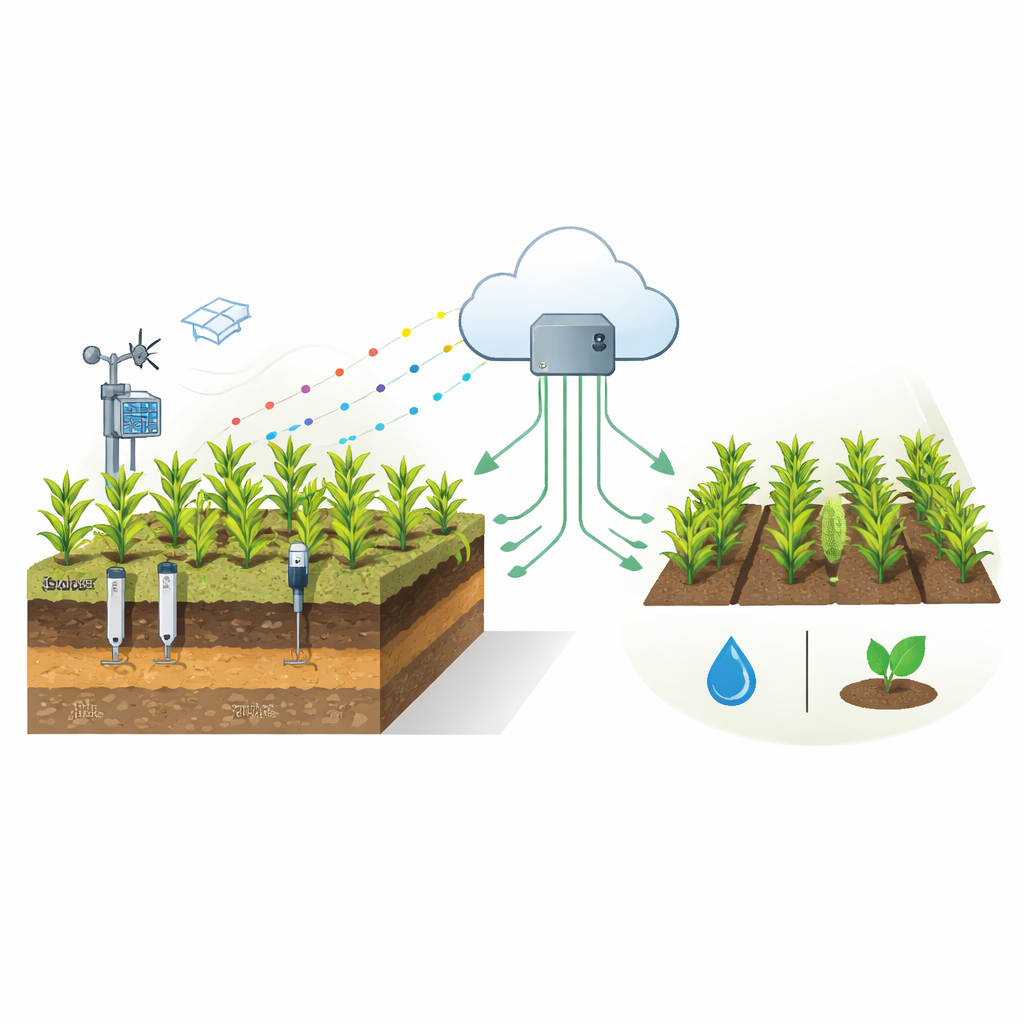
The authors describe how “smart farming” aims to replace one‑off soil checks with continuous, fine‑grained monitoring. In this approach, small Internet‑connected devices are buried in fields or mounted on poles and drones. These sensors track moisture, temperature, salt levels, acidity, and key nutrients such as nitrogen, phosphorus, and potassium. Wireless links then send the readings to central computers or cloud platforms. Because data arrive constantly and from many locations, farmers can see how soil conditions change from one corner of a field to another and from hour to hour, opening the door to precise irrigation and fertilization instead of blanket treatments.
How Learning Machines Read the Ground
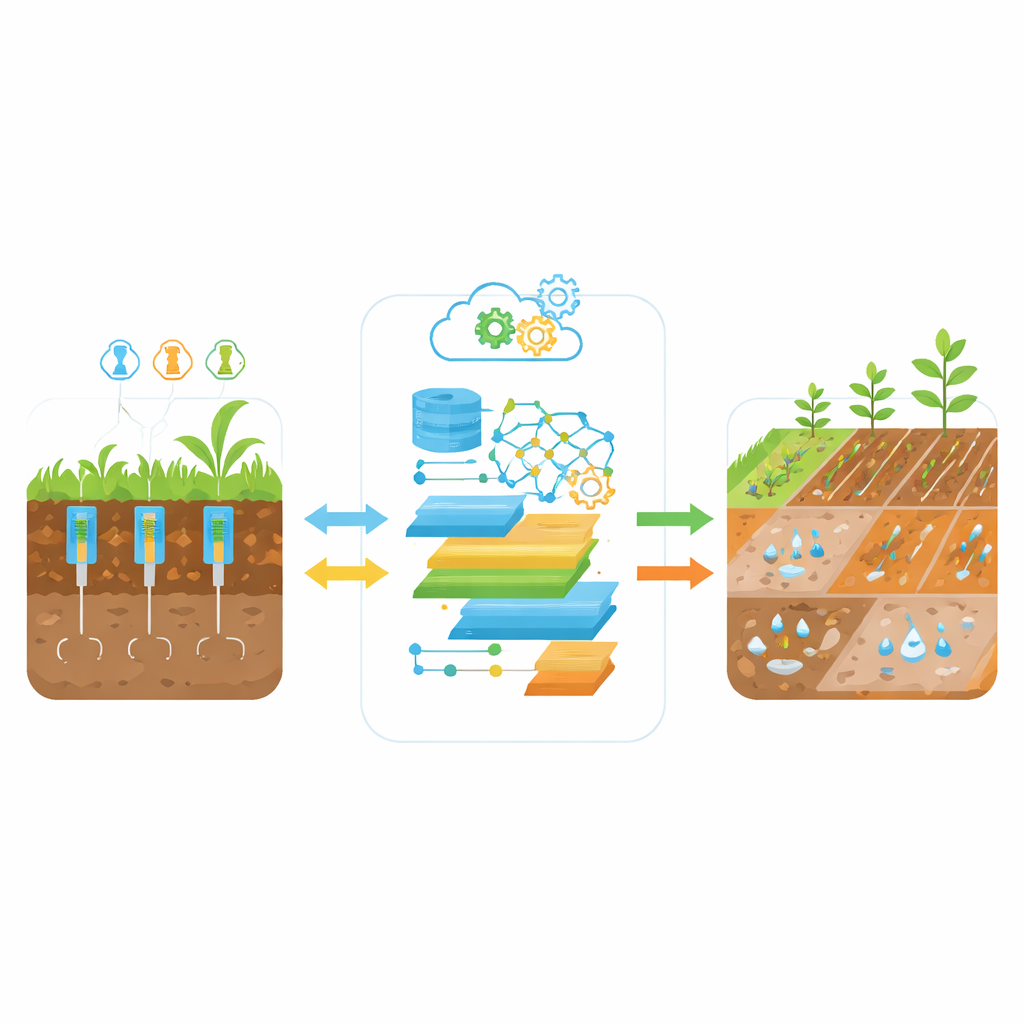
The heart of the paper is a systematic review of 77 recent studies that use machine learning—computer methods that learn patterns from data—to make sense of soil information. Most of these studies rely on “supervised” models that are trained using examples where both measurements and true soil conditions are known. Algorithms such as random forests, support vector machines, gradient boosting, and deep neural networks learn to link sensor readings, lab tests, or even soil photographs and satellite spectra to properties like fertility, acidity, or texture. Once trained, these models can quickly classify soil quality, estimate nutrient levels, or recommend suitable crops, often achieving accuracy above 90% on well‑organized datasets.
Real‑World Tools and Their Limits
The review highlights promising real‑world uses. Some systems predict how much fertilizer a particular plot of land needs, others classify soil types from smartphone photos, and several combine weather data with soil readings to suggest which crops are likely to thrive. IoT‑based sensing generally improves predictions by supplying richer, real‑time data. However, the authors also find recurring challenges: sensors can be fragile or drift out of calibration; wireless networks in rural areas are patchy; and energy‑hungry devices and models strain batteries and farm budgets. Many machine learning systems work well on local data but struggle when moved to regions with different soils and climates, and complex “black‑box” models can be hard for farmers and advisors to trust.
Roadblocks on the Path to Smarter Fields
Beyond technical concerns, the paper surveys broader obstacles. Smallholders may lack the skills or connectivity to run advanced digital tools. Data from different sensors, platforms, and studies are often hard to combine, making it difficult to compare methods or build shared standards. Privacy, security, and long‑term maintenance of sensor networks remain open questions. At the same time, the authors see opportunities in more energy‑efficient devices, low‑cost long‑range communication networks, and machine learning techniques that can work with smaller, noisier datasets and explain their decisions more clearly.
What This Means for Farmers and Food
Overall, the review concludes that combining soil sensors with machine learning can make soil analysis faster, cheaper, and more detailed than conventional lab testing. This can help farmers match crops to land, fine‑tune irrigation, and apply just enough fertilizer—boosting yields while cutting waste and pollution. Yet the authors stress that technology alone is not enough. To truly transform agriculture, smart soil systems must be robust, affordable, and understandable to farmers in diverse settings, and they must be backed by investments in rural infrastructure and training. If these hurdles can be overcome, the ground beneath our feet could become a powerful ally in feeding a growing world sustainably.
Citation: Chaudhary, P., Gulia, P., Gill, N.S. et al. An evaluation of machine learning for soil analysis in internet of things-enabled smart farming. Sci Rep 16, 10318 (2026). https://doi.org/10.1038/s41598-026-36017-z
Keywords: smart farming, soil sensors, machine learning, precision agriculture, soil fertility