Clear Sky Science · en
High isolation MIMO antenna based on metasurface for linear-circular polarization conversion and decoupling
Why your phone’s antennas struggle in crowded spaces
Our phones, cars, and wireless gadgets all rely on tiny antennas packed tightly together to move huge amounts of data. But when antennas sit too close, they start to “talk over” each other, and when their radio waves are twisted the wrong way, much of the signal is simply lost. This paper presents a new way to tame both problems at once, promising clearer, faster links for future 5G and 6G devices.
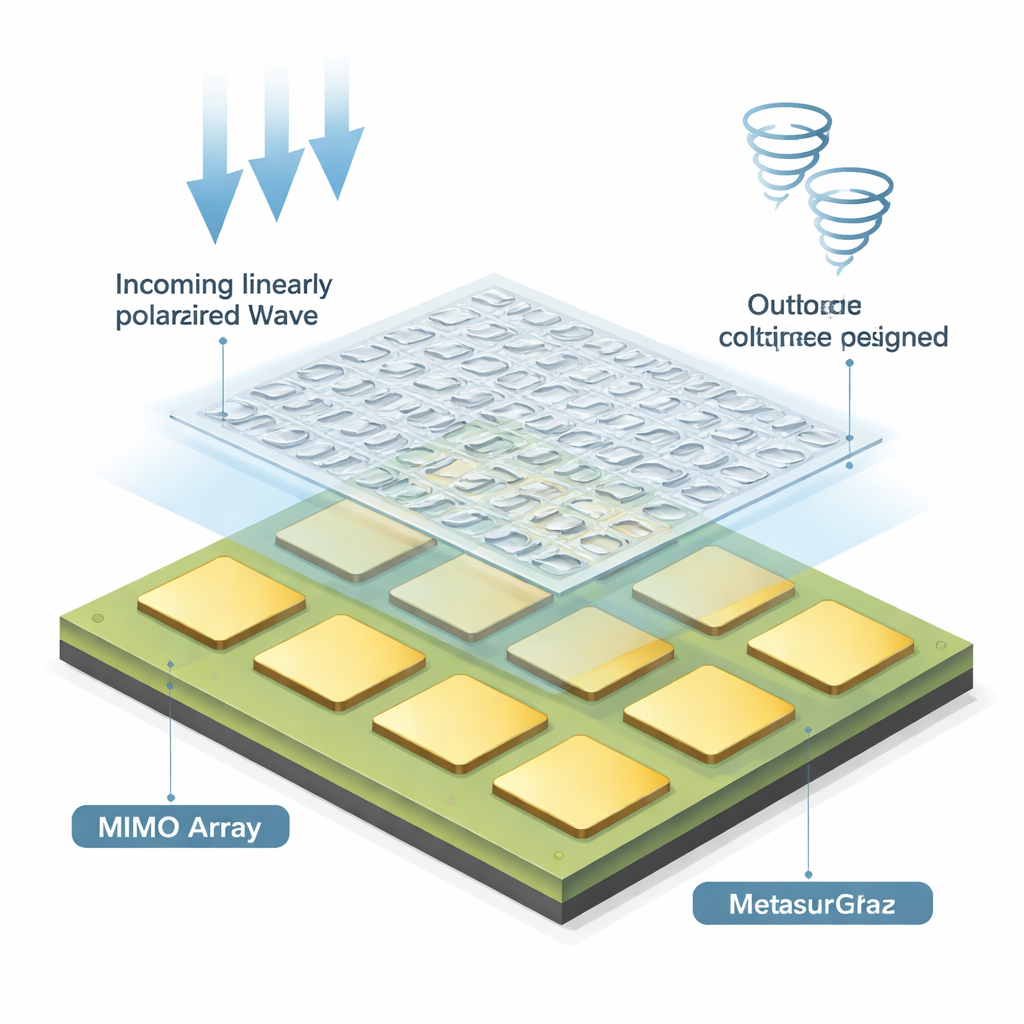
Turning straight waves into spinning waves
Radio waves can be thought of as ripples whose electric field can point in different directions. In many systems the wave is “linearly” polarized: the field swings back and forth along one line. In others it spins like a corkscrew, known as circular polarization. Circular waves are attractive because they are less sensitive to how a device is oriented and can better survive twisting effects in the atmosphere and in vehicles. Today, antennas and add-on structures usually tackle either polarization control or interference reduction, but rarely both. The authors aim to build a single, compact structure that converts simple linear waves into circular ones while also keeping neighboring antennas from interfering with each other.
A clever patterned surface above the antennas
The heart of the design is a multilayer metasurface—an engineered sheet made of many repeating metal shapes separated by thin insulating layers. Although the individual pieces are much smaller than the radio wavelength, together they act like a filter that treats waves differently depending on their direction and timing. By carefully choosing the shapes, sizes, and spacing of these metal patches, the team makes the surface delay one part of the wave more than another. When those parts rejoin after passing through the metasurface, the result is a wave whose electric field now traces a circle instead of a straight line. At the same time, the patterned surface behaves like a set of passive “helper” elements that reroute stray energy which would otherwise leak between nearby antennas.
Keeping tightly packed antennas from shouting at each other
To show this works in practice, the researchers start with simple arrays of two patch antennas—flat, square radiators commonly used in phones and base stations—placed extremely close together at only about 5% of a wavelength edge to edge. Without any extra structures, energy from one patch readily couples into its neighbor, spoiling the signal. When the metasurface is mounted a small distance above the patches, that coupling drops dramatically: in one orientation, the unwanted leakage is reduced by about 21 decibels, meaning less than a tenth of the previous interference power. At the same time, the antennas now radiate circularly polarized waves over a useful slice of the 4.5–5 gigahertz band, the range often used for sub‑6 GHz 5G. The radiation pattern also becomes cleaner and the gain—how strongly the antenna sends energy in the desired direction—rises modestly.
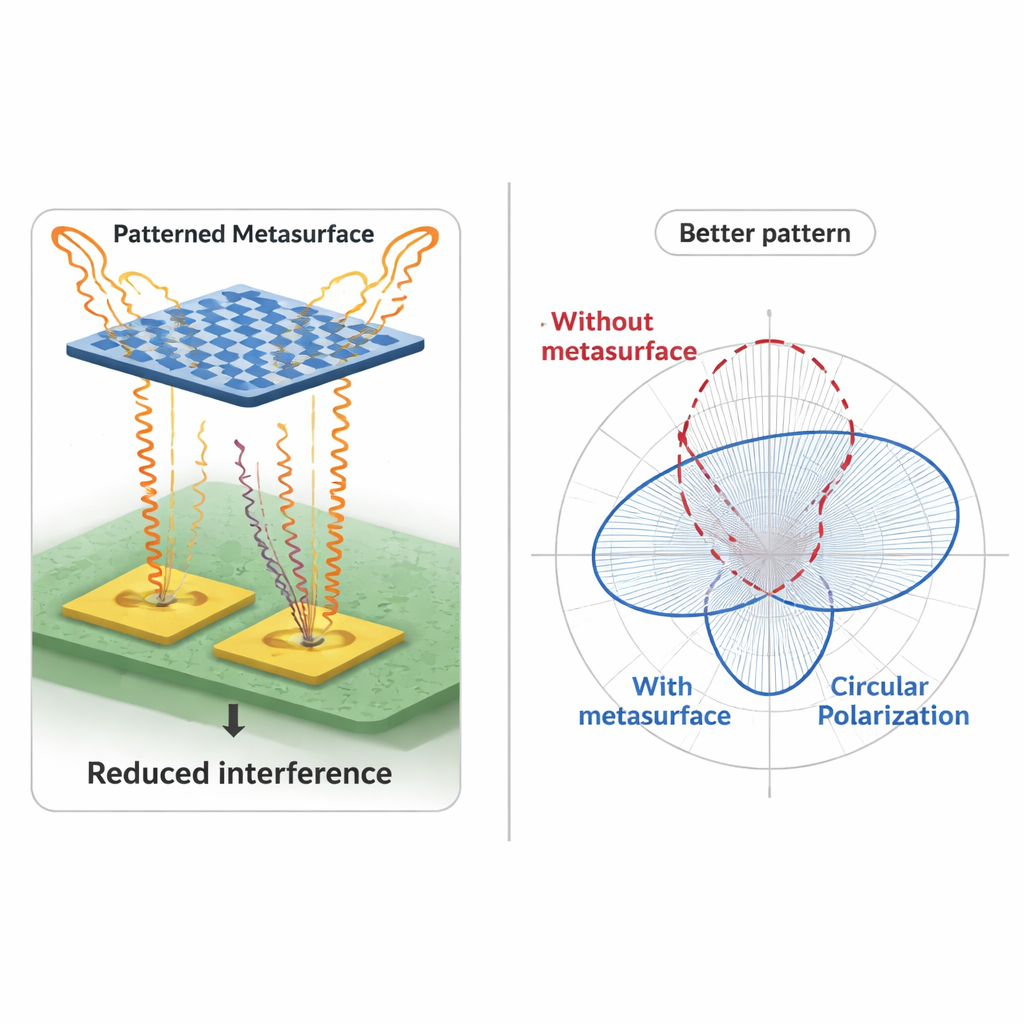
Scaling up to a full grid for real-world use
Building on the two‑element tests, the team assembles a 3×3 grid of nine patches, again placed very close together to mimic a high‑density MIMO (multiple‑input, multiple‑output) system. With no metasurface, the central antenna strongly disturbs its neighbors and the combined beam points off at an angle, with no clear circular polarization. After adding a periodic array of metasurface cells above the grid, most antenna pairs are isolated by more than 20 decibels, the beam straightens to point forward, and the radiation clearly becomes right‑hand circularly polarized. Measurements in an anechoic chamber match computer simulations closely, confirming that the structure behaves as designed over a bandwidth of a few percent—enough for practical sub‑6 GHz 5G channels.
What this means for future wireless devices
In simple terms, the authors have created a “smart roof” that sits over a crowded set of antennas and simultaneously straightens out their beams, stops them from interfering with each other, and twists their waves into a more robust circular form. Compared with many earlier approaches, their design works at tighter spacing, offers stronger isolation, and provides wider bandwidth for circular polarization. Such a compact, dual‑purpose layer could help future 5G/6G base stations, satellite terminals, and connected vehicles pack more antennas into less space without sacrificing signal quality, making our wireless links faster and more reliable.
Citation: Wu, T., Ma, F., Wang, L. et al. High isolation MIMO antenna based on metasurface for linear-circular polarization conversion and decoupling. Sci Rep 16, 6075 (2026). https://doi.org/10.1038/s41598-026-36016-0
Keywords: metasurface antenna, MIMO, 5G sub-6 GHz, circular polarization, mutual coupling reduction