Clear Sky Science · en
Teacher support enhances self-efficacy and learning outcomes in the age of AI
Why this matters for students and teachers
As chatbots and other AI tools rush into classrooms, many people wonder: will they actually help students learn, or simply make it easier to cut corners? This study looks closely at how college students in China use generative AI, like ChatGPT, to learn English as a foreign language—and, crucially, how teachers can make the difference between shallow use and real progress. The findings show that supportive teachers and confident students form a powerful partnership with AI, leading to better learning outcomes.
Learning with AI is more than just using a new tool
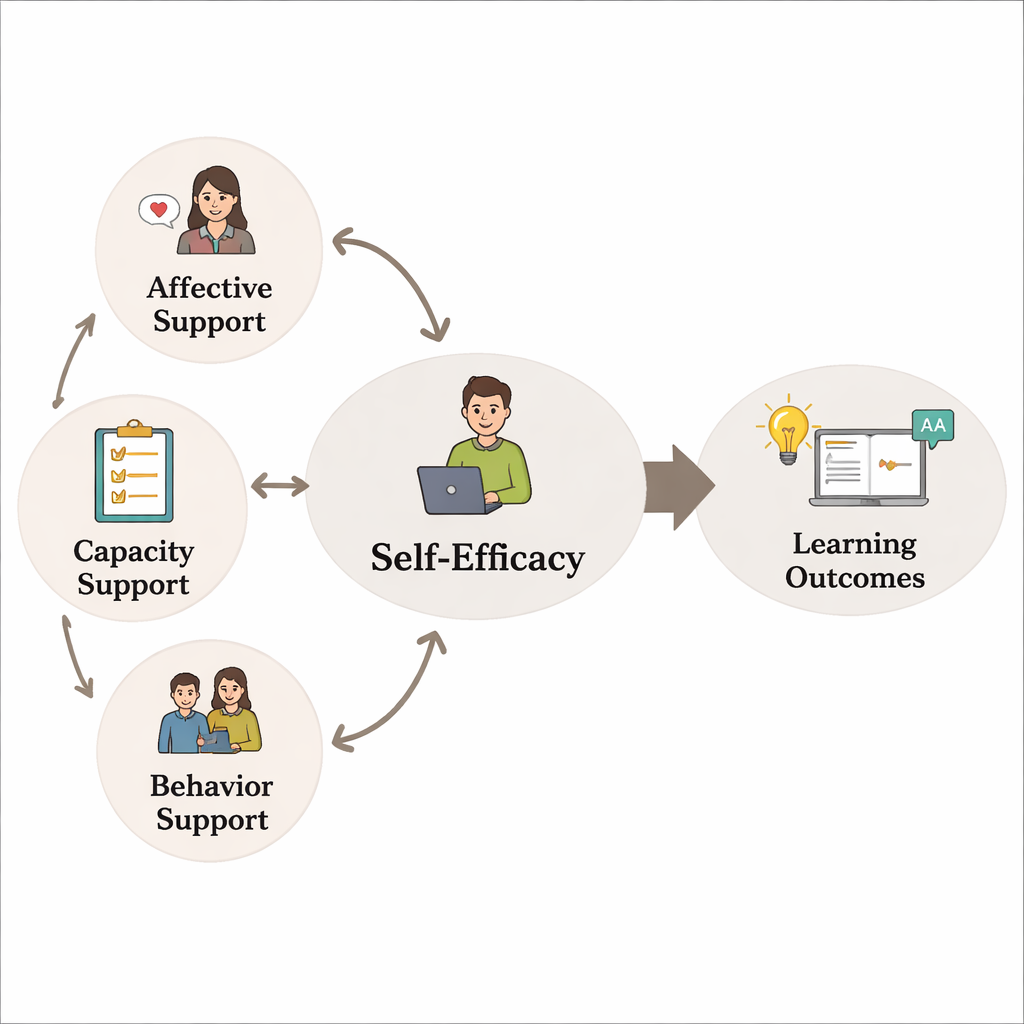
The research starts from a simple idea: technology alone does not guarantee learning. Drawing on a well-known psychological framework called social cognitive theory, the author argues that students’ beliefs about their own abilities—known as self-efficacy—play a central role in how much they benefit from any tool, including AI. Generative AI can offer instant feedback, endless conversation practice, and tailored language examples, which are especially helpful in English learning. But without guidance and encouragement, students may not know how to use these features effectively or may rely on AI to do the work for them instead of building real skills.
What kinds of teacher support matter most
The study breaks teacher support into three everyday forms. Affective support includes warmth, encouragement, and showing that teachers care about students’ progress. Capacity support means teaching students how to use AI tools well—showing functions, modeling good prompts, and explaining the benefits and limits of the technology. Behavior support involves designing concrete activities that require students to engage with AI in meaningful ways, such as practice dialogues, revision tasks, or projects that combine AI output with students’ own work. Together, these types of support create a classroom climate where AI is not a shortcut, but a structured aid.
How the study was done and what it found
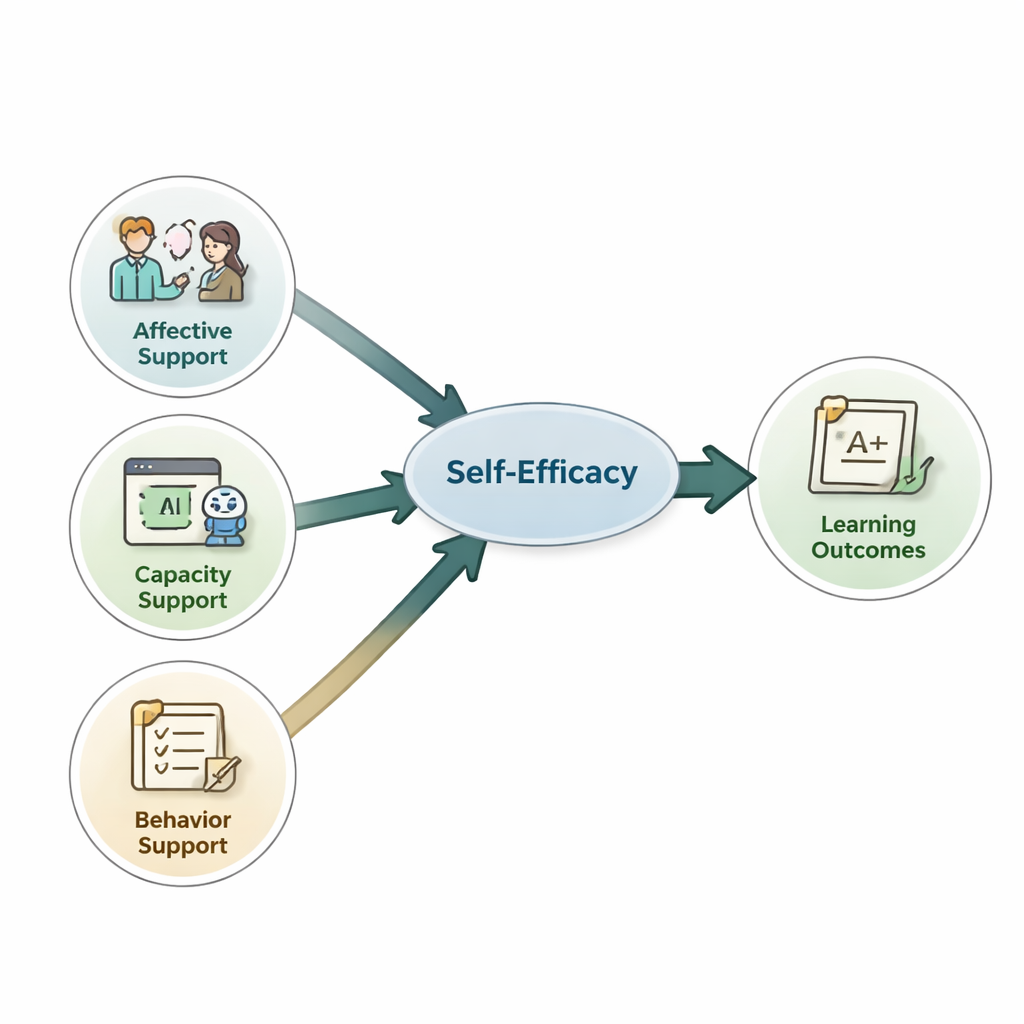
To test these ideas, the researcher surveyed 906 students at a higher vocational college in Chengdu who were learning English and using generative AI. Students answered questions about how much support they felt from their teachers, how confident they were in their ability to succeed in English, and how they viewed their learning outcomes. Using a statistical technique that maps relationships between hidden factors, the study found a clear pattern: when teachers offered strong capacity and behavior support, students’ self-confidence in their English learning rose, and this in turn was strongly linked to better learning outcomes. Affective support alone, without concrete AI-related guidance, did not reliably boost students’ confidence—perhaps because many teachers are still unsure about AI or focus mainly on exams.
Confidence is the key link between AI and achievement
One of the most striking results is how strongly students’ academic self-efficacy predicts their English learning outcomes when using AI. Students who believed they could handle AI-assisted tasks, manage challenges, and meet course expectations were far more likely to report better learning. Teacher capacity and behavior support did not just help directly; they also worked indirectly by raising students’ confidence, which then translated into improved performance. In other words, AI works best when students feel capable of driving their own learning with it, rather than passively receiving answers.
What this means for classrooms in the age of AI
For a layperson, the takeaway is straightforward: AI can be a powerful ally in learning English, but only when combined with skilled, active teaching and students who believe in their own abilities. The study suggests that colleges should invest in training teachers not only to understand AI tools, but also to design tasks, give clear feedback, and coach students in using AI responsibly. When teachers provide practical guidance and structured activities, and when students build confidence in their own learning, generative AI becomes less of a threat and more of a partner in achieving better educational outcomes.
Citation: Xia, S. Teacher support enhances self-efficacy and learning outcomes in the age of AI. Sci Rep 16, 5113 (2026). https://doi.org/10.1038/s41598-026-36014-2
Keywords: teacher support, self-efficacy, generative AI, English language learning, student confidence