Clear Sky Science · en
Fractal nature of galaxy clustering in the updated CfA redshift catalog
Why the night sky is dark but not empty
Look up on a clear night and you see scattered stars, a hazy band of the Milky Way, and perhaps a faint smudge of another galaxy. Yet astronomers now know there may be a trillion galaxies in the Universe. If matter were spread perfectly evenly, the sky would blaze with light in every direction. Instead, space is mostly dark, and galaxies gather in clumps and filaments separated by huge empty regions. This article asks a deceptively simple question: do galaxies follow hidden “fractal” patterns—like cosmic versions of branching trees or coastlines—that can explain how matter is arranged on the largest scales?
From smooth cosmos to cosmic web
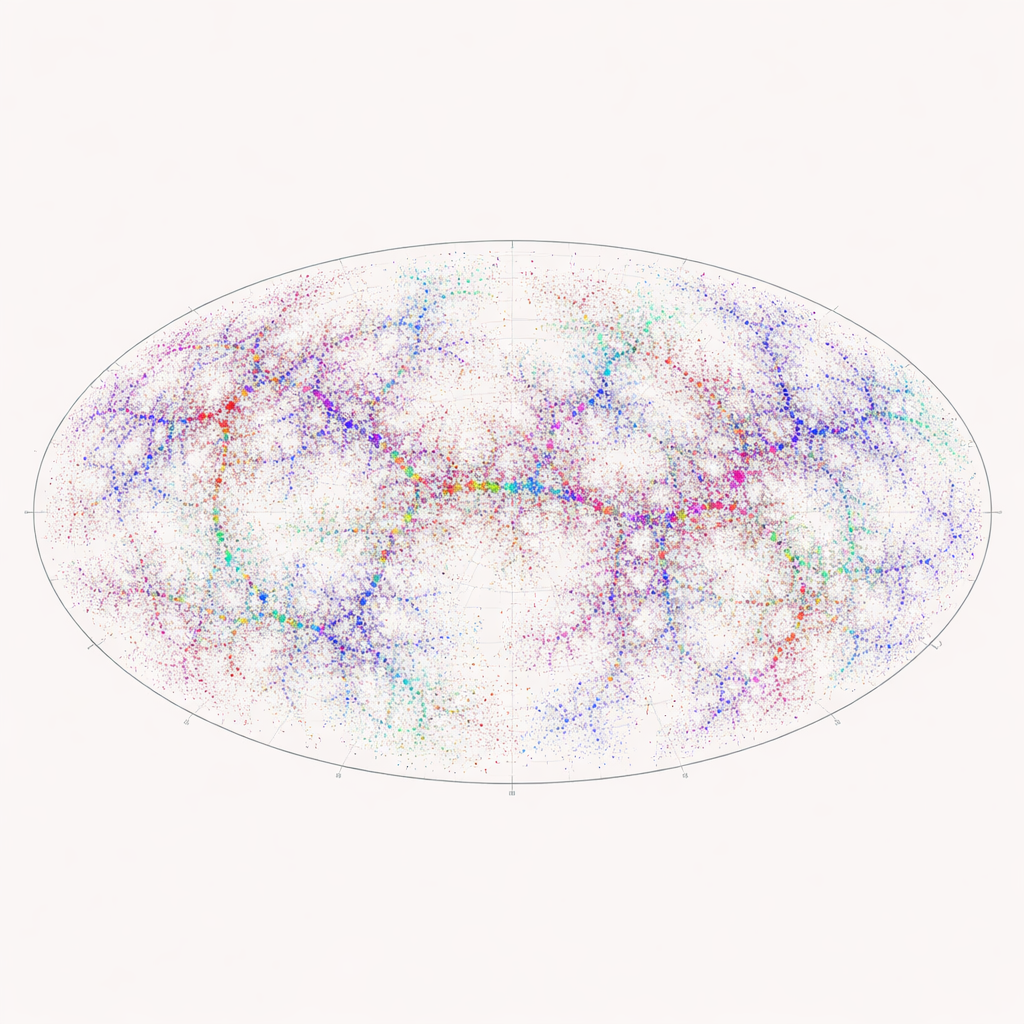
Modern cosmology often treats the Universe as smooth when you zoom out far enough, an idea that underpins the standard model of cosmic evolution known as ΛCDM. But detailed maps of galaxies show something more intricate: long chains, sheet-like walls, and vast voids, together forming a giant three-dimensional web. The authors revisit a proposal, going back to mathematician Benoît Mandelbrot, that this web may be described using fractals—structures that repeat similar patterns over many scales. Instead of assuming galaxies eventually smear into a uniform fog, they test whether the real data behave more like a fractal hierarchy, where clusters, superclusters, and filaments echo one another from small to very large distances.
Mining a million galaxies for hidden patterns
To probe this idea, the researchers turn to one of the most comprehensive resources available: the Updated CfA Redshift Catalog (UZCAT). This compilation gathers radial velocities—how fast galaxies move away from us due to cosmic expansion—for roughly three-quarters of a million galaxies, drawn from multiple major surveys. From each measured redshift, the team estimates the galaxy’s distance using an updated form of Hubble’s law. They clean the sample by removing misclassified objects, problematic measurements, and extreme outliers, then group galaxies into seven distance or speed “bands,” from nearby systems to those racing away at more than half the speed of light. Statistical checks suggest that the remaining gaps in the data occur essentially at random, so they are unlikely to distort the large-scale patterns the team is hunting.
Reading the cosmic web through fractal glasses
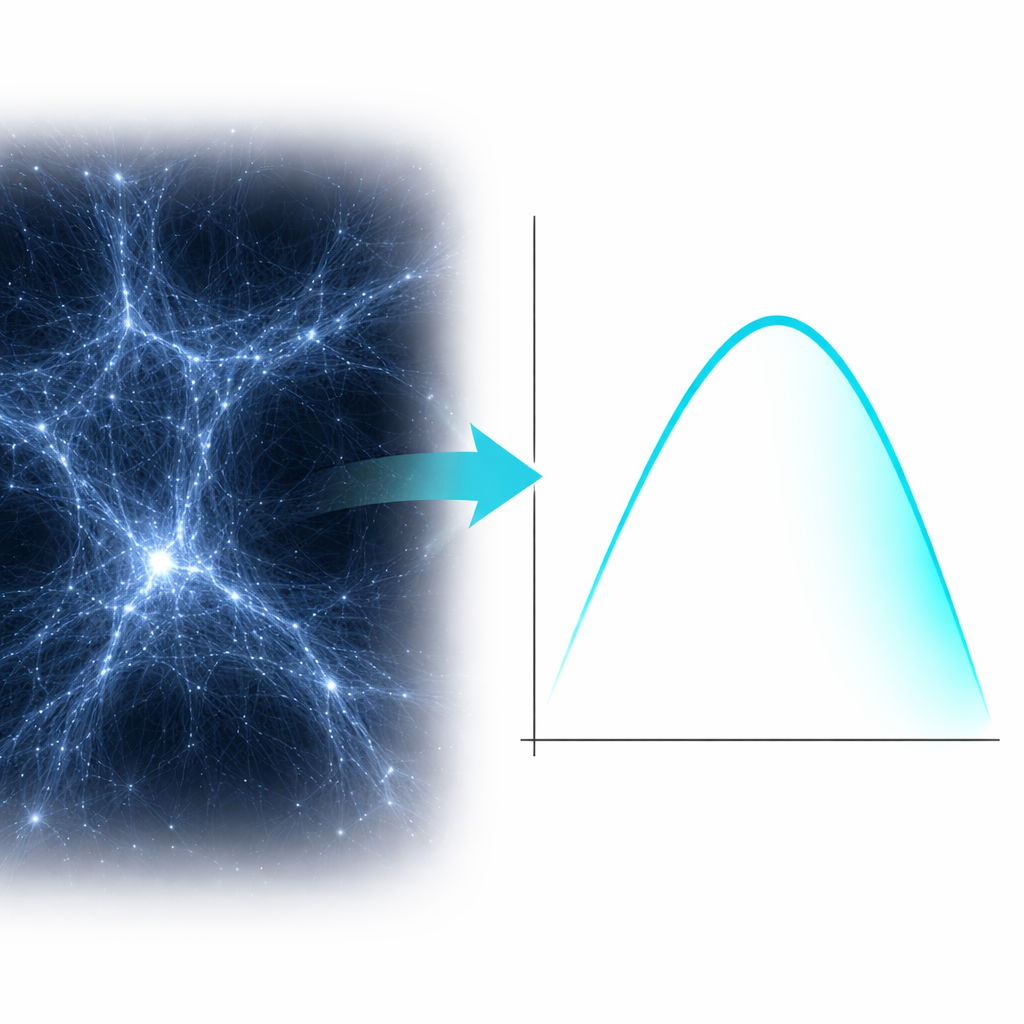
Rather than simply counting galaxies in boxes, the authors apply tools from the study of turbulence and chaos, where irregular, bursty behavior is the norm. They slice space into shells at increasing distances from the Sun and calculate how the average number of galaxies changes with scale. From these counts they construct a “multifractal spectrum,” a mathematical fingerprint that tells how strongly dense regions and empty voids contribute at different scales. In a perfectly smooth Universe this spectrum would collapse to a single value; in a fractal one it spreads out. The team compares the observed spectrum with a simple theoretical construction called a weighted Cantor set—a classic fractal built by repeatedly cutting out middle pieces from a line and redistributing “weight” unevenly between the remaining parts. This model has previously been used to describe turbulent plasmas in the solar wind and laboratory experiments.
What the numbers say about cosmic structure
The analysis shows that the galaxy distribution is not purely uniform, but it is not wildly fractal either. The multifractal spectrum extracted from UZCAT matches the weighted Cantor-set models quite well, especially for the denser parts of the cosmic web. A single key number, which measures how broad the spectrum is, turns out to be modest—about 0.1 to 0.15—much smaller than values seen in the turbulent solar wind, but larger than in the relatively calm local interstellar medium outside the Sun’s influence. This suggests that galaxies follow a mostly simple scaling rule with gentle, but real, departures from uniformity. The spread and slight asymmetry of the spectrum vary somewhat between nearer and more distant galaxy samples, hinting that large voids and subtle departures from an ideal Hubble expansion may leave a measurable imprint on how galaxies cluster.
A fractal flavor to a standard Universe
In everyday terms, the study argues that the Universe is broadly consistent with the standard cosmological picture while still showing a “fractal flavor” in how galaxies are arranged. The cosmic web appears to follow scaling laws similar to those seen in turbulent fluids, and these patterns can be captured with remarkably simple fractal recipes. Yet the overall deviations from smoothness are small enough to fit comfortably within current ΛCDM models of structure formation. We still cannot map more than a tiny fraction of all galaxies, nor fully resolve the three-dimensional web, so the final verdict on whether the cosmos is truly fractal remains open. For now, this work shows that the night sky’s dark gaps and glowing strands are not random: they carry a subtle signature of fractal order written across the largest structures we can observe.
Citation: Macek, W.M., Wójcik, D. Fractal nature of galaxy clustering in the updated CfA redshift catalog. Sci Rep 16, 6181 (2026). https://doi.org/10.1038/s41598-026-36013-3
Keywords: galaxy clustering, cosmic web, fractal universe, large scale structure, multifractal analysis