Clear Sky Science · en
Numerical simulation on heat transfer characteristics of a bionic leaf-vein fractal fin heat exchanger
Why leaves can inspire better cooling
From smartphone chips to building air conditioners, modern life quietly depends on devices that move heat away before things overheat. Engineers are now turning to an unlikely teacher for better cooling ideas: the humble green leaf. This study explores how copying the branching patterns of leaf veins and carving them into the thin metal plates inside heat exchangers can boost cooling power dramatically without demanding much extra energy.
Borrowing nature’s built-in plumbing
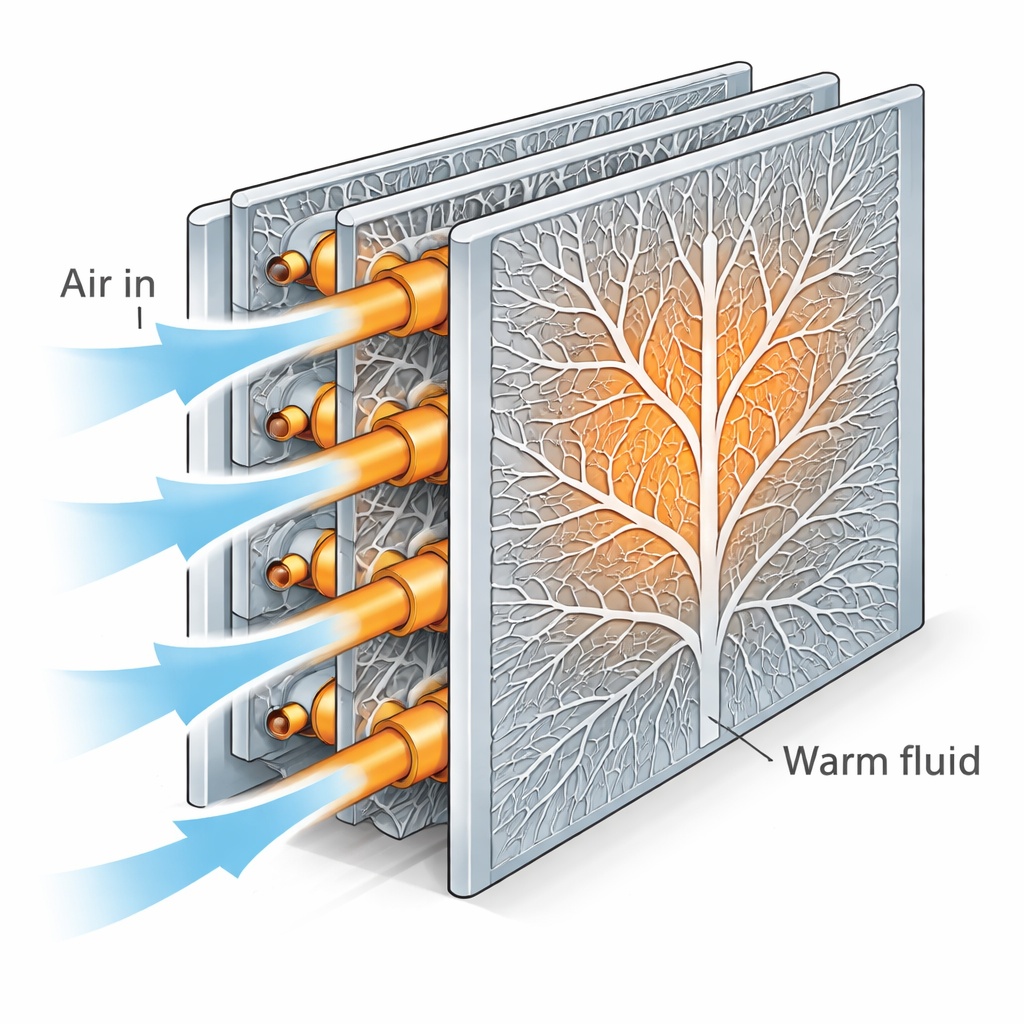
Plant leaves are masters at moving water and nutrients through a vast network of branching veins. These networks are “fractal” – similar patterns repeat at different scales – which helps spread flow evenly with little wasted energy. The authors of this paper asked: what if we etched a similar branching pattern into the metal fins that sit around the tubes in common heat exchangers, such as those used in cars, refrigerators, and building air-conditioning systems? Instead of simple flat plates or straight channels, the fins would carry tree-like paths that guide air more intelligently past hot tubes.
Testing a digital prototype
Rather than building hardware first, the team created a detailed three-dimensional computer model of air flowing through one section of a fin-and-tube heat exchanger. They compared standard flat fins to a family of new “leaf-vein” fins whose branches split and narrow in several levels around each tube. Using established fluid dynamics software, they simulated how air moves and how heat transfers as it passes through, at flow speeds typical of real equipment. They systematically varied two key geometric features: the angle at which each branch splits and the width of the main veins, then watched how these changes affected both heat transfer and the pressure drop that fans must overcome.
Finding the sweet spot in the pattern
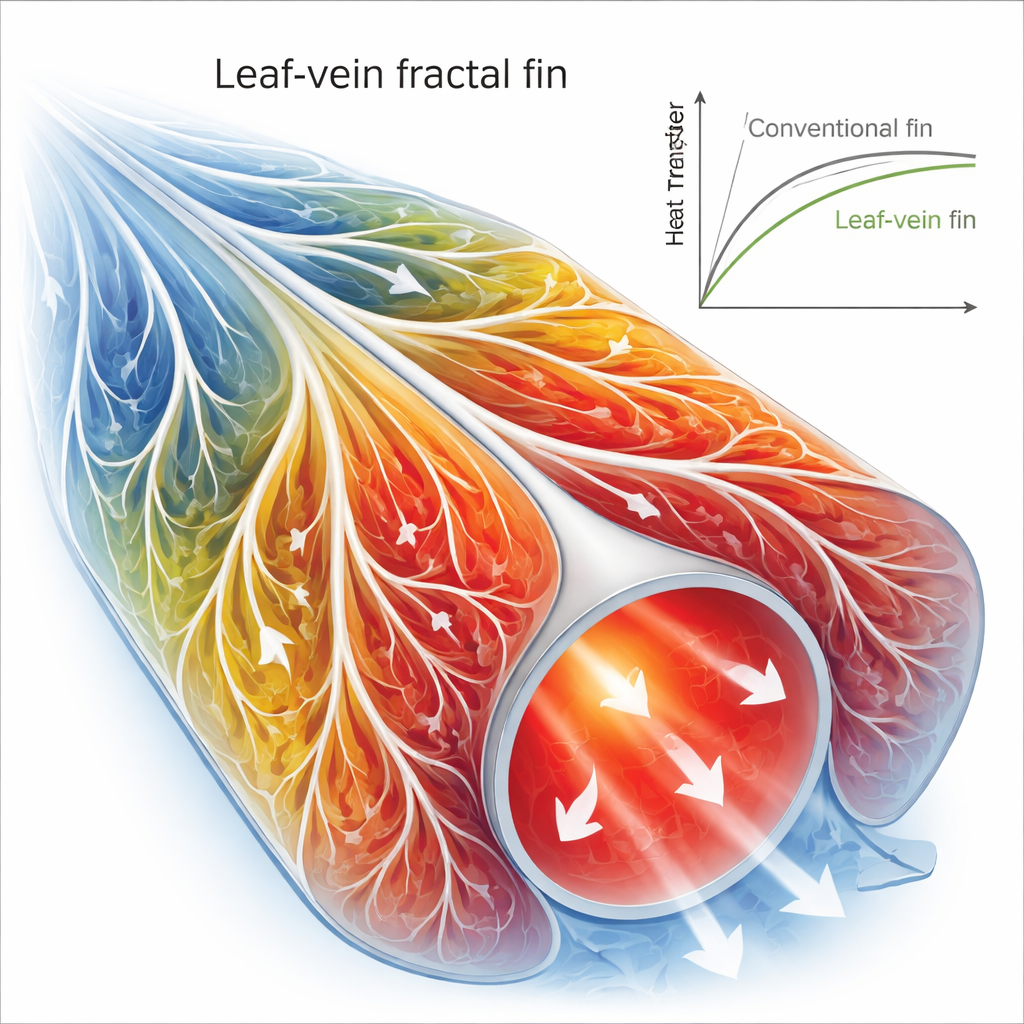
The leaf-inspired fins did not all behave the same. When the branches spread too widely or became too crowded, flow pathways worsened and performance dropped. The simulations revealed that an intermediate branch angle of about 30 degrees strikes the best balance: it makes the air follow more winding paths, which repeatedly disturb the insulating layer of still air that clings to surfaces, yet does not choke the flow. Likewise, making the main veins too thick blocked passages, while making them too thin reduced useful surface area. A primary vein width of 1 millimeter, paired with smaller secondary and tertiary widths, emerged as the most effective combination.
How much better than standard fins?
With this optimized geometry, the leaf-vein fin outperformed conventional flat fins across the tested airflow range. At a representative operating condition, the new design increased the heat transfer coefficient by about 51–52 percent, meaning it could move roughly half again as much heat for the same air speed. At the same time, the fin’s overall effectiveness was nearly ten times that of an unfinned surface, even though its local efficiency along each branch was only moderate. In simple terms, the extra intricate surface created by the branching pattern more than compensates for the small losses along its length. The pressure penalty—extra effort required from the fan—did rise, but not in proportion to the gain in heat transfer, leaving a net advantage.
What this means for everyday technology
For non-specialists, the bottom line is that by carving leaf-like fractal networks into metal fins, we can build heat exchangers that remove heat far more effectively without needing equally larger fans or pumps. In applications like building climate control or car radiators, that could translate into smaller, lighter equipment or lower energy bills for the same cooling performance. The study is based on advanced computer simulations rather than laboratory hardware, so the authors call for future experiments and cost analyses. Still, their results suggest that the familiar pattern on a tree leaf may point the way to more efficient, climate-friendly cooling systems.
Citation: Wang, R., Hou, Y., Yu, H. et al. Numerical simulation on heat transfer characteristics of a bionic leaf-vein fractal fin heat exchanger. Sci Rep 16, 5887 (2026). https://doi.org/10.1038/s41598-026-36012-4
Keywords: heat exchanger, bionic design, leaf vein fractal fin, heat transfer enhancement, energy-efficient cooling