Clear Sky Science · en
Porous media grouting diffusion mechanism based on tailings slurry phase change characteristics
Turning Mine Waste into a Useful Tool
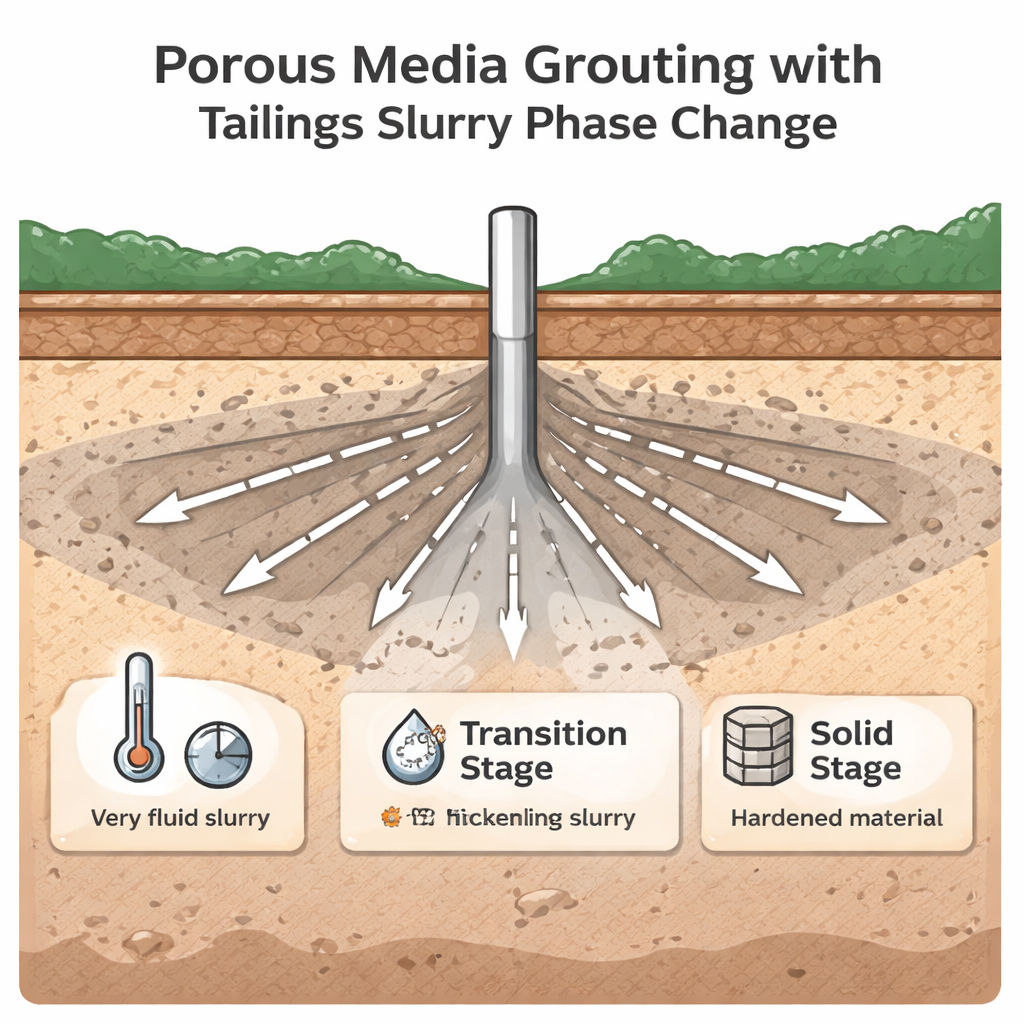
Modern mining leaves behind vast lakes of fine waste called tailings, which can leak metals and threaten dams. Engineers are learning to reuse this muddy waste as a construction material by pumping it into weak ground or empty mine spaces, a process called grouting. This study asks a deceptively simple question with big safety implications: as this waste-based slurry flows through the ground and slowly hardens, how exactly does it move and how much pressure is needed to push it?
Why the Flow and Hardening Matter
Grouting is often treated, in calculations, as if the injected mixture stays a thin liquid the entire time it travels underground. In reality, tailings slurry behaves more like soft toothpaste that gradually stiffens into rock. If this slow hardening is ignored, engineers can badly overestimate how far the slurry will spread and underestimate the pressure needed to drive it through soil or mine waste. Because real ground is a maze of winding pores—not straight pipes—simplified theories can mislead designs, risking poor reinforcement or even damage to nearby structures.
Watching Slurry Thicken in Real Time
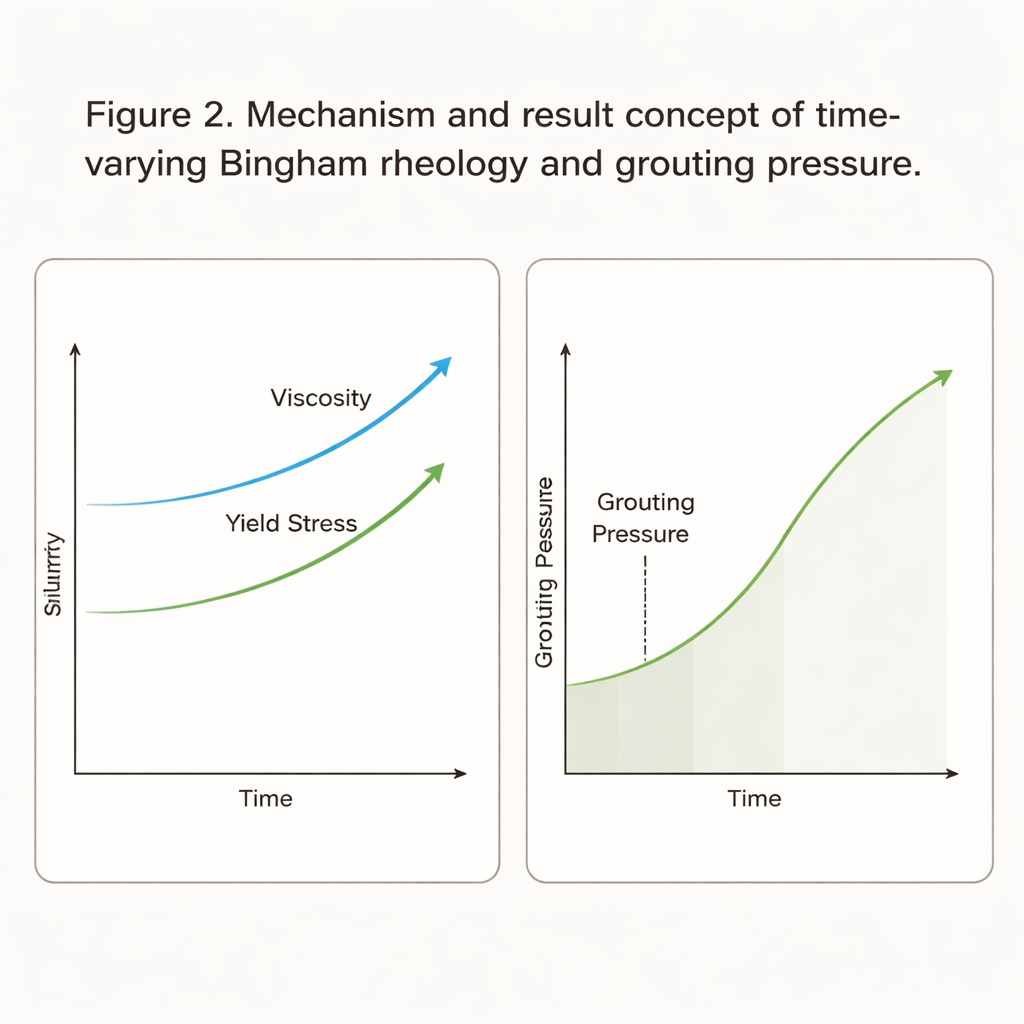
The researchers first mixed fine tailings with cement, lime, fly ash and water in carefully controlled recipes, then used a high-precision rotational rheometer to measure how easily the slurry sheared and flowed over two hours. They varied two key knobs that practical projects can control: temperature (10°C, 25°C and 50°C) and water–cement ratio (from relatively dry, 1.0, to more watery, 3.0). The slurry’s response matched a type of “yield-stress” material known as a Bingham fluid: below a certain push it barely moves, above that threshold it flows. Crucially, both the threshold stress and the apparent thickness (viscosity) rose over time, and both could be described by simple quadratic curves in time. Drier mixes and higher temperatures made the slurry stiffen faster and more strongly, with water content having the larger effect.
From Lab Curves to Underground Flow
Next, the team built a mathematical model of how this time-thickening slurry diffuses through a porous medium. They treated the tortuous pore network as bundles of narrow tubes, accounted for the fact that some regions of the tube carry a rigid “plug” of nearly unsheared slurry, and allowed both yield stress and viscosity to depend on the slurry’s age since mixing. By linking local pressure gradients, average flow speed and the evolving material properties, they derived an equation that predicts how grouting pressure should grow over time as the front of the slurry advances into the ground.
Testing the Theory in a Tall Sand Column
To see if the theory matched reality, the authors constructed a 2.4‑meter‑high steel test container packed with different tailings-based sands and silts. They injected tailings slurry at controlled flow rates, temperatures and mix ratios, monitoring pressure at twelve depths. In all nine test conditions, pressure at each sensor rose with time and was higher closer to the injection pipe. The pressure–time curves showed a clear two-stage behavior: an early, nearly straight, gently rising segment, followed by a later, rapidly accelerating rise as the slurry thickened and flow paths became harder to penetrate. When they compared model predictions to measurements, the new time-varying Bingham model tracked the data much better than an older version that assumed a fixed yield stress, cutting overall errors to within about 10%.
What This Means for Safer, Smarter Grouting
For non-specialists, the takeaway is that mine waste slurry is not just dirty water—it is a living material that thickens as it moves, and small changes in water content or temperature can dramatically alter how it flows underground. By capturing this phase change in both laboratory measurements and a refined flow model, the study offers engineers a more realistic way to predict how far such slurries will spread and how grouting pressure will build up in time. This can help design safer tailings dams, more reliable ground reinforcement and better reuse of mining waste, reducing environmental risks while making underground construction more predictable.
Citation: Xing, S., Jia, J., Zheng, C. et al. Porous media grouting diffusion mechanism based on tailings slurry phase change characteristics. Sci Rep 16, 5571 (2026). https://doi.org/10.1038/s41598-026-36009-z
Keywords: tailings slurry, grouting, porous media, rheology, mine waste reuse