Clear Sky Science · en
Analysis of 3D printed longitudinal Flatfoot pads with lattice structures using various microfoaming filament
Why sore arches matter
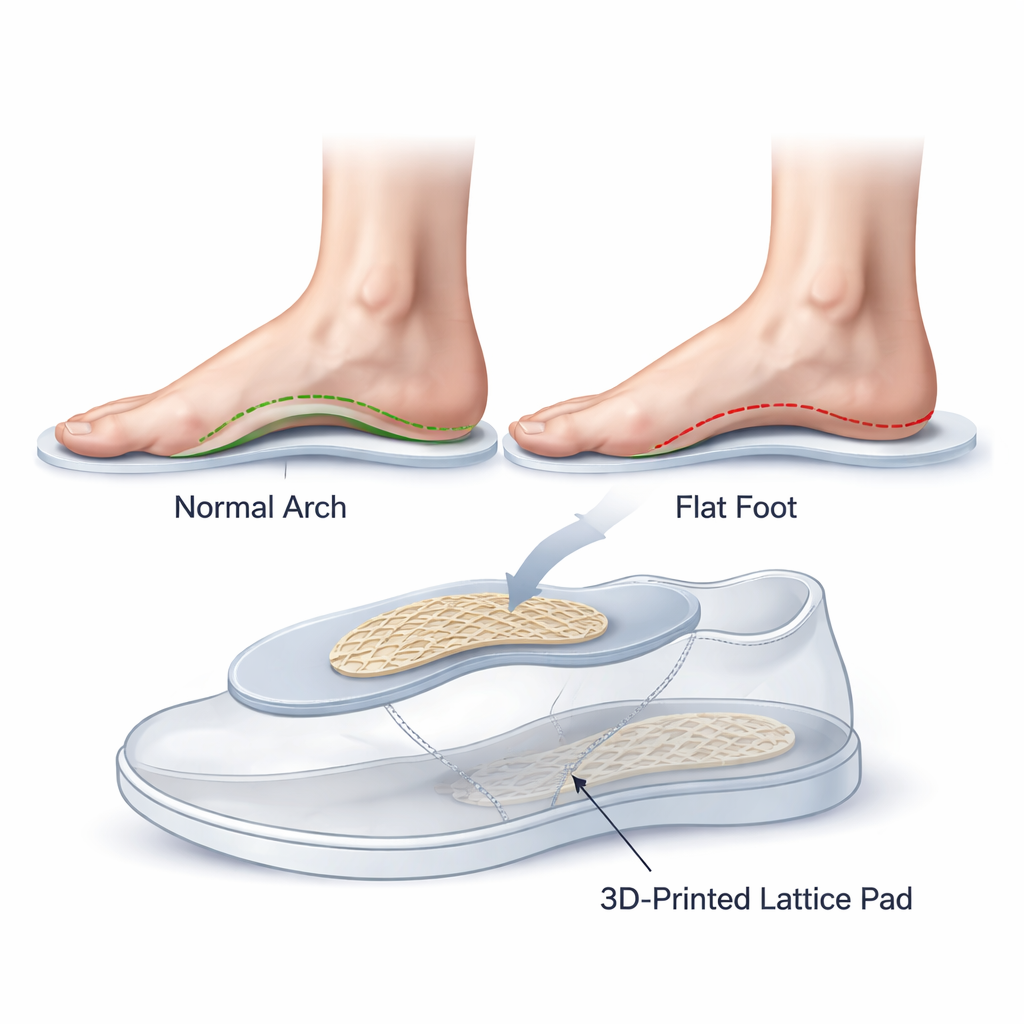
Many people go through life with aching, tired feet without ever knowing that a fallen arch—often called flatfoot—may be to blame. When the natural curve on the inside of the foot collapses, each step can overload the bones, joints and soft tissues all the way up to the knees, hips and lower back. This study explores a new way to support that arch using 3D-printed pads made from airy, lattice-like structures. By carefully tuning the internal pattern and material, the researchers show it is possible to spread pressure more evenly under the foot, offering greater comfort and protection in everyday shoes.
Building smarter foot pads
Instead of traditional wool, foam or gel pads, the team designed slim inserts that sit along the inside edge of the foot—the area where the arch should rise. These pads were created with a 3D printer that lays down plastic in precise patterns, allowing the inside of each pad to be a lightweight network of tiny beams, known as a lattice. Five different lattice designs, plus one solid version, were tested. Some patterns were dense and stiff, like a tightly packed honeycomb, while others were more open and springy, like a mesh. The researchers also compared three printing plastics: a flexible rubber-like material (TPU), and two microfoaming "lightweight" versions (LW-TPU and LW-PLA) that expand into tiny bubbles as they are printed, making them lighter and more cushioned.
From printer settings to real-world feel
The scientists first examined how each design actually printed. Using microscopes and measurements, they found that dense patterns such as the icosahedral lattice built thick, tightly connected walls and took the longest time and the most material to print. Open designs, like the Voronoi lattice, created larger gaps, printed faster and weighed less. Mechanical tests that squeezed the pads showed that the dense icosahedral design was the strongest and stiffest, while the open Voronoi version was the most flexible but less supportive. Among the materials, lightweight PLA was the stiffest, lightweight TPU offered the best balance of strength and energy absorption, and traditional TPU was the softest and most easily compressed.
How pressure spreads under the foot
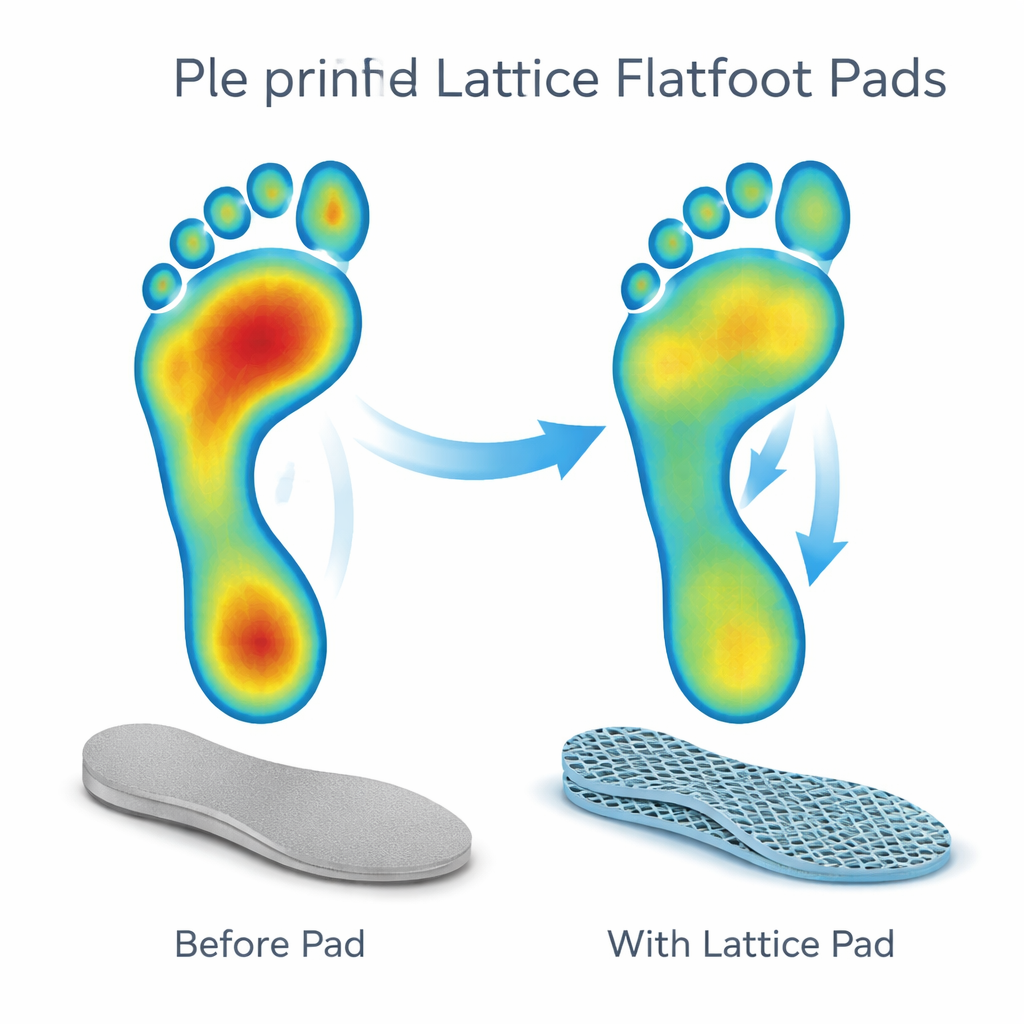
To see what these differences meant for real feet, the team recruited young women with normal arches and with flatfoot. Each participant stood and walked on a pressure-sensing walkway while wearing socks alone, a standard wool pad, or the various 3D-printed pads. For people with flatfoot, barefoot measurements showed a telltale third pressure peak under the midfoot, where the arch had collapsed and more of the sole touched the ground. When the 3D-printed pads were added, pressure maps changed: the contact area under the arch grew, and peak forces shifted away from small hot spots. Lightweight PLA pads, especially those with lattice interiors, were particularly effective at enlarging the midfoot contact area, which helps share the load across a broader region rather than focusing it on one sore spot.
Finding the sweet spot between firm and forgiving
Not every strong pad performed best in motion. Under static standing, the stiff icosahedral lattice made from lightweight PLA reduced pressure in the midfoot while increasing the area that touched the ground, offering firm support for the arch. During walking, however, pads that were too rigid could push pressure back into the midfoot and risk discomfort over time. Combinations that used lightweight materials and carefully chosen lattices, such as solid and icosahedral designs made from lightweight PLA or flexible lightweight TPU, tended to lower peak pressures under the ball of the foot and arch while still expanding the contact area. This balance between support and gentle give is crucial for comfort and for protecting tissues during thousands of daily steps.
What this means for everyday feet
For a layperson, the takeaway is straightforward: by sculpting the inside of a small arch pad as a carefully engineered 3D lattice, it is possible to make support that is lighter, more comfortable and better at spreading out pressure than standard flat pads. In this study, lattice-based pads printed from lightweight plastics improved how forces were shared under the foot, especially in people with flatfoot. Some designs were better for firm arch stabilization, others for softer cushioning, and the best choices blended both traits. The work points toward a future where shoe inserts can be tailored to an individual’s foot shape and pressure pattern, using 3D printing to dial in just the right mix of stiffness, flexibility and weight for healthier, less painful walking.
Citation: Chowdhury, D., Jung, I. & Lee, S. Analysis of 3D printed longitudinal Flatfoot pads with lattice structures using various microfoaming filament. Sci Rep 16, 5066 (2026). https://doi.org/10.1038/s41598-026-36008-0
Keywords: flatfoot, 3D printed insoles, lattice structures, plantar pressure, arch support