Clear Sky Science · en
Synergistic nitrification inhibitors with best management practices can achieve higher yield and nitrogen use efficiency in semi-arid saline-alkali soils
Feeding crops in harsh lands
In many dry parts of the world, farmers struggle to grow enough food on salty, wind‑swept soils while keeping fertilizer from polluting water and air. This study from Inner Mongolia, China, shows how a smarter way of using nitrogen fertilizer—helped by special additives called nitrification inhibitors—can raise maize yields close to their potential, cut fertilizer waste, and reduce environmental damage, even when rainfall is scarce.
The challenge of dry, salty farms
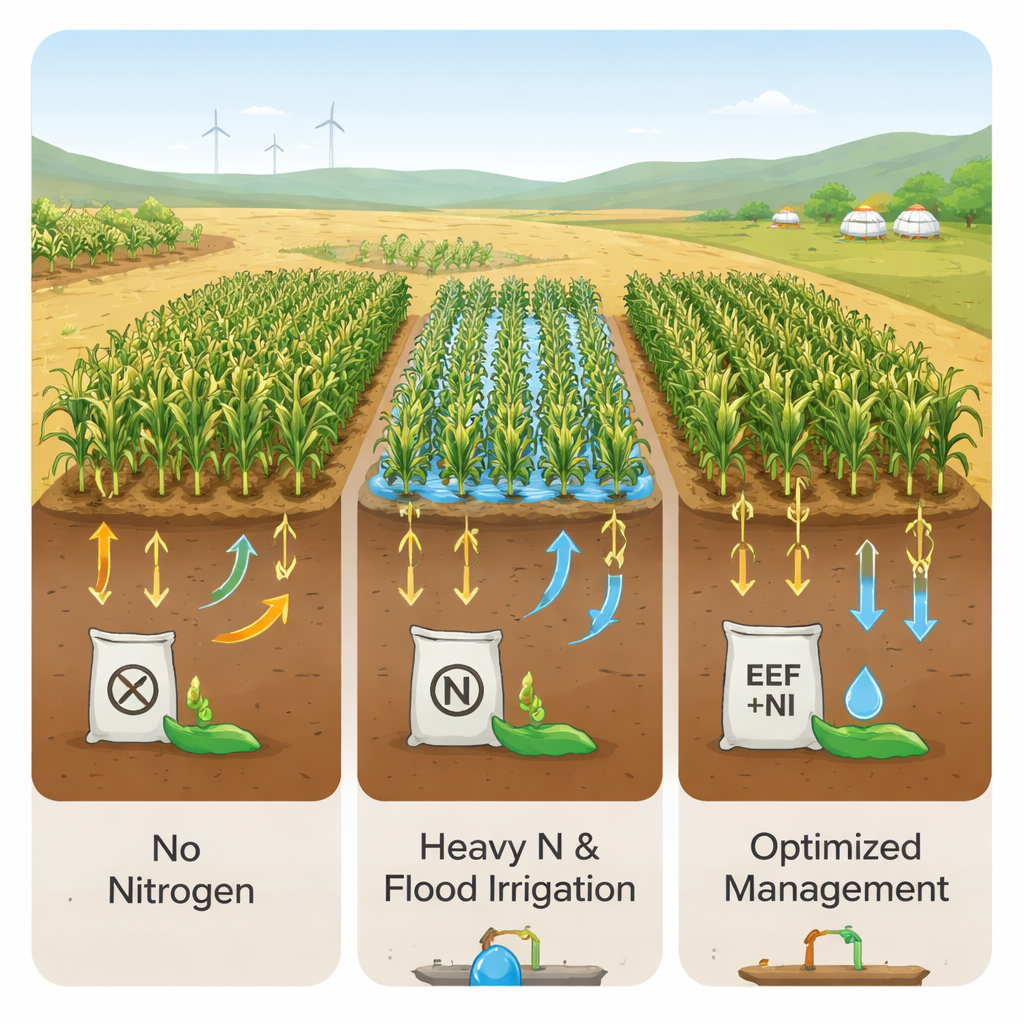
Arid and semi‑arid regions cover more than 40% of the world’s cropland and produce most of our food, yet they face serious problems: little rain, salty soils, and heavy reliance on irrigation. In the Hetao Irrigation District of western Inner Mongolia, farmers traditionally apply very large amounts of nitrogen fertilizer to maize—300 to 450 kilograms per hectare—hoping to secure high yields. Instead, yields have stalled at only about 40% of what is possible. Much of the nitrogen escapes into the air or is washed into canals and lakes, wasting money and polluting water. The key question for the researchers was how to get much closer to the region’s attainable yield while using less nitrogen and losing less to the environment.
Designing a smarter fertilizer system
The team set up a three‑year field experiment in a typical saline‑alkali soil with very little rainfall and flood irrigation from the Yellow River. They compared four management systems for maize: no nitrogen at all; the common high‑input farmer practice; a “high‑yield and high‑efficiency” system that cut nitrogen by about one‑third and simplified fertilization; and a “high‑yield and stress‑tolerant” system that used the same reduced nitrogen dose but added a nitrification inhibitor called DMPP, mixed into the fertilizer and applied once at planting. All plots used the same maize variety and similar phosphorus and potassium, so differences could be traced mainly to nitrogen strategies.
More grain with less nitrogen
Across 2020–2022, the unfertilized plots steadily lost productivity, confirming that the soil alone could not feed high‑yielding maize. In contrast, both improved systems with reduced nitrogen reached grain yields of 15–18 tonnes per hectare—about 80% of local yield potential—matching or nearly matching the high‑input farmer practice in normal years. Crucially, the optimized systems did this with only 250 kilograms of nitrogen per hectare and just one fertilizer application, compared with 380 kilograms and three applications in the traditional system. This raised nitrogen use efficiency—the share of applied nitrogen actually taken up by the crop—from below 50% to around or above 60% in good rainfall years, meeting international “green development” targets.
Built‑in insurance against drought
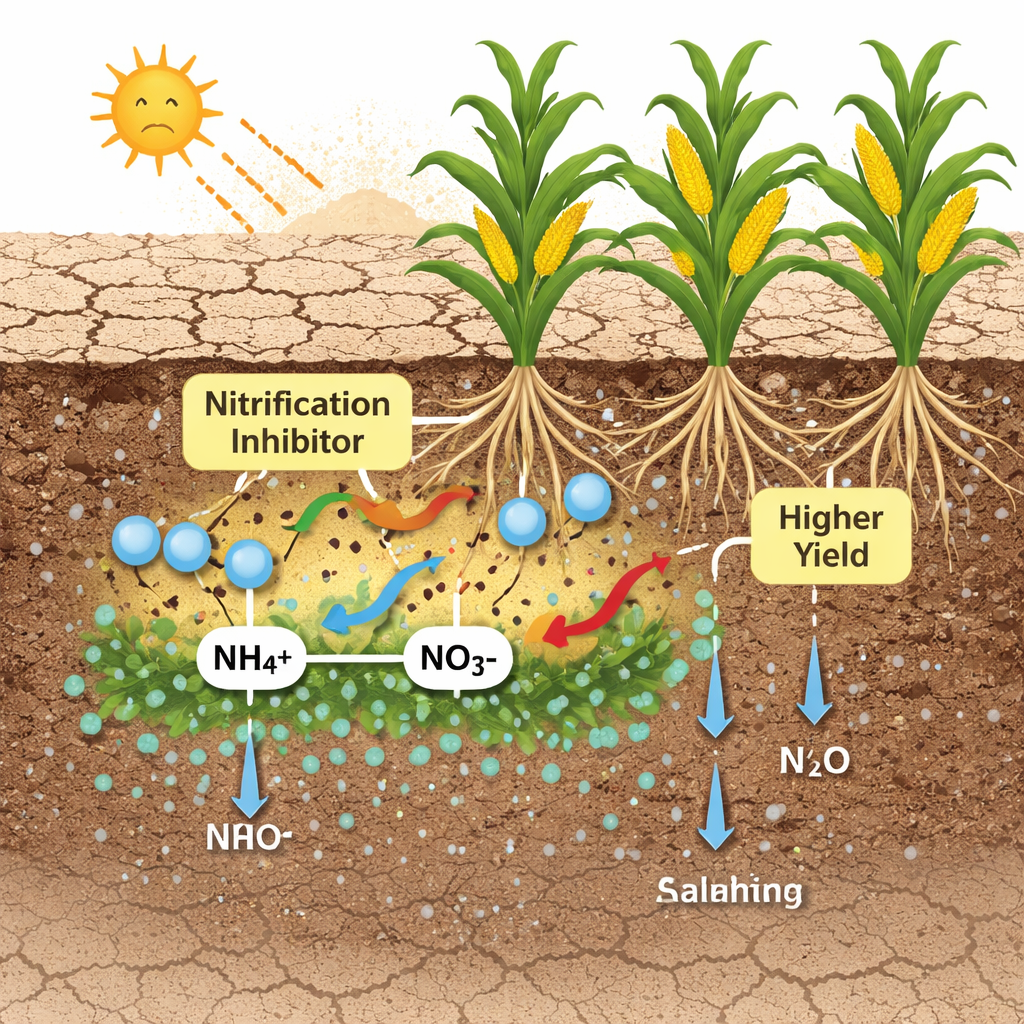
The toughest test came in 2022, when rainfall plunged and maize faced severe drought during a key growth stage. Under these harsh conditions, the reduced‑nitrogen system without the inhibitor suffered a notable yield drop compared with the high‑input practice. By contrast, the system using the nitrification inhibitor maintained yields, mainly by keeping kernel weight higher. Measurements showed that this treatment preserved above‑ground nitrogen uptake, boosted phosphorus absorption, and maintained total plant biomass even in the dry year. By slowing the conversion of ammonium to nitrate in the high‑pH, salty soil, the inhibitor kept more usable nitrogen near the roots over time, helping plants cope better with water stress.
Cleaner fields and water
Because crops took up more of the applied nitrogen, the improved systems left much smaller nitrogen surpluses in the field. The high‑input farmer practice built up more than 160–200 kilograms of extra nitrogen per hectare each year—nitrogen that is likely to escape as gas or leach into drainage water. The optimized systems roughly halved this surplus, and in some years the inhibitor treatment nearly balanced inputs and outputs. This means less risk of greenhouse gas emissions and less nitrogen flowing into local waterways, where it has already been identified as a major pollutant.
What this means for farmers and the environment
For farmers working in dry, saline regions, the study offers a clear message: simply adding more nitrogen does not guarantee more grain, but better‑timed, better‑formulated nitrogen can. A single reduced‑rate application of nitrogen fertilizer, combined with a nitrification inhibitor, can deliver high maize yields, increase the fraction of fertilizer that plants actually use, and cut down on pollution. Perhaps most importantly, this approach acts like an insurance policy in drought years, helping crops hold on to yield when water is scarce. If adopted widely in similar regions, such practices could boost food production while easing pressure on fragile soils and waters.
Citation: Zeng, Z., Wu, L., Liu, J. et al. Synergistic nitrification inhibitors with best management practices can achieve higher yield and nitrogen use efficiency in semi-arid saline-alkali soils. Sci Rep 16, 5287 (2026). https://doi.org/10.1038/s41598-026-36007-1
Keywords: nitrogen use efficiency, nitrification inhibitor, maize yield, semi-arid agriculture, saline-alkali soil