Clear Sky Science · en
Discovery of Goethe’s amber ant: its phylogenetic and evolutionary implications
A Forgotten Treasure in a Famous Writer’s Cabinet
Most people know Johann Wolfgang von Goethe as a great poet and thinker, not as a contributor to modern biology. Yet a small, overlooked piece of amber in his personal collection has now helped scientists answer questions about how ancient ants lived and evolved. By combining today’s powerful 3D X‑ray imaging with a 200‑year‑old museum specimen, researchers have reconstructed a long‑extinct “amber ant” in remarkable detail, showing how even old collections can still change what we know about life on Earth.
An Old Collection Meets New Technology
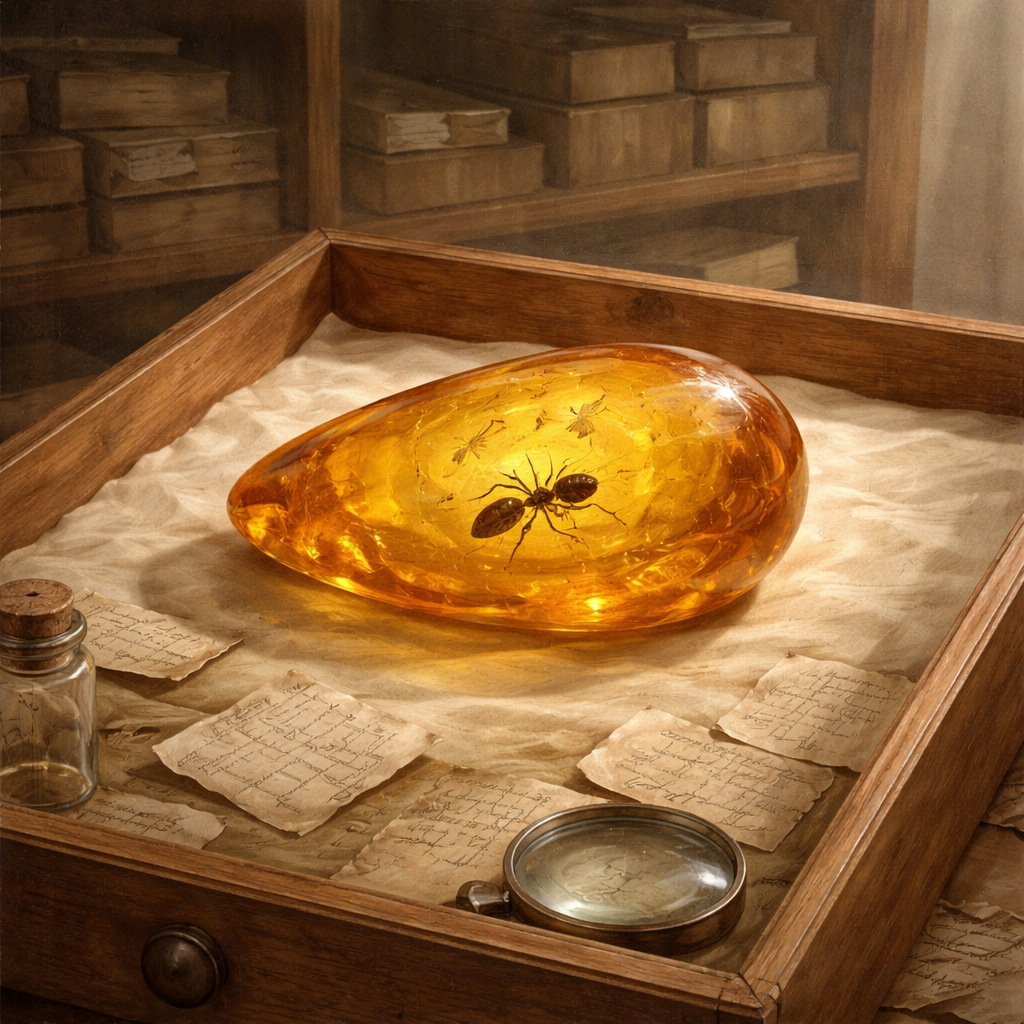
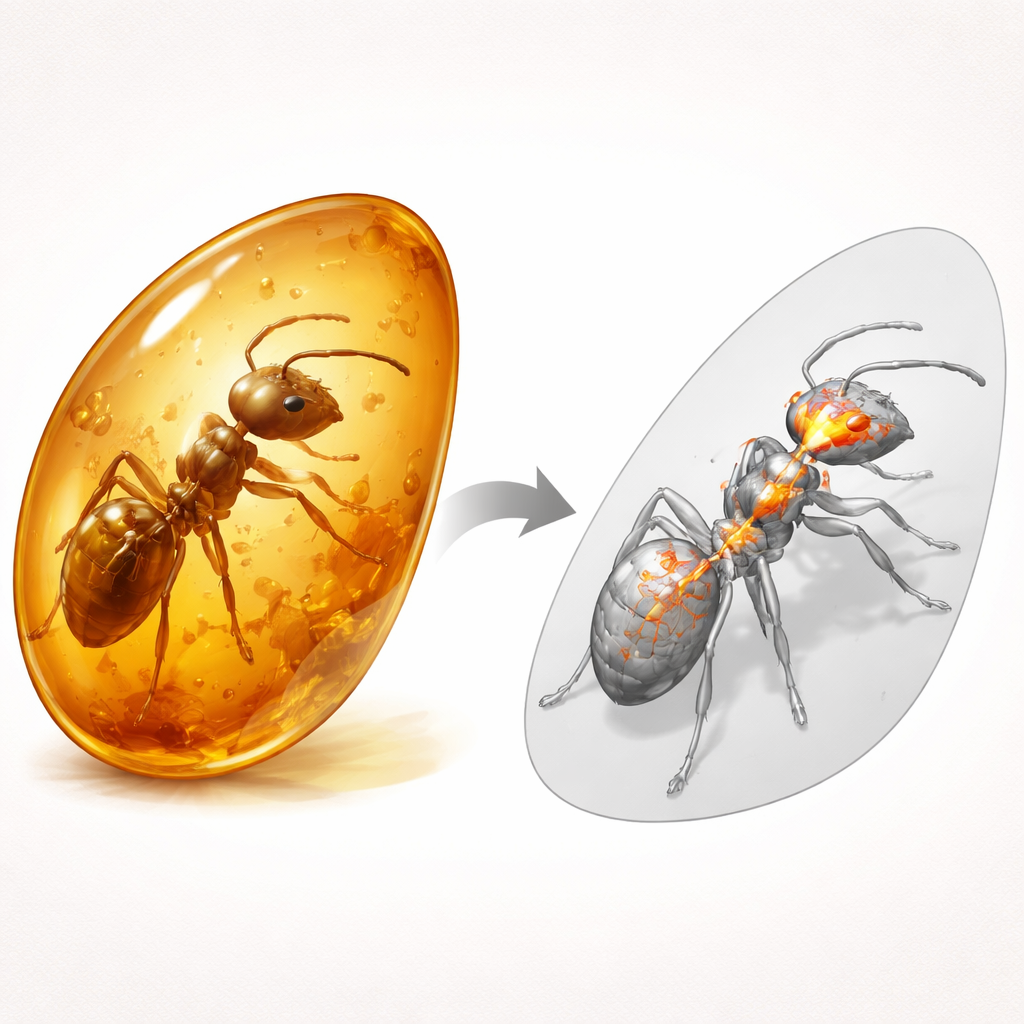
Goethe maintained extensive cabinets of rocks, minerals, and other natural objects, many still stored today exactly as he left them in Weimar, Germany. Amber, which he filed under “combustible substances” rather than fossils, formed only a small part of this trove. When modern researchers recently re‑examined his roughly 40 pieces of amber under microscopes and with high‑energy X‑rays from a particle accelerator, they found three trapped insects: two tiny flies and a worker ant from the Baltic region, preserved in resin about 47 to 34 million years old. Because the amber is cloudy and fragile, traditional methods of grinding and polishing were not an option. Instead, the team used synchrotron‑based micro‑computed tomography, a technique that acts like a super‑powered medical CT scan, to look inside the amber without damaging it.
Rebuilding an Ant from Stone‑Hard Resin
The scans allowed the scientists to create detailed three‑dimensional models of the ant, named Ctenobethylus goepperti. Earlier researchers had seen many similar ants in Baltic amber, but their sheer abundance and the limitations of older methods meant they had not been studied very deeply. The new 3D reconstructions revealed not just the outer body, but internal skeletal supports in the head and chest that had never before been documented in an ant fossil from this time period. By carefully measuring features such as head shape, eye position, the form of the waist segment, and even subtle internal struts, the team could compare this species with living ant groups and untangle a confusing taxonomic history, in which names and identities had long been mixed.
Placing the Amber Ant on the Family Tree
Using these anatomical clues, the researchers concluded that Ctenobethylus goepperti belongs within a modern branch of ants known for chemical defenses and complex social lives. It appears to be closely related to the living genus Liometopum, sometimes called “carton‑nesting ants” because they build large nests in trees using chewed plant material. The study shows that another fossil ant, previously placed in a separate genus, is actually the same species and should be merged with Ctenobethylus. This careful sorting of names and relationships may sound like bookkeeping, but it is central to reconstructing how ant lineages diversified and moved across ancient landscapes.
Clues to a Lost Forest World
The close link to modern tree‑dwelling ants suggests that Goethe’s amber ant once dominated the canopies of warm, humid conifer forests that covered parts of Europe during the Eocene period. Today, similar ecological roles are filled by other ant genera, because both Ctenobethylus and several of its Baltic amber neighbors have vanished. Their disappearance likely reflects major climate shifts over tens of millions of years, including cooling trends and later glaciations that reshaped European ecosystems. By tracing which ants were common in amber and how they relate to living forms, scientists can infer how entire communities responded as ancient climates changed.
Why a Poet’s Amber Matters Today
For non‑specialists, this work offers two key messages. First, amber is not just pretty jewelry: it is a time capsule that can preserve tiny animals with astonishing fidelity, right down to internal scaffolding in an insect’s head. Second, museum and private collections, even those assembled for reasons that were more artistic than scientific, can remain powerful research tools for centuries. By applying modern imaging and data‑analysis techniques to Goethe’s specimens—without altering their cultural value—the authors show how historical objects can still yield fresh biological insights. In doing so, they echo Goethe’s own belief in careful, open‑minded observation of nature, demonstrating that an ant sealed in resin millions of years ago can still help us understand evolution, extinction, and the deep history of Earth’s forests.
Citation: Boudinot, B.E., Bock, B.L., Tröger, D. et al. Discovery of Goethe’s amber ant: its phylogenetic and evolutionary implications. Sci Rep 16, 2880 (2026). https://doi.org/10.1038/s41598-026-36004-4
Keywords: amber fossils, ancient ants, Goethe collection, Eocene forests, museum collections