Clear Sky Science · en
Design, simulation, and 3D-printing of new auxetic metamaterials considering sensitivity analysis under impact loadings
Why squishy plastics and strange patterns matter
Every time a cyclist falls, a car crashes, or a drone drops from the sky, energy has to go somewhere. If that energy is not safely absorbed, it ends up damaging people and equipment. This study explores a new class of 3D‑printed “metamaterials” — plastics shaped into intricate repeating patterns — that can soak up impact energy far more efficiently than ordinary foams or honeycombs. By carefully arranging tiny internal cells, the researchers create structures that behave in counter‑intuitive ways and could lead to lighter, smarter protection in helmets, cars, and aerospace hardware.
Materials that act stranger than nature
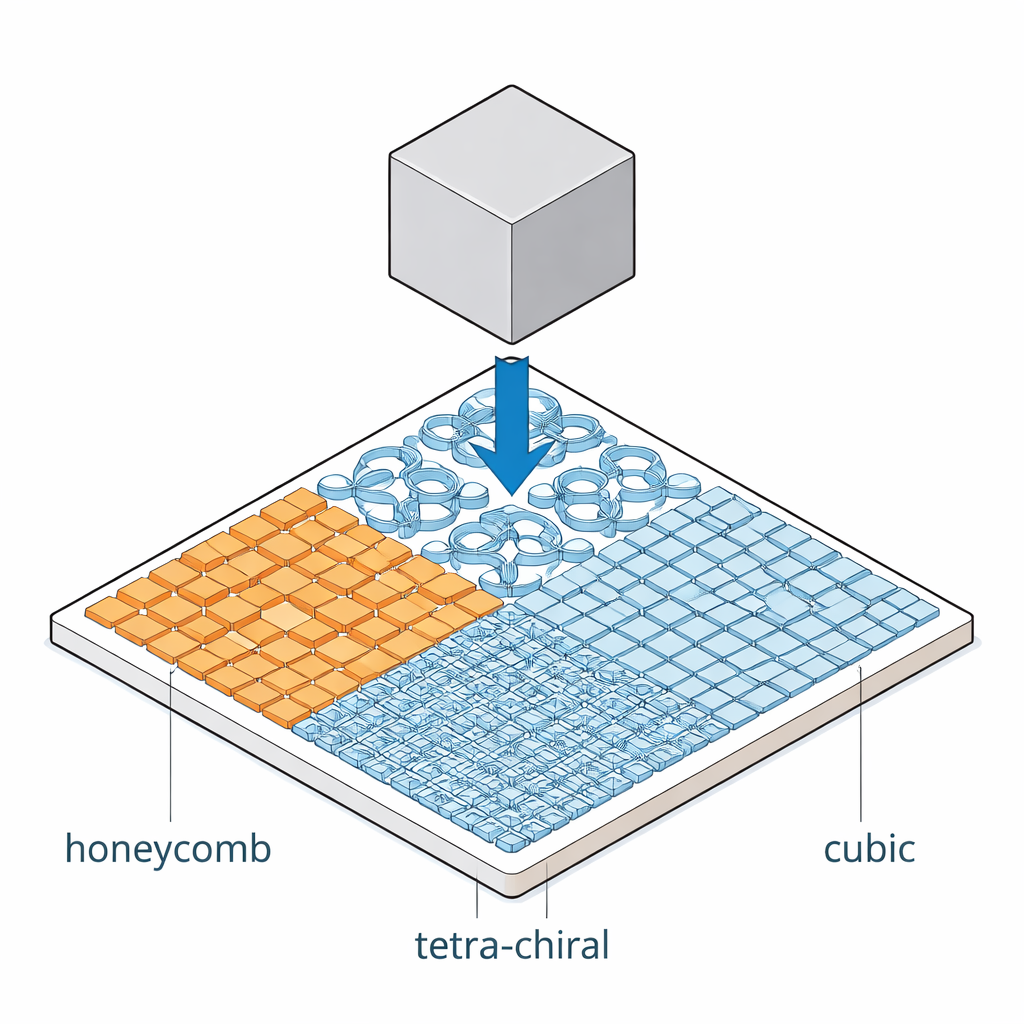
Metamaterials are engineered materials whose behavior comes mainly from their internal geometry rather than the substance they are made of. In this work, all samples are made from the same common plastic, polylactic acid (PLA), but are sculpted into three different building blocks: a standard hexagonal honeycomb, a square cubic grid, and a more exotic “tetra‑chiral” pattern built from rings and ligaments. Some of these patterns are auxetic, meaning they get wider when stretched and thicker when squeezed — the opposite of most materials. By combining auxetic and non‑auxetic blocks into layered lattices, the team aims to mix and match their strengths and discover which combinations best tame sudden impacts.
Building tiny crash zones with desktop printers
Using a common fused‑filament 3D printer, the researchers fabricated four panel‑shaped metamaterials, each filling the same overall volume so that mass differences would not bias the results. The panels were assembled from different combinations of the three unit cells: honeycomb–tetra‑chiral (HT), honeycomb–cubic (HC), tetra‑chiral–cubic (TC), and a three‑way hybrid honeycomb–tetra‑chiral–cubic (HTC). The printer settings, such as layer height and nozzle temperature, were tightly controlled to make the comparison fair. Before impact tests, the team also measured the basic strength and stiffness of the PLA itself under slow compression to ensure the plastic behaved as expected and to calibrate their computer models.
Drop tests that reveal hidden behavior
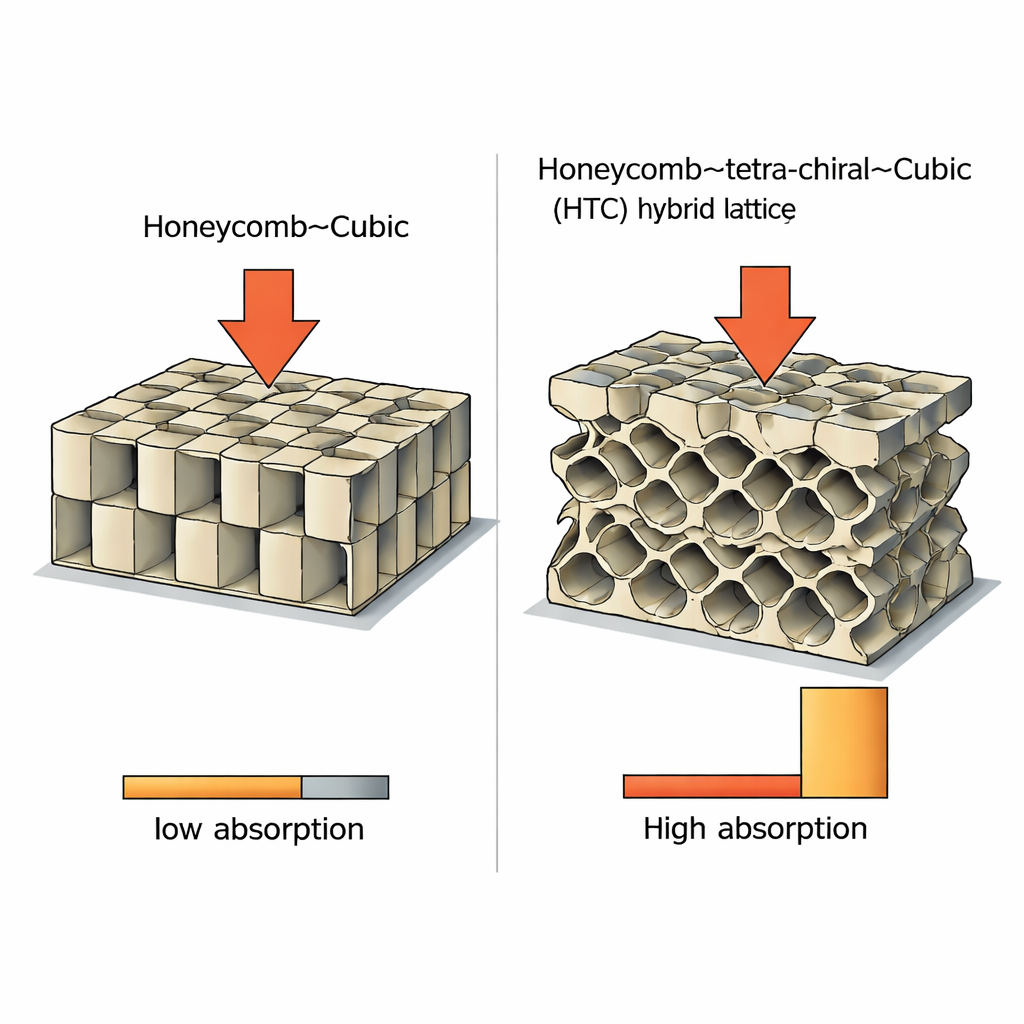
To mimic real‑world knocks, the scientists carried out low‑height drop tests, letting a 7.5‑kilogram impactor fall onto each panel from 1, 3, and 5 centimeters. Sensitive accelerometers recorded how quickly the impactor slowed down, from which the team reconstructed force, deformation, and energy absorption. At the lower heights, all panels survived with only minor damage, but at the highest drop only the HTC hybrid remained intact; the others failed completely. By integrating the force–displacement curves, the researchers calculated how much energy each design absorbed and then divided by its mass to obtain specific energy absorption — a fair, weight‑independent measure of performance. The HTC structure stood out, achieving about 18 percent higher specific energy absorption than its rivals and safely dissipating up to roughly 78 percent of the incoming impact energy.
Simulations, sensitivities, and what really matters
Computer simulations using the ABAQUS software reproduced the drop tests in virtual form, tracking stresses and deformations inside the tiny cells. The simulated acceleration curves closely matched the experiments, giving confidence that the model could be used to peer inside regions that instruments cannot easily reach. Color maps of displacement showed that simple honeycomb–cubic designs spread deformation more uniformly but did not dissipate much energy, while the HTC hybrid concentrated controlled crushing and bending in selected zones, turning impact energy into permanent shape change. A statistical sensitivity analysis then ranked the key factors controlling peak acceleration: drop height (a stand‑in for impact energy) dominated, followed by the effective Poisson’s ratio of the lattice and, finally, the specific cell pattern. In other words, both how hard you hit and how “auxetic” the structure is strongly shape the outcome.
From strange lattices to safer gear
For non‑specialists, the bottom line is that clever geometry can make a simple plastic behave like an advanced shock absorber. The best‑performing design in this study, the three‑part HTC hybrid, combines different cell types so that some regions bend, others rotate, and all work together to slow an impact more gently and over a longer distance. Because these lattices can be 3D‑printed on relatively inexpensive machines and tuned without changing the base material, they offer a promising path toward lighter helmets, protective pads, vehicle crumple components, and aerospace structures. The work shows that the safest design is not always the one that looks strongest under slow loading; instead, it is the pattern that can rearrange and collapse in a controlled way when a sudden hit arrives.
Citation: Shahmorad, A., Hashemi, R. & Rajabi, M. Design, simulation, and 3D-printing of new auxetic metamaterials considering sensitivity analysis under impact loadings. Sci Rep 16, 6644 (2026). https://doi.org/10.1038/s41598-026-36003-5
Keywords: auxetic metamaterials, 3D-printed lattices, impact energy absorption, lightweight protective structures, PLA mechanical behavior