Clear Sky Science · en
Behavioral and innovation drivers of farmers’ support for forest policy at the forest agriculture interface
Why farmers’ views on forests matter to everyone
Across much of the world, forests and farms sit side by side and together shape the food we eat, the water we drink, and the climate we experience. When governments design rules to protect forests, those rules only work if local farmers see them as fair, useful, and manageable. This article looks at farmers living along the forest–agriculture boundary in Iran’s Zagros Mountains and asks a simple but powerful question: what makes them willing to support new forest policies aimed at tackling climate change and environmental damage?
A living patchwork of fields and forests
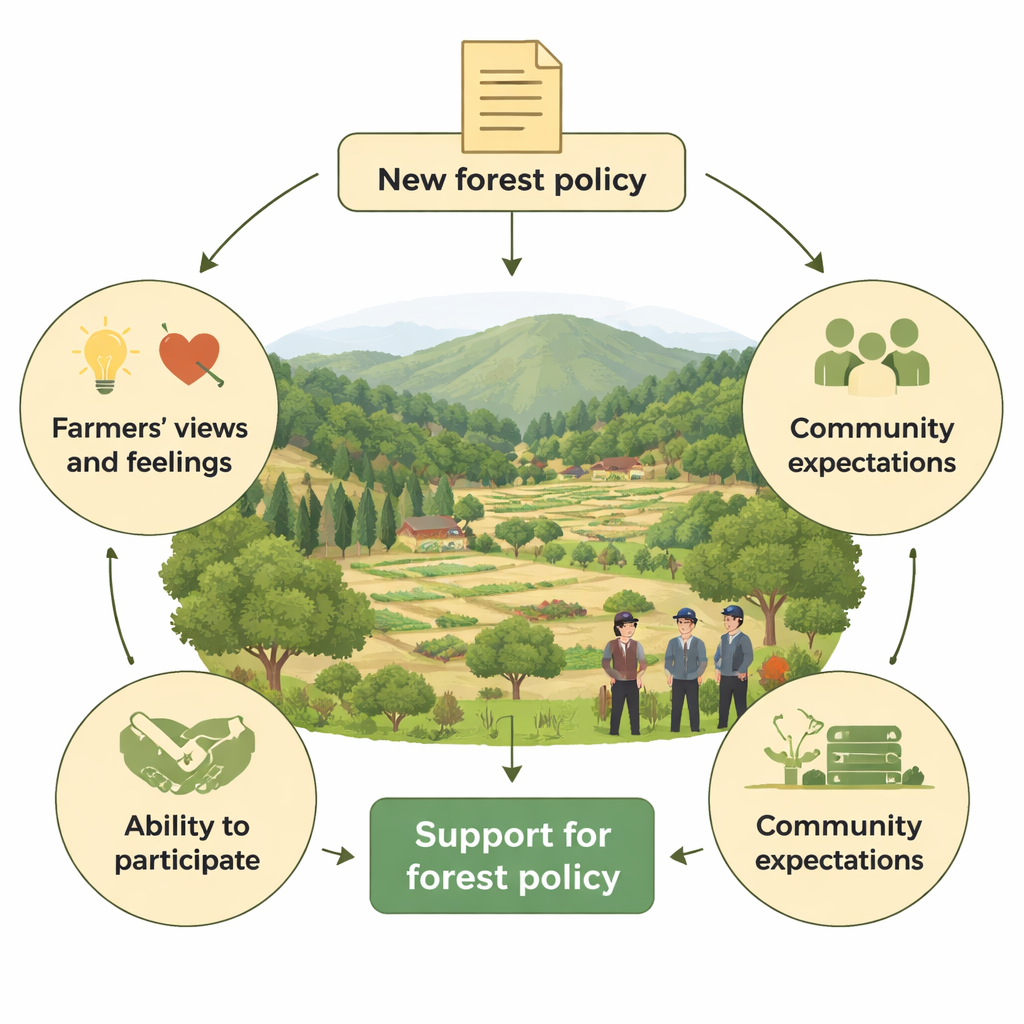
In western Iran, the Dowreh Chegeni region is a patchwork of oak forests, grazing lands, and small farms. Most land is publicly owned, but local families rely heavily on it for crops, livestock, and fuel. Traditional practices such as grazing animals under the trees and planting crops between them have long tied livelihoods to the forest. In recent decades, however, population growth, land conflicts, and droughts have led to forest degradation, soil erosion, and weaker natural regeneration. Authorities have responded with a series of programs, from tree planting on slopes to community reforestation projects. Yet many of these efforts have stumbled because farmers viewed them as impractical, confusing, or unfair. The study investigates why some policy ideas gain local backing while others do not.
How the study approached farmers’ decisions
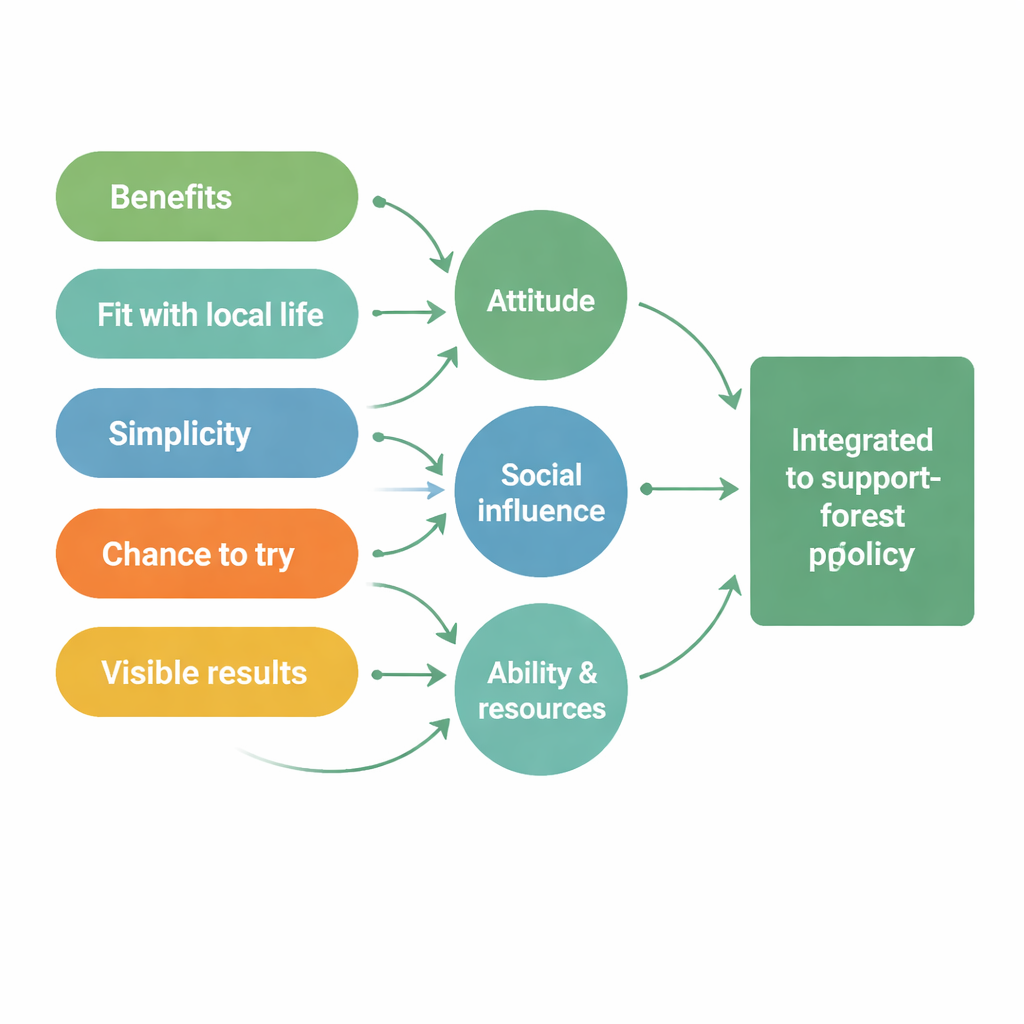
The researchers combined two well-known ideas from social science to understand farmers’ intentions. The first, the Theory of Planned Behavior, focuses on three forces that shape what people plan to do: their personal attitude (whether they think an action is good), social influence (what important others expect), and their sense of control (whether they feel able to act). The second, the Diffusion of Innovation perspective, looks at how people judge something new—by asking if it brings clear benefits, fits with their way of life, is simple enough, can be tried on a small scale, and produces visible results. Using a carefully tested questionnaire, the team interviewed 385 rural household members responsible for land and livestock decisions. They then applied advanced statistical modeling to see how views about new forest policies fed into attitudes, social influence, feelings of control, and ultimately the intention to support policy.
What most convinces farmers to back new rules
The analysis showed that differences in how farmers perceived policy features explained nearly two-thirds of the variation in their intention to support forest measures—a remarkably high share for social research. Three perceptions mattered most. Farmers were more willing to support policies they believed offered real advantages for both the environment and their livelihoods; that fit smoothly with local traditions and everyday work; and whose positive results they could clearly see, either in their own village or nearby communities. These same features also strengthened positive attitudes, supportive community norms, and confidence in being able to participate. By contrast, when policies seemed tangled in red tape or too complicated to follow, farmers’ intention to support them declined, even if the ideas looked good on paper. The chance to test new approaches on a small scale helped farmers feel more positive and capable, although it did not by itself directly change intentions.
The power of community and confidence
All three psychological factors—attitude, social influence, and sense of control—played a significant role in shaping farmers’ intentions. Among them, feeling able and resourced to take part was the strongest driver. Farmers were more likely to back forest policies when they believed they had the time, skills, and institutional support to comply. Social expectations also mattered: approval from family, neighbors, village leaders, and forestry officials increased the pressure to join in. While most farmers already agreed in principle that protecting forests was worthwhile, that positive outlook alone was not enough to guarantee participation if rules were hard to follow or did not mesh with daily realities.
What this means for future forest policies
For non-specialists, the study’s message is straightforward: forest policies succeed when they make sense in people’s lives. In the Zagros Mountains and in similar forest–farm regions worldwide, effective rules will be those that are co-designed with local communities, deliver clear and visible benefits, and cut through needless complexity. Training, on-the-ground support, and demonstration plots can boost farmers’ confidence and show that new approaches really work. Rather than relying on top-down commands, policy makers are more likely to protect forests—and the climate benefits they provide—by treating farmers as partners and innovators whose perceptions and daily constraints are central to long-term success.
Citation: Maleknia, R., Pakravan-Charvadeh, M.R. & Halalisan, A.F. Behavioral and innovation drivers of farmers’ support for forest policy at the forest agriculture interface. Sci Rep 16, 6290 (2026). https://doi.org/10.1038/s41598-026-35995-4
Keywords: forest policy, rural livelihoods, climate change, farmer behavior, participatory governance