Clear Sky Science · en
Cashew nutshell liquid derivatives as a sustainable route to alkyd-free surface coatings
Turning Waste Shells into Useful Protection
Every year, mountains of cashew shells are discarded after the nuts are processed for food. Hidden inside those shells is a dark, oily liquid that has mostly gone to waste. This study shows how that liquid can be transformed into a new kind of protective paint for metals and other surfaces—one made from renewable materials instead of fossil fuels. For readers concerned about pollution, climate change, and safer industrial products, this work offers a glimpse of how smart chemistry can turn agricultural leftovers into high‑performance, eco‑friendly coatings.
Why Today’s Coatings Need a Rethink
Modern life depends on paints and surface coatings to protect cars, bridges, electronics, and buildings from rust, wear, and weather. Most of these coatings are based on alkyd resins and other ingredients made from petroleum. Their production often uses harsh solvents and strong acid or base catalysts, which can release harmful fumes and generate hazardous waste. These issues raise health concerns and contribute to environmental problems, from poor air quality to greenhouse gas emissions. Finding substitutes that match or surpass the performance of conventional coatings, while relying on safer and renewable raw materials, is therefore a key challenge for sustainable industry.
The Promise Inside Cashew Shells
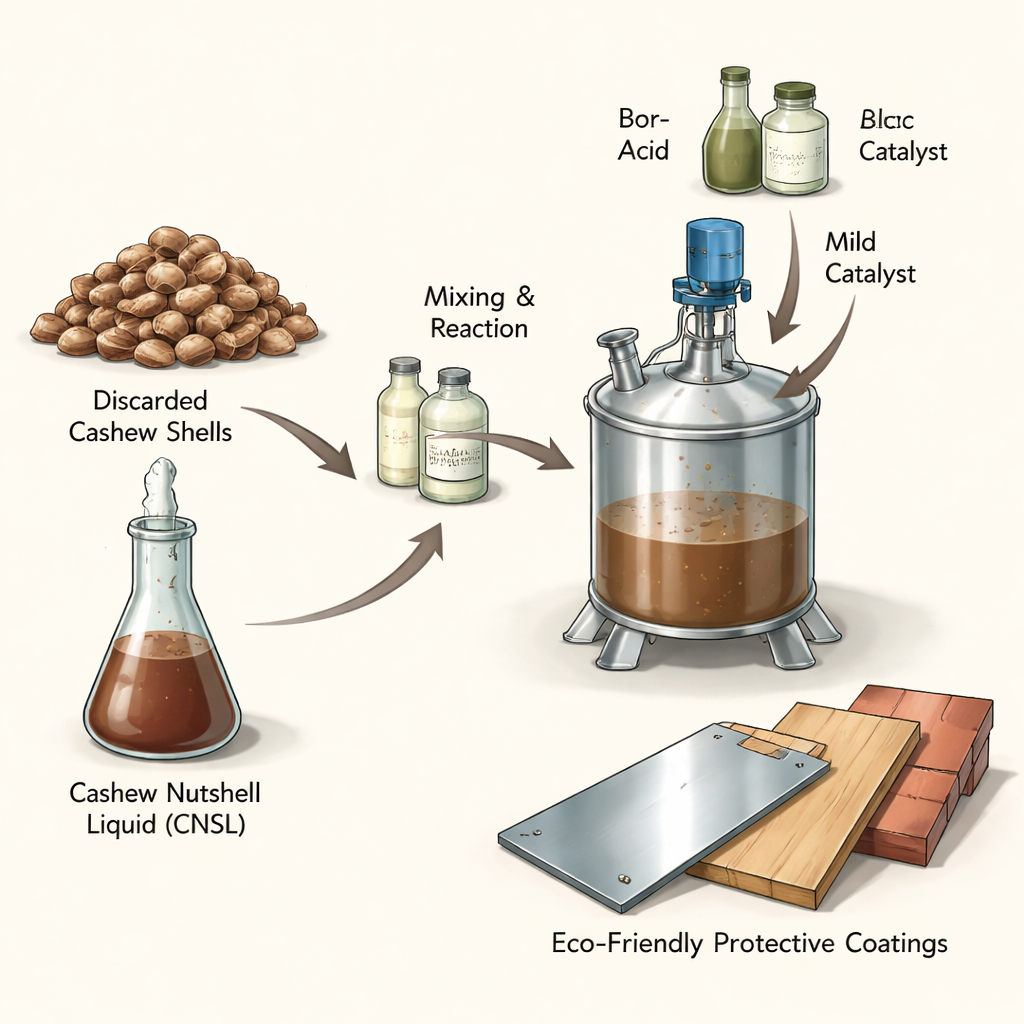
Cashew nutshell liquid (CNSL) is a thick, phenolic oil found in the outer shell of cashew nuts. It is not edible, but it is rich in reactive molecules that can be turned into durable polymers. Countries such as Ghana produce tens of thousands of tonnes of potential CNSL each year, simply as a by‑product of nut processing. The researchers tapped into this resource by first extracting CNSL with a mild solvent at room temperature, avoiding high heat or complex equipment. They then chemically linked the CNSL molecules to simple alcohols and to boric acid, using sulphamic acid as a comparatively gentle catalyst. This approach fits well with green chemistry principles: it relies on renewable feedstock, uses relatively low‑hazard additives, and aims to minimise waste.
Building a New Kind of Bio‑Based Coating
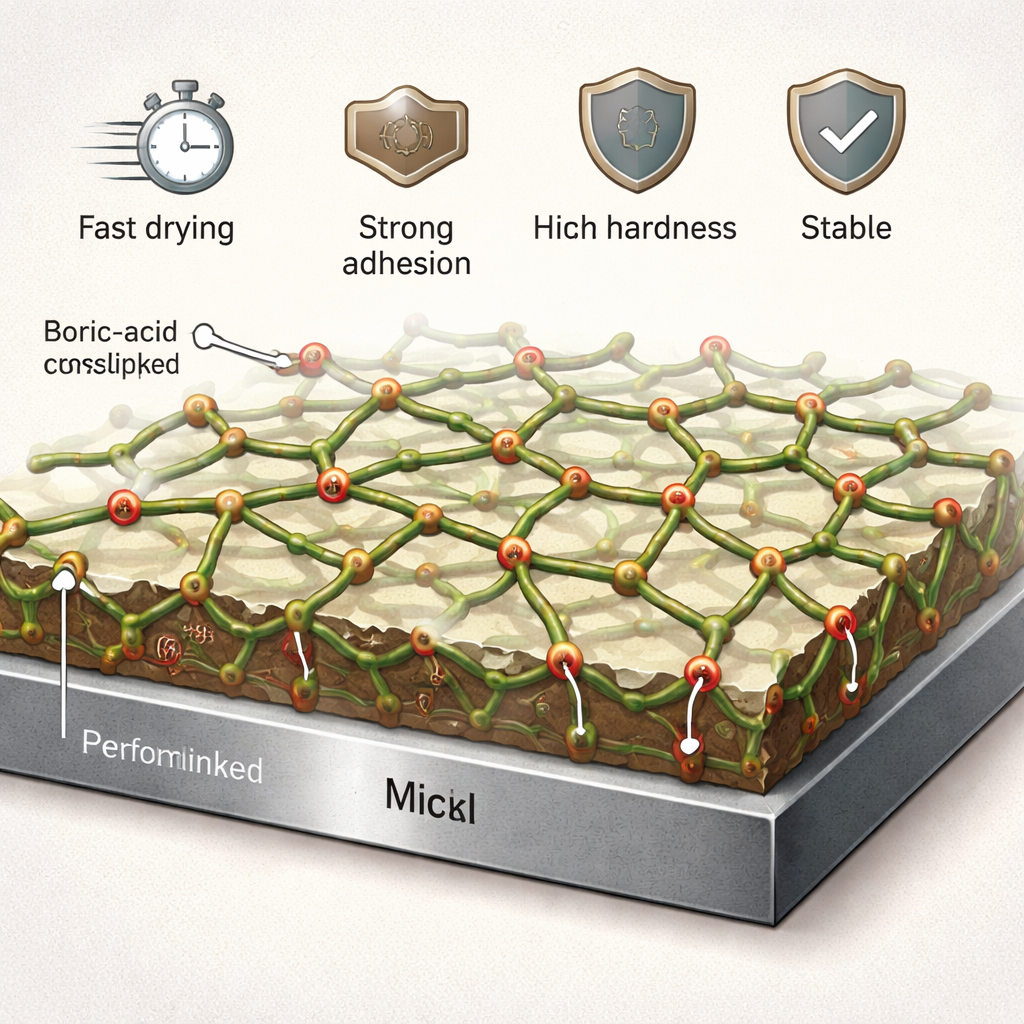
To create practical coatings, the team blended CNSL–alcohol liquids with a CNSL–borate resin in a fixed ratio, without adding any traditional alkyd resin. A small amount of a standard drying agent was included so the mixture could cure into a solid film at room temperature. The resulting coatings were carefully examined using several techniques. Infrared and nuclear magnetic resonance measurements confirmed that new chemical bonds had formed, especially borate linkages that help tie the network together. Microscopy images showed mostly smooth surfaces dotted with nano‑sized spherical domains, a structure that supports good film integrity and water‑repellent behavior. Measurements of particle size and electrical charge in dispersion indicated that the boric‑acid‑modified systems formed smaller, more stable particles, which helps the coatings remain uniform during storage and application.
How the Green Coatings Performed
The researchers then tested how these cashew‑derived coatings behave in real‑world‑like conditions. They found that the new films dried much faster than a commercial alkyd coating—often in less than half the time—meaning surfaces could be handled and put into service more quickly. Mechanical tests using pencil scratching showed that most of the CNSL‑based coatings were just as hard, or even harder, than the conventional product, indicating strong resistance to wear. Adhesion tests, in which a cross‑hatched pattern is cut into the film and tape is pulled off, showed that the cashew‑based coatings clung very well to metal, with almost no material removed. These properties point to a dense, well cross‑linked network created by the boric acid and CNSL chemistry.
What This Means for Greener Materials
In simple terms, this work proves that a coating made almost entirely from cashew shell oil—without the usual fossil‑based alkyd resins—can still dry quickly, stick firmly, and resist scratching about as well as a standard commercial paint. While more studies are needed to confirm long‑term corrosion protection, weather resistance, and safety, the results suggest that agricultural waste can be upgraded into high‑performance protective films. If scaled up, such cashew‑based coatings could reduce dependence on petroleum chemistry, cut waste from nut processing, and move the coatings industry a step closer to sustainable, circular production.
Citation: Kyei, S.K., Nkrumah, K., Donkor, B.T.S. et al. Cashew nutshell liquid derivatives as a sustainable route to alkyd-free surface coatings. Sci Rep 16, 6463 (2026). https://doi.org/10.1038/s41598-026-35993-6
Keywords: bio-based coatings, cashew nutshell liquid, sustainable materials, green chemistry, protective paints