Clear Sky Science · en
Comparative analysis of enzymatic defence mechanisms in Sapindus mukorossi Gaertn. and Acacia concinna (Willd.) DC. using a Michaelis–Menten kinetic model
Why these soap plants matter
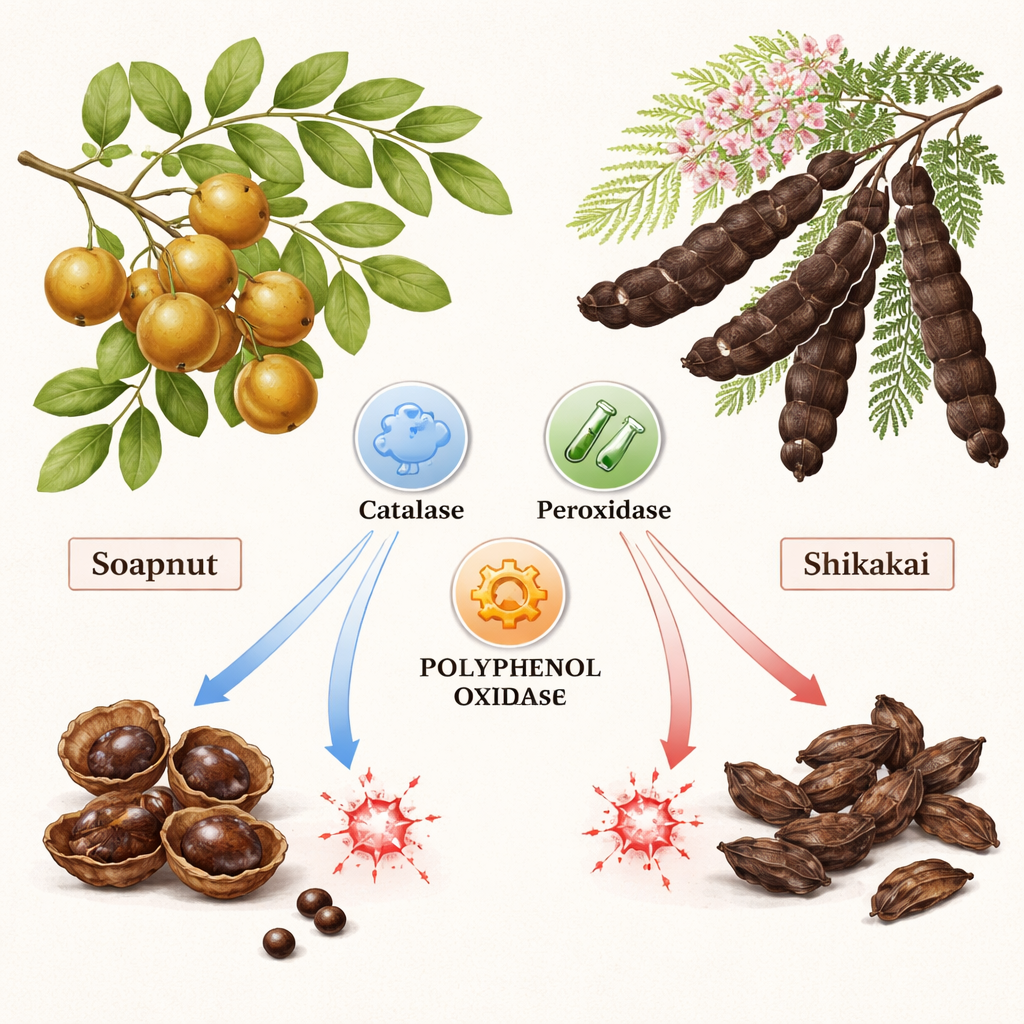
Many traditional herbal shampoos and cleansers in South Asia rely on two humble fruits: soapnut (Sapindus mukorossi) and shikakai (Acacia concinna). Beyond making foam, these plants are packed with natural compounds that help them survive harsh sunlight, pollution, and pests by fighting damaging "oxygen sparks" inside their cells. This study asks a simple but important question: which plant’s built‑in defence enzymes work harder and more efficiently, and what might that mean for health, skincare, and future crops?
Soap plants under the microscope
The researchers bought dried fruits of soapnut and shikakai from a local market in India, ground the fruit shells into powder, and extracted their proteins. They focused on three key enzymes that act as the plants’ internal clean‑up crew: catalase, which breaks down hydrogen peroxide; peroxidase, which helps remove various harmful by‑products; and polyphenol oxidase, which turns plant phenolics into brown, protective pigments. Using classic color‑change tests and a spectrophotometer, they measured how fast these enzymes worked under different conditions and how much protein each fruit extract contained.
Measuring the speed of nature’s cleaners
To go beyond simple activity values, the team used the Michaelis–Menten model, a standard way to describe how quickly an enzyme works as more substrate is added. Two numbers are especially revealing: Vmax, the maximum reaction speed, and Km, the substrate level at which the enzyme runs at half speed. A high Vmax means the enzyme can clear damaging molecules quickly, while a low Km means it latches onto its target very readily. By fitting their data to this model, and using graphical tools called Lineweaver–Burk plots, the scientists estimated Vmax and Km for each enzyme in both species.
Different defence styles in two familiar fruits
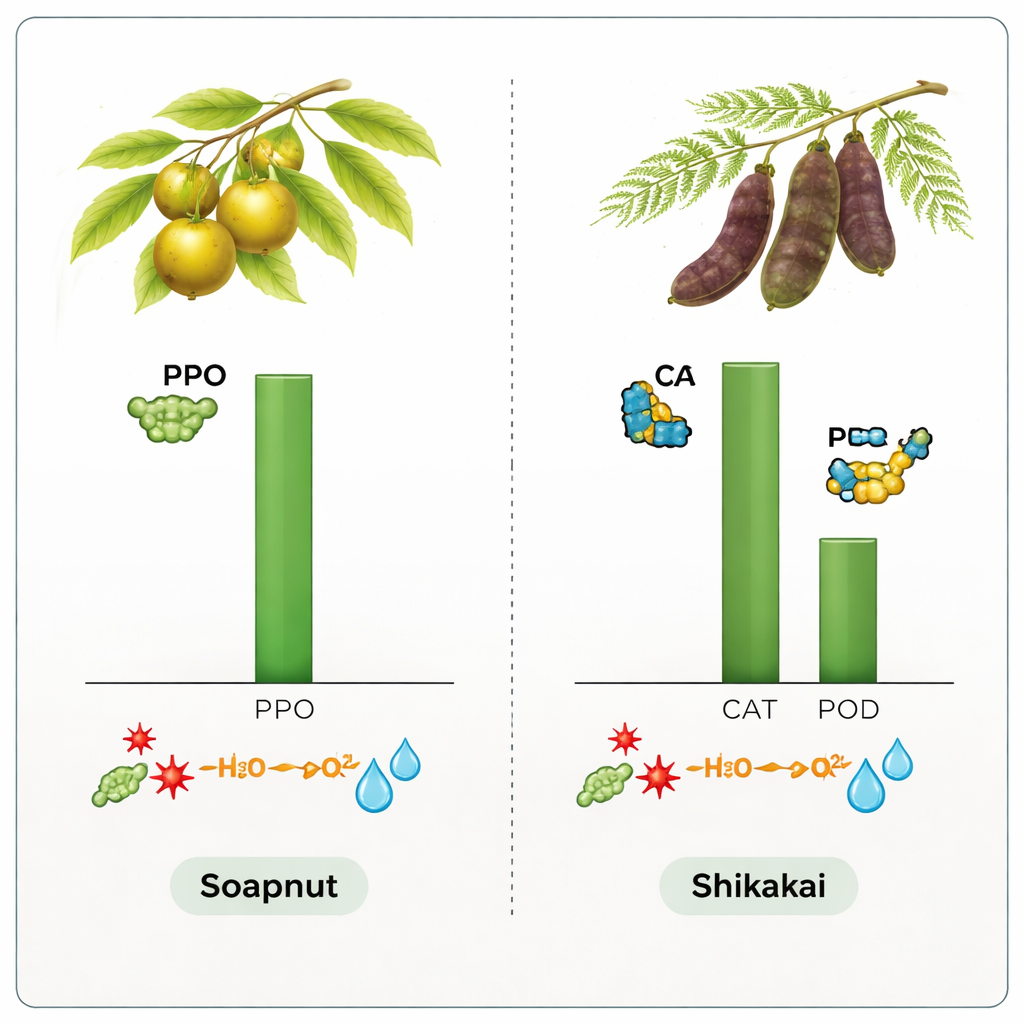
The results showed striking contrasts. Shikakai consistently contained more total protein in its fruit shells and displayed higher catalase and peroxidase activities than soapnut across all tested concentrations. Its enzymes also tended to have lower Km and higher Vmax values, pointing to both stronger grip on their substrates and faster clean‑up once bound. Soapnut, however, stood out for polyphenol oxidase: it showed higher activity than shikakai, suggesting it leans more heavily on converting phenolic compounds into protective brown pigments. Together, these patterns hint that the two plants use overlapping, but not identical, strategies to tame reactive oxygen species and cope with environmental stress.
Finding clear patterns in complex data
Because enzyme activity can vary with time and concentration, the researchers used additional statistics to test whether the two species really differ in a consistent way. A method called Linear Discriminant Analysis grouped the samples based on their three enzyme activities and showed that almost all of the variation could be explained by just two combined axes—effectively separating soapnut and shikakai into distinct clusters. Follow‑up tests confirmed that most comparisons between enzymes and species were statistically significant, reinforcing that the observed differences are unlikely to be due to random chance.
What it means for skincare, health, and crops
In everyday terms, this work shows that shikakai’s enzymes are generally faster and more efficient at mopping up damaging oxygen‑based molecules, while soapnut invests more in pigment‑forming defences. Both approaches help protect cells from stress and may contribute to the plants’ long‑standing use in gentle cleansers, anti‑aging remedies, and protective hair and skin formulations. By mapping these natural defence strategies with quantitative tools, the study also points to a future in which such saponin‑rich species could inspire more resilient crops and eco‑friendly products that harness the same built‑in, enzyme‑powered protection.
Citation: Parmar, R., Varsani, V., Dudhagara, D. et al. Comparative analysis of enzymatic defence mechanisms in Sapindus mukorossi Gaertn. and Acacia concinna (Willd.) DC. using a Michaelis–Menten kinetic model. Sci Rep 16, 5119 (2026). https://doi.org/10.1038/s41598-026-35992-7
Keywords: antioxidant enzymes, soapnut, shikakai, plant defence, saponins