Clear Sky Science · en
Exploring phytochemistry, antioxidant potential, essential oil profiling and bioactive profiling of Pogostemon mollis Benth. through GC–MS and UPLC-QTOF-MS/MS
Why a Wild Mint Relatives Matters for Everyday Health
Pogostemon mollis is a little-known cousin of the mint and patchouli plants that quietly carpets rocky slopes in India’s Western Ghats. This study shows that this humble herb is packed with natural chemicals that can mop up harmful “free radicals,” contains a rich essential oil, and even harbors molecules similar to modern anticancer and antiviral drugs. For readers interested in plant-based remedies, food preservation, or gentler cosmetic ingredients, the work offers a glimpse of how wild plants may seed tomorrow’s natural health products.
A Mountain Herb with a Medicinal Past
Pogostemon mollis is a small aromatic shrub that grows on sun‑baked hillsides above 1,200 meters in southwestern India. Local traditions have long used it for easing pain, calming asthma, reducing inflammation, and fighting infections. Such folk uses suggest that the plant is rich in “secondary metabolites” – diverse small molecules that plants make for defense, many of which turn out to be useful as human medicines. The researchers set out to examine this species in a systematic way, asking four questions: how strong is its antioxidant power, which parts of the plant are richest in helpful compounds, what is in its essential oil, and how do all these factors relate to one another?
Testing the Plant’s Natural Shield Against Damage
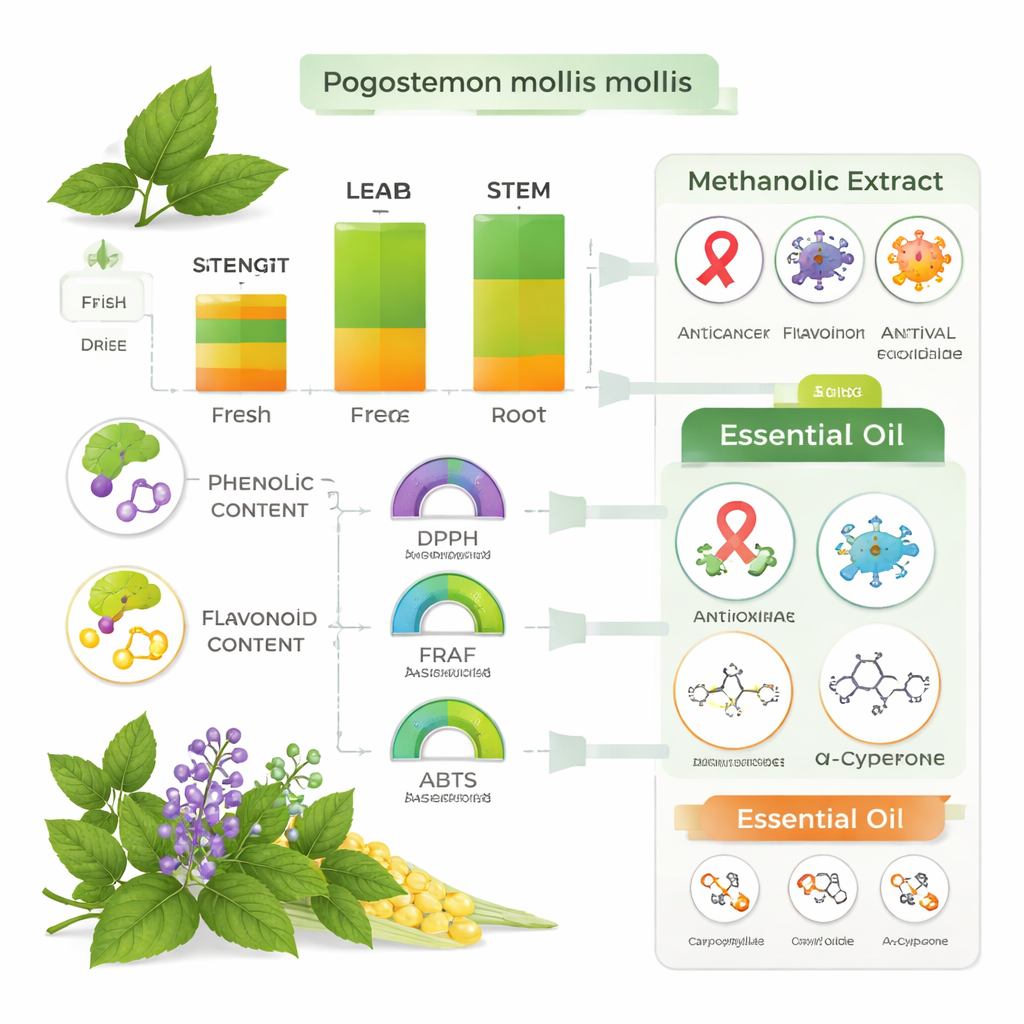
To probe antioxidant power – the ability to neutralize cell‑damaging free radicals – the team prepared extracts from fresh and dried leaves, stems, and roots using three common solvents: water, methanol (an alcohol), and acetone. They then ran three standard laboratory tests (DPPH, FRAP, and ABTS) that change color when free radicals are neutralized or metal ions are reduced. Across all tests, dried material clearly outperformed fresh material, and leaves consistently beat stems and roots. In particular, a dried leaf extract made with water showed the highest radical‑scavenging activity, while a fresh stem extract in water showed the weakest. These patterns suggest that both the choice of plant part and how it is processed can greatly influence the strength of herbal preparations.
Peeking Inside: What Chemicals Are Really There?
Antioxidant strength often goes hand in hand with two classes of plant molecules: phenolics and flavonoids. The researchers measured total levels of each and found that, again, dried leaves stood out. A dried leaf extract made with methanol had the highest phenolic content, while a dried leaf extract made with acetone had the most flavonoids. To identify individual compounds, the team used high‑resolution instruments similar to those in forensic labs. One setup (UPLC‑QTOF‑MS/MS) separated and weighed molecules in a methanolic extract, revealing 99 distinct substances. These included well‑known bioactive molecules: camptothecin, associated with anticancer activity; zidovudine, a classic antiviral agent; luteolin and other flavonoids linked to anti‑inflammatory and antioxidant effects; and terpenoids such as nerolidol.
Essential Oils: Fragrance with a Functional Edge
The aerial parts of P. mollis – mainly leaves and flower spikes – were steam‑distilled to obtain a pale yellow essential oil. Gas chromatography–mass spectrometry, which separates and then fingerprints volatile chemicals, uncovered 68 different components. The oil was dominated by complex terpenes such as lupeol, alpha‑cyperone, globulol, and caryophyllene oxide. Several of these have been studied elsewhere for anticancer, antimicrobial, or anti‑inflammatory properties. Earlier work already showed that P. mollis oil can inhibit bacteria and fungi, including some that infect humans. By mapping which groups of compounds occur together, and how they track with antioxidant tests, the authors found strong statistical links between flavonoid levels and antioxidant strength, with phenolics also contributing.
From Laboratory Bench to Possible Everyday Uses
For non‑specialists, the take‑home message is that Pogostemon mollis is far more than a fragrant weed. Its dried leaves, in particular, are rich in natural antioxidants and contain a cocktail of molecules with profiles similar to known drugs and health‑promoting compounds. While this study was done in test tubes rather than in people or animals, it provides a detailed chemical map and shows that the plant’s traditional medicinal use has a solid scientific basis. With further testing for safety and effectiveness, P. mollis could help inspire new herbal formulations, natural food preservatives, or cosmetic ingredients that rely less on synthetic additives and more on the hidden chemistry of wild plants.
Citation: Momin, S., Jadhav, M. & Gurav, R. Exploring phytochemistry, antioxidant potential, essential oil profiling and bioactive profiling of Pogostemon mollis Benth. through GC–MS and UPLC-QTOF-MS/MS. Sci Rep 16, 6277 (2026). https://doi.org/10.1038/s41598-026-35989-2
Keywords: Pogostemon mollis, natural antioxidants, medicinal plants, essential oils, bioactive phytochemicals