Clear Sky Science · en
Heat generation of autologous bone harvesting drills: an in vitro study
Why hotter drills matter for everyday dentistry
When dentists place implants or rebuild lost jawbone, they often recycle a patient’s own bone by gently drilling and collecting tiny bone chips. This sounds simple, but there is a hidden risk: drilling can overheat bone, killing cells and undermining how well an implant heals. This study explored how much heat these special bone-harvesting drills create, how drill settings and wear change temperatures, and what that means for safe treatment.
Bone chips as a natural building material
Surgeons like to use a person’s own bone as a natural grafting material because it contains living cells and growth factors that help new bone grow. One way to obtain this graft is with a hollow drill that collects chips inside its body as it cuts. Unlike ordinary drills, which push debris out of the hole and carry heat away, collecting drills trap the hot fragments. At the same time, bone itself does not conduct heat well, so heat can easily build up and damage tissue. If bone is exposed to high temperatures for even short periods, parts of it can die, slowing healing or weakening the bond to an implant placed in that area.
Building a controlled lab version of drilling
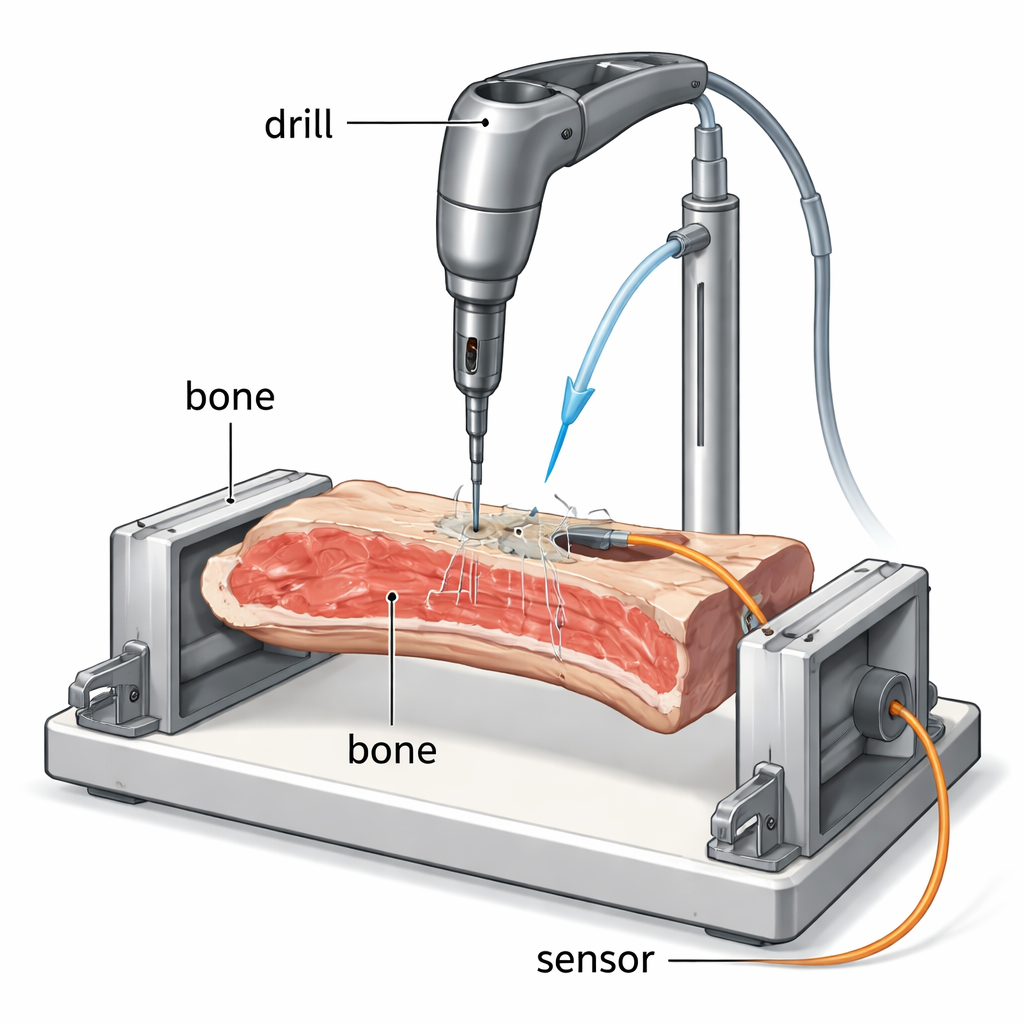
To safely test how much heat these drills produce, the researchers worked with fresh pig ribs, which behave similarly to human jawbone. They used a custom-built drilling tower that pushed a surgical handpiece straight down with a precisely controlled force, removing human variability from the process. The team tested one commercial bone-collecting drill at four rotation speeds (300, 600, 1200 and 2000 turns per minute) and three pushing forces, or axial loads (15, 20 and 25 newtons). Tiny temperature sensors were placed just half a millimeter from the drilled cavity to track changes inside the bone, while a non-contact infrared thermometer measured the temperature of the bone chips trapped in the drill. All drilling was done with generous cooling fluid, much like in careful clinical practice.
How hot the bone and chips actually got
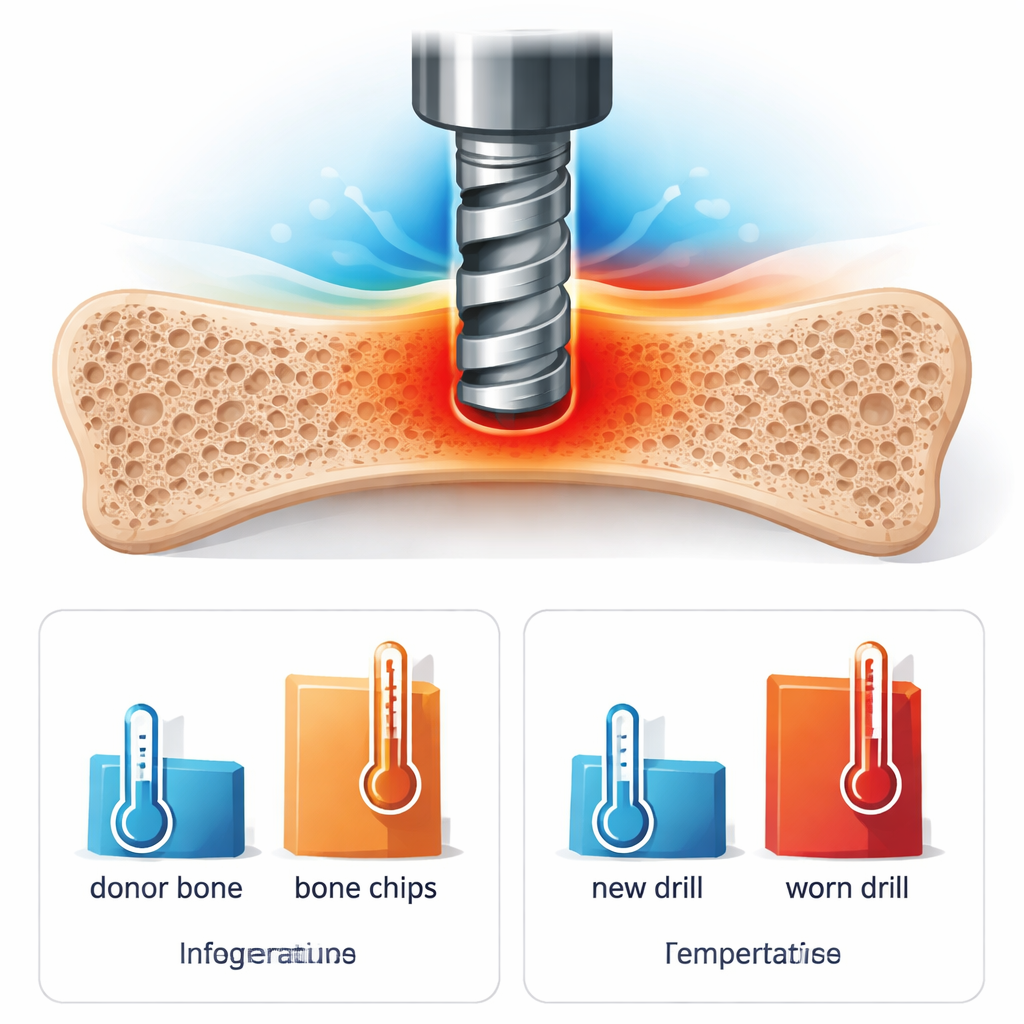
The central question was whether drilling ever raised the bone’s temperature into a danger zone. In this model, a rise of more than about 10 degrees Celsius was considered risky for the health of bone cells. Across the combinations tested, temperature rises in the collected bone chips always stayed under 5 degrees—reassuring news for the quality of the graft material itself. The donor bone surrounding the drilled hole showed larger increases, but most settings remained below the 10-degree threshold. The hottest condition reached an average rise of just over 10 degrees at 1200 revolutions per minute with the highest pushing force. In contrast, using a moderate force of 20 newtons kept bone temperature increases between roughly 3 and 5 degrees at all speeds, and drilling at 600 revolutions per minute stayed below the threshold regardless of force.
When speed, pressure and wear become risky
The study also examined how long drilling took and how the drills themselves wore out. Higher speeds, especially 2000 revolutions per minute, cut very quickly, often finishing in less than two seconds, while slower combinations could take more than six seconds. Microscopic images showed only minor edge blunting after ten uses, but pronounced rounding and chipping after thirty uses, with some drill tips beginning to split. These worn drills ran hotter and slower: average bone temperature rises more than doubled, and cutting times nearly doubled as well. Although the bone chips still stayed under a 5-degree rise, the surrounding donor bone approached or exceeded the danger zone more often, increasing the risk of heat-related damage in a real patient.
Translating the findings to the dental chair
For dentists and oral surgeons, the message is practical and clear. Bone-collecting drills can safely harvest useful graft material under well-chosen settings and with good cooling. In this study, the safest combinations were a pushing force around 20 newtons—no matter the speed—or using 600 revolutions per minute at any of the tested forces, conditions that kept bone heating below a harmful range. However, drills should not be pushed beyond roughly 30 uses, because heavy wear leads to more friction, higher bone temperatures and longer drilling times, even if the bone chips themselves remain relatively cool. Regular visual checks of the drill tip and timely replacement can therefore help protect bone health and improve the chances of strong, long-lasting implants.
Citation: Jáni, F., Köhler, N., Lempel, E. et al. Heat generation of autologous bone harvesting drills: an in vitro study. Sci Rep 16, 5093 (2026). https://doi.org/10.1038/s41598-026-35988-3
Keywords: dental implant drilling, bone grafting, drill wear, thermal injury, oral surgery