Clear Sky Science · en
Assessment of multiple outcomes of habitat models can significantly affect conservation decisions for threatened species
Why hidden forest life matters
Across Europe, the last patches of old, undisturbed forest shelter a surprising cast of hidden organisms, including fungi that live on fallen trees. These species help recycle wood, store carbon and keep forests healthy, yet they rarely appear in conservation plans that focus on birds, mammals or trees. This study uses one striking fungus that lives on dead pine logs to ask a big question: how do our assumptions about the future, and not just climate change itself, shape the decisions we make about which forests to protect?
A rare fungus as a warning light
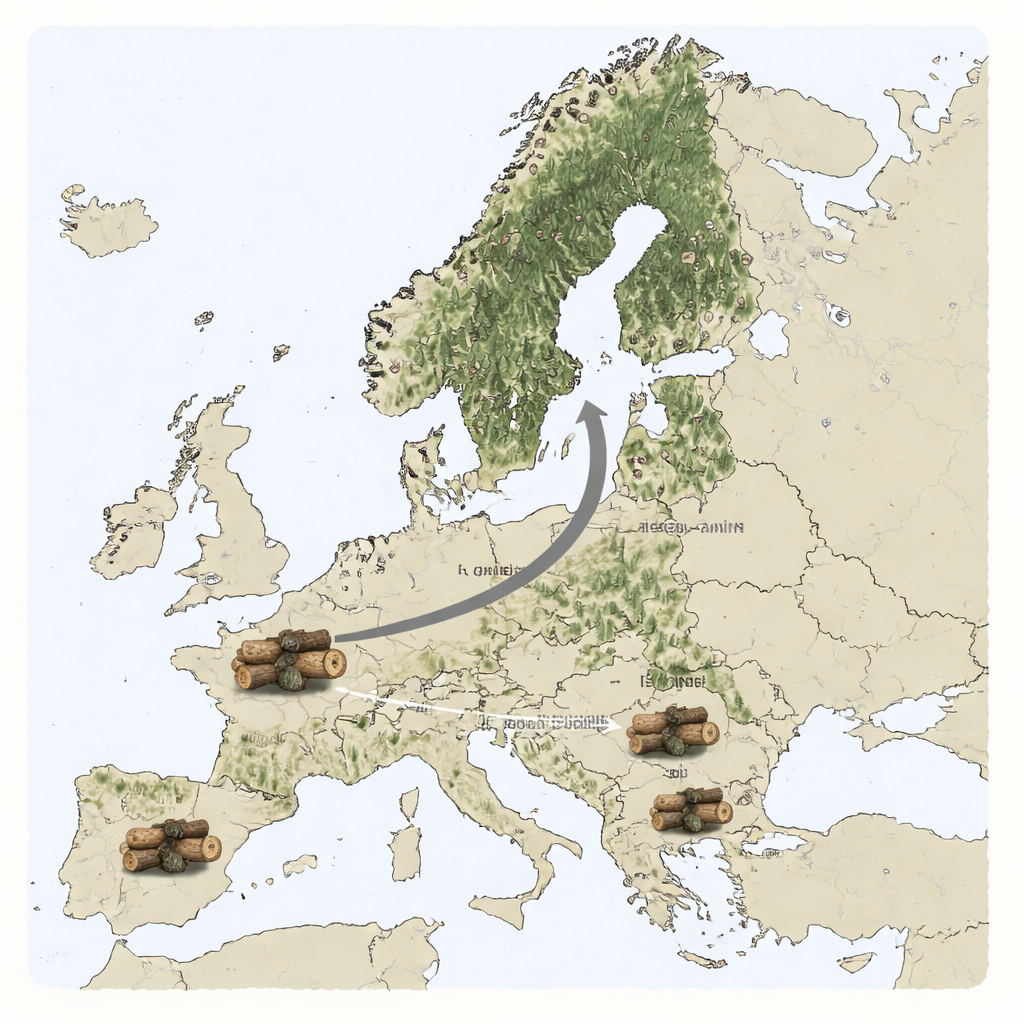
The researchers focus on Anthoporia albobrunnea, a conspicuous bracket fungus that grows mainly on downed trunks of Scots pine in old, dry, conifer forests. Today, most of its European stronghold is in the boreal forests of Finland, Sweden and Norway, with a few scattered and isolated pockets as far away as Spain and Poland. Because the fungus needs plenty of large, long-dead logs in relatively undisturbed stands, it signals forests with high natural value. It is already considered threatened or near threatened in several countries, and is being evaluated for inclusion on global fungal red lists. That makes it a useful test case for seeing how future climate and forest use might treat other old-growth specialists.
Using maps and math to look ahead
To peer into the future, the team combined thousands of fungus records from biodiversity databases with fine-scale maps of climate, soil, forest cover and the ranges of its main host trees, Scots pine and Norway spruce. They then applied a widely used technique called species distribution modelling, which looks for the combination of conditions where the fungus is found today and projects where similar conditions will occur under future climates. Two climate pathways were compared: a more moderate one and a high-emissions, strongly warming one, each represented by several global climate models. The model performed very well at reproducing the known current range and suggested that low winter temperatures, dry forest climates, moderately acidic soils and the presence of host trees together define the best habitat.
Different futures from the same data
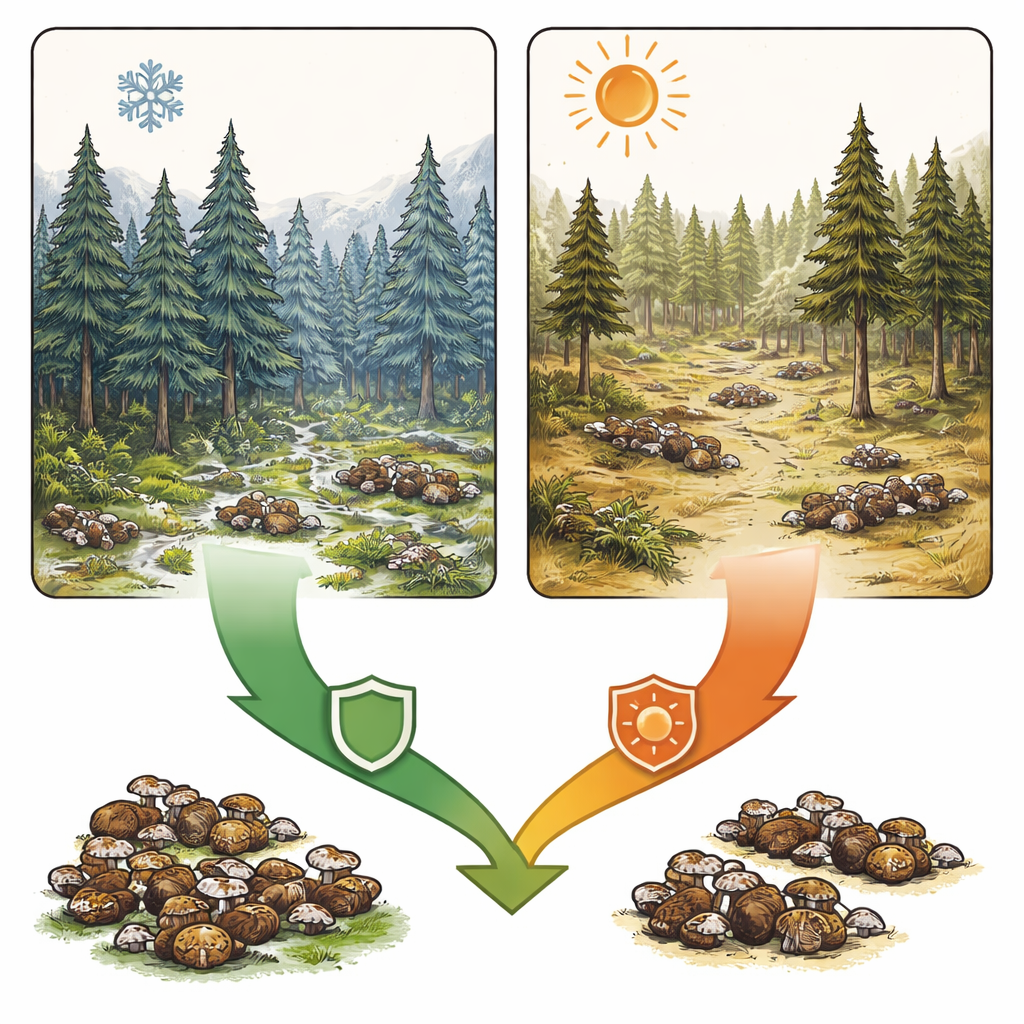
Instead of stopping at a single forecast, the authors explored how different ways of interpreting multiple scenarios change the conservation message. They built two summary views from the same set of model outputs. A “cautious” view focused on agreement across scenarios and emphasized only areas that were consistently predicted as good habitat, treating uncertainty as a warning. An “optimistic” view highlighted any place that at least one scenario suggested could be suitable, treating uncertainty as an opportunity. Both views agreed that the total area of habitat will shrink by 2060, especially under stronger warming, and that most remaining habitat will still be concentrated in Fennoscandia. Yet the size and quality of the predicted future range differed dramatically depending on which lens was used.
Why our risk attitude rivals climate change
When the team compared the maps, they found that differences caused by the chosen interpretation were much larger than differences caused by the climate pathway itself. In other words, whether scientists and policymakers decide to emphasize worst cases or best cases can shift the apparent future habitat of the fungus more than moving from a moderate to a severe warming scenario. The cautious view suggests sharp losses of high-quality habitat, especially in southern parts of the Nordic region, and stresses the need to lock in protection for current strongholds. The optimistic view reveals more potential for new habitat patches to arise in places like northern Poland, southern Sweden and parts of Central Europe—but often far from current populations, raising doubts about whether the fungus can reach them without help.
What this means for saving old forests
For non-specialists, the key message is that protecting old-growth forests cannot rely solely on increasingly sophisticated computer models. The same technical results can support very different strategies depending on whether planners stress precaution or possibility. The authors argue for combining both perspectives: swiftly granting strict protection to core old-growth areas in Fennoscandia, improving deadwood and habitat connectivity in surrounding managed forests, and treating uncertain “marginal” forests as potential future refuges rather than expendable. More broadly, they call on conservation scientists to show decision‑makers not just one forecast but a range of clearly explained futures, making the value judgements behind forest policy more transparent.
Citation: Copot, O., Lõhmus, A. Assessment of multiple outcomes of habitat models can significantly affect conservation decisions for threatened species. Sci Rep 16, 5860 (2026). https://doi.org/10.1038/s41598-026-35987-4
Keywords: old-growth forests, fungal conservation, climate change, species distribution models, forest protection