Clear Sky Science · en
Research on the impact of ground subsidence of varying degrees caused by underground coal mining on soil erodibility
Why sinking ground matters for our soil
Across the world’s coalfields, the ground above underground mines slowly sinks and cracks as rock is removed far below the surface. This hidden reshaping of the land can quietly change how easily soil washes or blows away, with big consequences for farming, grasslands, and rivers. In China’s Xinjiang region, researchers used a coal mine in the Yili River Valley as a natural laboratory to ask a deceptively simple question: when the ground sags more, does the soil become easier—or harder—to erode?
A coal valley under pressure
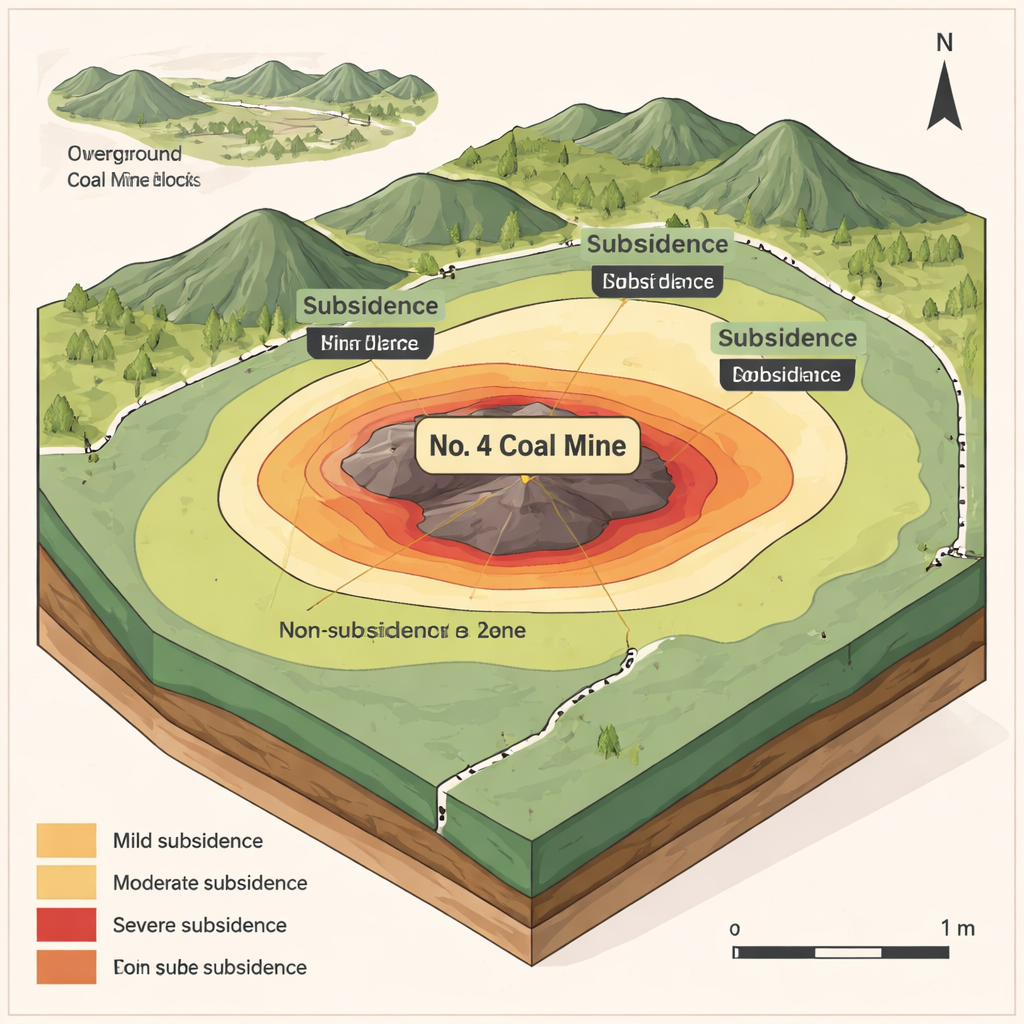
The study centers on the No. 4 Coal Mine in Yili, one of Xinjiang’s major coal-rich areas and a key energy base for China. Here, mining deep underground has created a broad subsidence zone: a shallow, stepped “crater” several kilometers across where the land has sunk by different amounts. The scientists divided this landscape into four bands—no subsidence, mild, moderate, and severe—and sampled soils at five depths down to 80 centimeters. They measured the size mix of soil particles (sand, silt, and clay) and the amount of organic matter, and then used a widely applied model, EPIC, to estimate how easily the soil could be eroded by water.
From firm ground to sandier soil
The first clear pattern was a shift in soil texture as subsidence intensified. Although the basic soil type stayed the same, its internal mix changed: overall, sand content rose while silt and clay declined, especially in the most severely subsided areas. Horizontally, soils in non-subsided zones had more silt, mildly subsided zones had the most clay, and severely subsided zones were dominated by sand. Vertically, at any given site, deeper layers tended to contain more clay and silt and less sand than the surface, meaning that the “sandification” effect of subsidence was strongest near the topsoil and weakened with depth.
Organic matter on the move
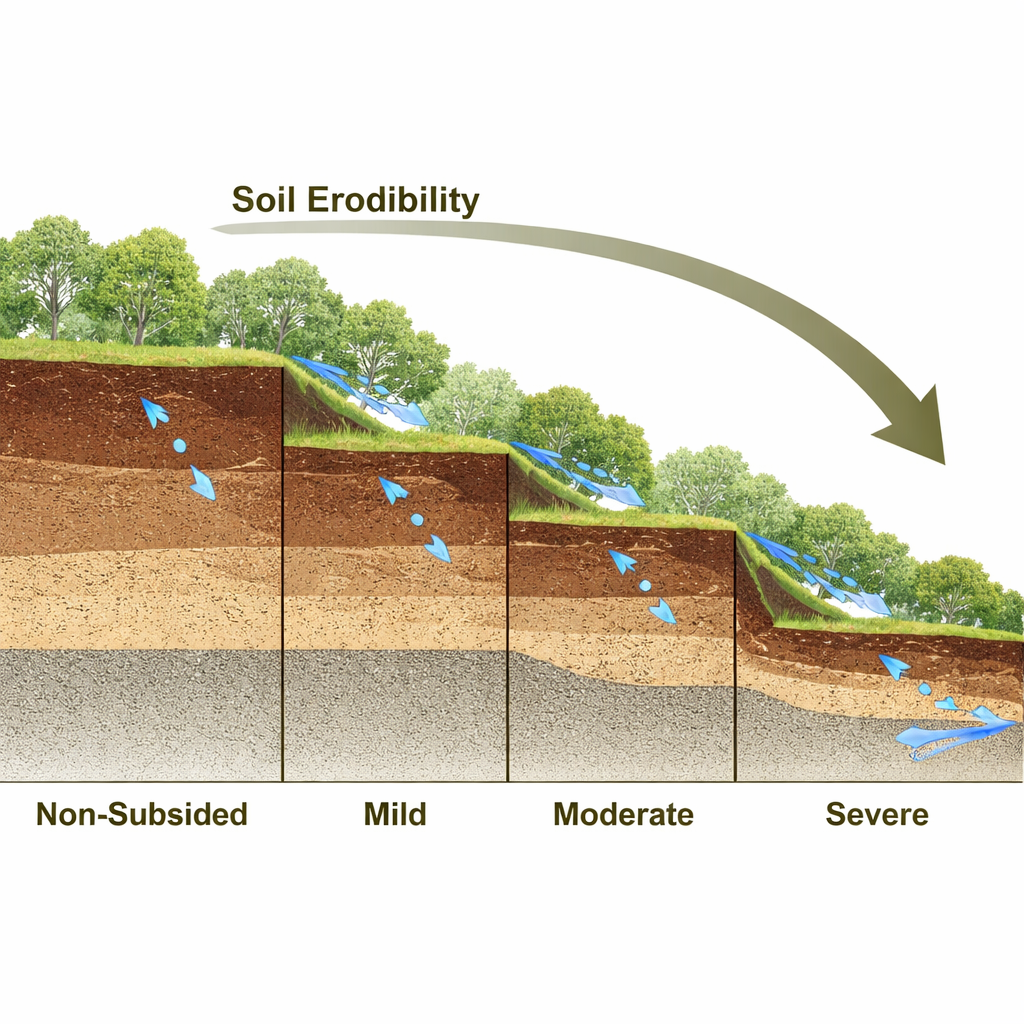
Soil organic matter—decayed plant and animal material that helps soil hold water and stick together—also changed with subsidence, but in a more complex way. Within each subsidence band, organic matter generally declined with depth, as expected. Across the whole profile, total organic matter dropped compared with non-subsided land, with the greatest net loss in mildly subsided areas. Yet the severely subsided zone showed partial recovery, holding slightly more organic matter than the mildly and moderately affected zones. Field observations suggest that the terraced shape of the sinking ground channels seasonal runoff and debris downslope, so some eroded material and organic matter are trapped and deposited in the deepest, most subsided steps rather than washing away entirely.
A surprising twist in erosion risk
When the team combined texture and organic matter into the EPIC model, they found something that runs counter to common expectations: in this landscape, soils in more strongly subsided areas were, on average, slightly less erodible. All sites fell in a medium-to-high risk range overall, but the key index—the K-value—showed a gentle downward trend from non-subsided to severe subsidence zones. In essence, while subsidence made the soil sandier and disturbed structures and roots, the particular topography of the mine and its seasonal runoff meant that eroded particles and organic-rich material tended to be redistributed and partly stored within the subsidence system, especially in the deeper terraces, rather than simply being stripped away.
What this means for land and water
For non-specialists, the takeaway is that the impact of underground coal mining on soil erosion is not always a simple story of “more subsidence equals worse erosion.” In the gently sloping Yili valley, with continuous subsidence zones and short, seasonal bursts of rain, the sinking ground both damages soils and rearranges them. Subsidence coarsens the topsoil and reduces organic matter, which would normally make erosion worse, but the stepped terrain and runoff paths help trap some of the loosened material, slightly lowering the calculated erosion sensitivity in the most subsided zones. The authors stress that this pattern depends on local climate and landforms; in steeper or wetter regions, subsidence can strongly amplify erosion instead. Their findings provide a scientific basis for mapping erosion-prone areas around mines and designing targeted restoration—such as stabilizing vulnerable surface layers and rebuilding vegetation—before the soil literally slips away.
Citation: Tian, H., Zhang, A., Sui, W. et al. Research on the impact of ground subsidence of varying degrees caused by underground coal mining on soil erodibility. Sci Rep 16, 5659 (2026). https://doi.org/10.1038/s41598-026-35985-6
Keywords: coal mining subsidence, soil erosion, soil texture, organic matter, Xinjiang Yili