Clear Sky Science · en
Modeling and optimization of sustainable ternary concrete incorporating rice husk ash and extracted micro silica
Turning Farm Waste into Stronger, Greener Concrete
Concrete keeps our buildings, bridges, and roads standing, but making the cement inside it releases huge amounts of carbon dioxide. This study explores how an agricultural waste product—rice husks—can be transformed into high‑performance ingredients for concrete, cutting emissions while actually improving strength and durability. For anyone interested in climate‑friendly construction or how everyday materials can be reinvented, it offers a glimpse of how smart chemistry and artificial intelligence can reshape one of the world’s most used materials.
Why Cement’s Carbon Footprint Matters
Cement production is responsible for roughly 7% of global human‑made CO₂ emissions, so even modest changes to concrete recipes can have an outsized climate impact. One promising strategy is to replace some of the cement with “supplementary” materials that come from waste streams rather than from energy‑intensive kilns. Rice husk ash, produced by burning rice husks, is rich in silica, a key ingredient in cement chemistry. When this ash is further refined into an ultra‑fine powder known here as extracted micro silica, it can react strongly with the cement paste and fill tiny pores, potentially making concrete both stronger and less leaky while also reducing the amount of cement needed.
Designing a Three‑Way Blend
The researchers created a “ternary” concrete—one whose binder is a blend of ordinary Portland cement, rice husk ash, and extracted micro silica. They mixed 13 different concretes, varying the amounts of rice husk ash (from 5% to 40% of the cement by mass) and micro silica (5%, 10%, or 15%). All other ingredients and workability were kept the same so that any changes in performance could be traced back to these two materials. The team then cured the concrete specimens for 14, 28, and 56 days and measured how much compressive force they could withstand, a key indicator of structural performance. They also selected several mixes for water‑penetration tests to see how easily fluids could move through the hardened concrete—a crucial factor for long‑term durability in harsh environments. 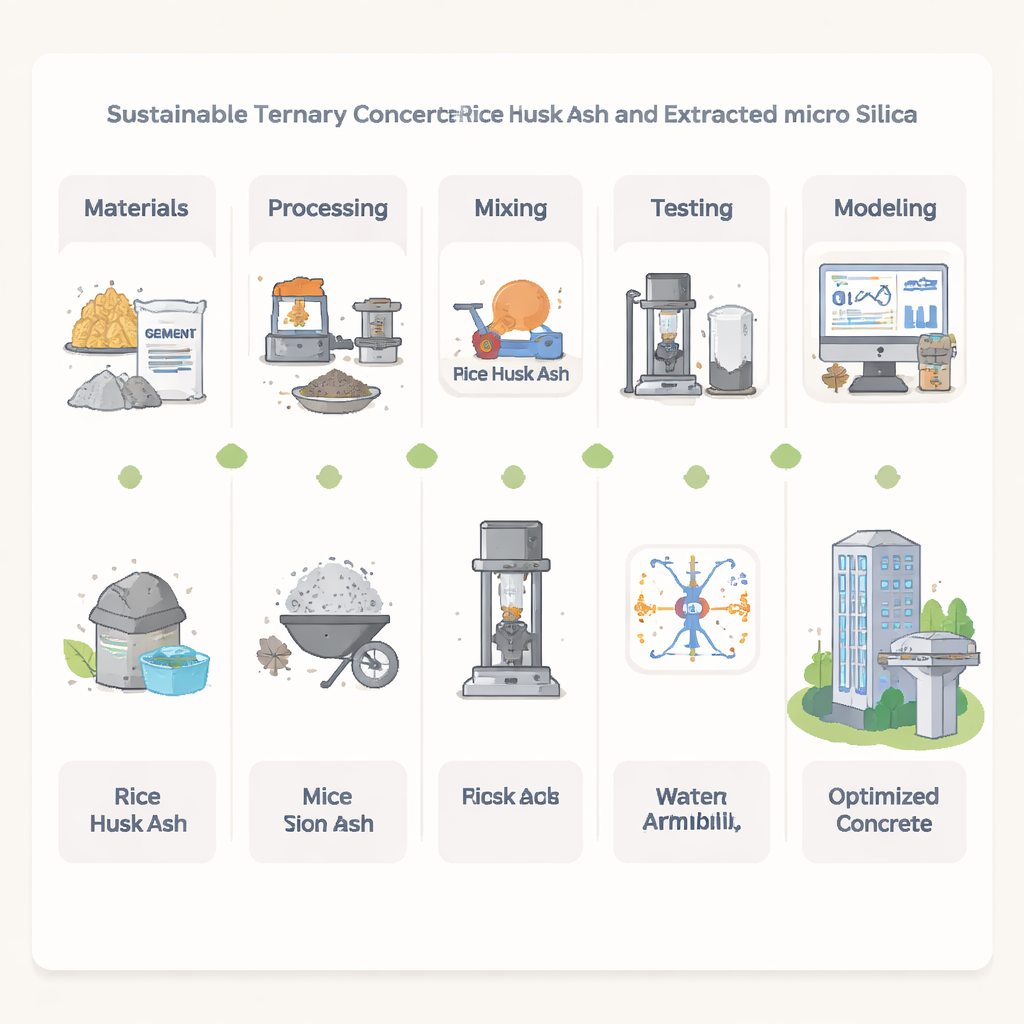
What Happens Inside the Concrete
To understand why some mixtures performed better than others, the team examined the hardened paste under a scanning electron microscope. In the best blends, moderate doses of micro silica (around 5–10%) combined with rice husk ash (about 15–25%) produced a dense, tightly knit internal network with fewer pores and cracks. This is because the ultra‑fine micro silica acts early, providing extra surfaces where the cement can hydrate and forming a compact gel, while the rice husk ash continues reacting over time, further filling voids. In contrast, when the replacement levels were pushed too high—especially with 15% micro silica combined with 35–40% rice husk ash—the images revealed clumps of fine particles, unreacted cement grains, and interconnected voids. This overcrowding of reactive silica actually slowed normal cement reactions and left a weaker, more porous structure.
How Smart Modeling Finds the Sweet Spot
Rather than relying on trial and error alone, the study used two advanced modeling tools to pinpoint the best recipes. Response Surface Methodology, a statistical technique, built equations that link the amounts of micro silica and rice husk ash to the measured strength at different ages. An Artificial Neural Network, inspired by how biological neurons learn patterns, was also trained on the test data. Both models could predict compressive strength with high accuracy, but the neural network performed slightly better, capturing subtle nonlinear effects. Using these tools, the researchers found that mixes with about 10–15% micro silica and 15–25% rice husk ash could surpass the strength of conventional concrete, with one blend reaching roughly 18% higher 56‑day strength than the control. Water‑permeability tests supported these findings: the optimized mixes allowed much less water to penetrate than standard concrete, a strong sign of improved durability. 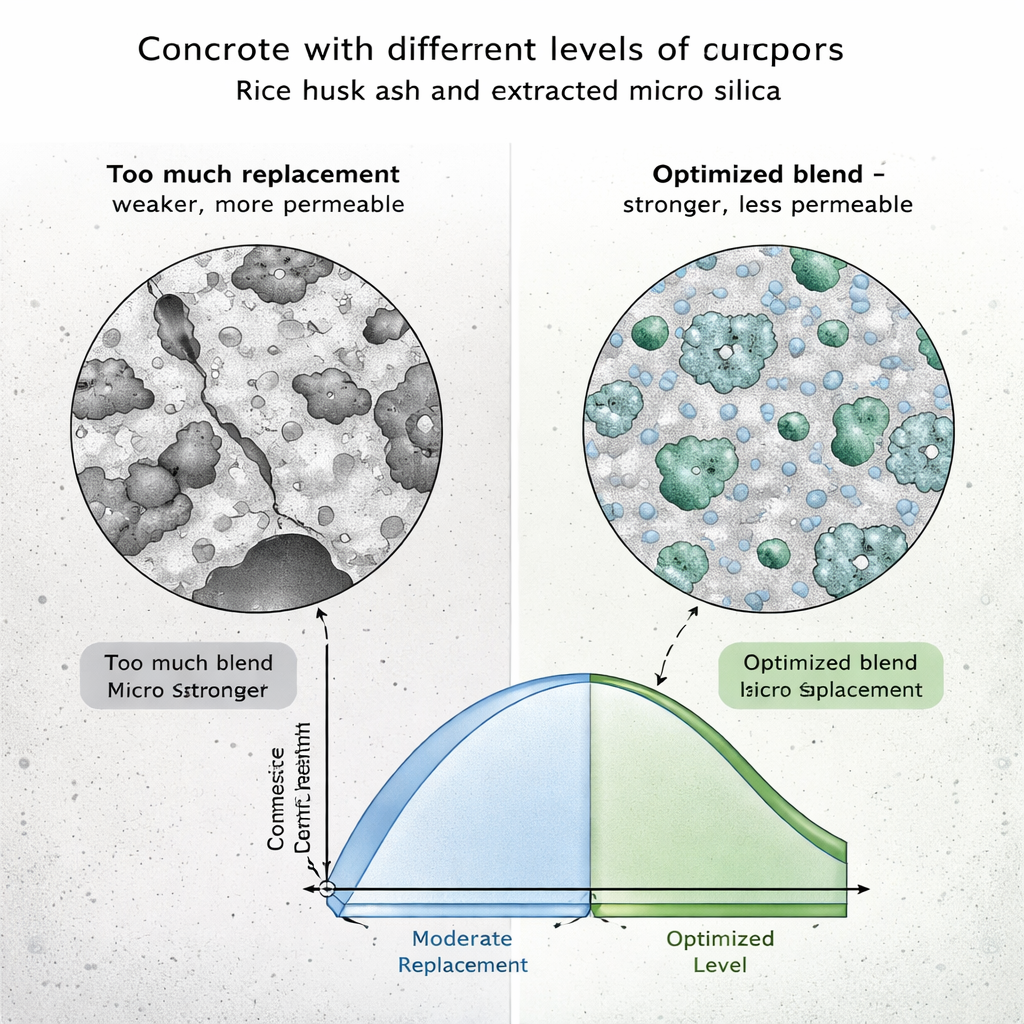
What This Means for Future Buildings
For a non‑specialist, the main message is straightforward: by carefully balancing how much rice‑derived ash and ultra‑fine silica are added, it is possible to make concrete that is both greener and better performing than traditional mixes. Low‑to‑moderate replacement levels reduce cement use, lock agricultural waste into long‑lasting structures, and produce a denser, more water‑resistant material. However, more is not always better—pushing substitutions too far can weaken the concrete. The authors suggest that their optimized blends, guided by both lab testing and artificial intelligence, offer a practical route toward more sustainable buildings and infrastructure, and they call for future work to track long‑term durability and full environmental impacts in real projects.
Citation: Ullah, M.F., Tang, H., Ullah, A. et al. Modeling and optimization of sustainable ternary concrete incorporating rice husk ash and extracted micro silica. Sci Rep 16, 5063 (2026). https://doi.org/10.1038/s41598-026-35983-8
Keywords: sustainable concrete, rice husk ash, micro silica, cement replacement, machine learning models