Clear Sky Science · en
Influence of confining pressure and stress amplitude on the mechanical properties and permeability characteristics of coal
Why the hidden life of coal seams matters
Far below our feet, coal seams bear the weight of the Earth while also enduring the jolts of mining blasts and heavy machinery. How this buried coal cracks, deforms and lets gas escape is not just a question for academics – it affects mine safety, the risk of sudden rock bursts, and how efficiently we can drain gas to prevent explosions or even store carbon underground. This study explores how two key forces – steady squeezing pressure from the surrounding rock and repeated stress shocks from mining – work together to shape the strength and leakiness of coal.
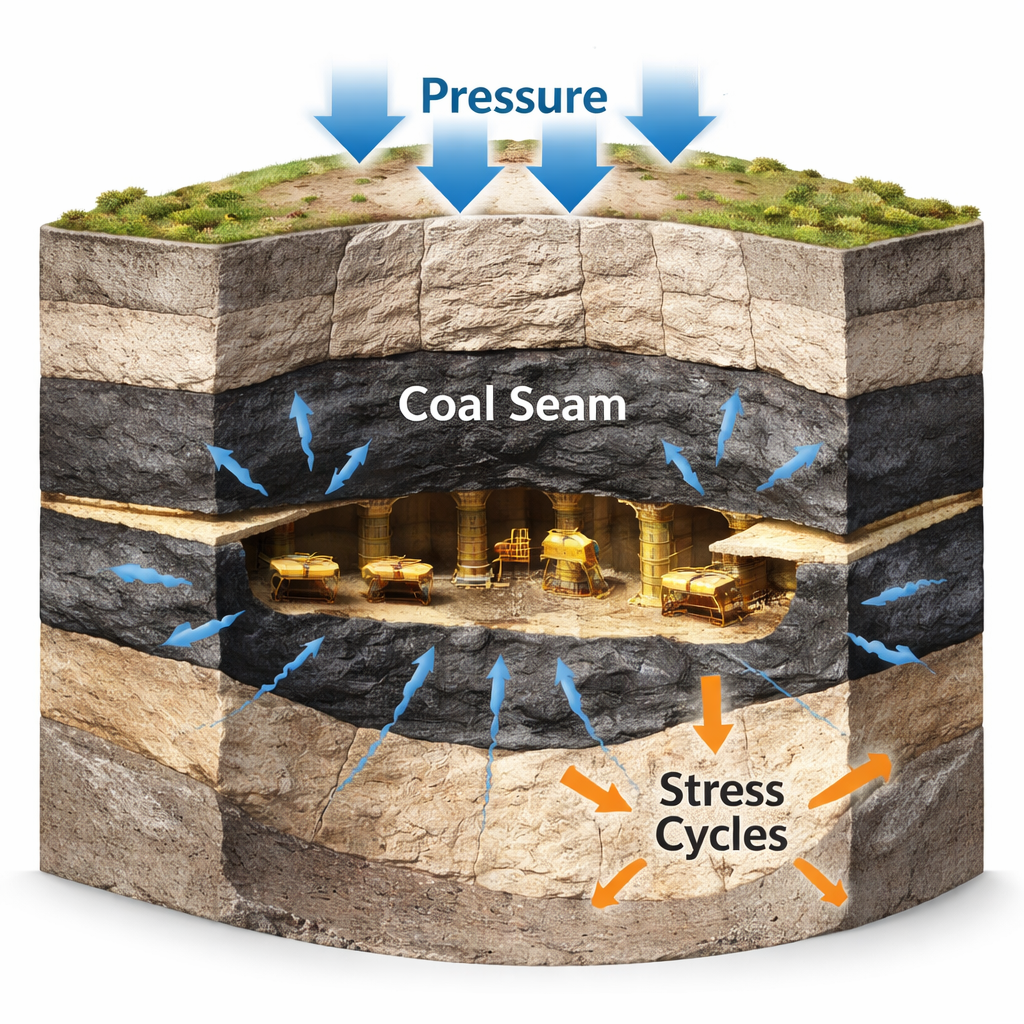
Two kinds of pressure deep underground
In deep mines, coal is squeezed from all sides by the surrounding rock, a steady force called confining pressure. At the same time, mining introduces on-and-off disturbances: blasting, machinery vibration and shifting of the rock layers repeatedly load and unload the coal. The authors recreated these conditions in the laboratory using cylindrical coal samples placed in a triaxial test system. They varied how hard the coal was squeezed (5, 10 and 15 megapascals of confining pressure) and how strong the stress cycles were (5–20% of the coal’s peak strength). Throughout the tests, they tracked how the coal shortened and crept over time, how much mechanical energy it stored or dissipated, how its internal fractures evolved in three dimensions, and how easily gas could flow through it.
How steady squeezing changes coal strength and leaks
When the confining pressure was increased, the coal became notably stronger and stiffer. The maximum stress the samples could bear rose by more than a third, and the slope of their stress–strain curves (a measure of stiffness) also increased. At higher pressure, the coal’s tiny pre-existing cracks were forced closed and the pore channels compacted. This limited the build-up of permanent, irreversible deformation and reduced the amount of mechanical energy lost as damage. As a result, the coal behaved more elastically, resisting disturbance instead of breaking apart easily. At the same time, its permeability – the ease with which gas could pass through – dropped sharply. Under 10 and 15 megapascals, gas flow at key measuring points fell by roughly 90–95% compared with the lowest pressure, and then tended to stabilize, suggesting the fracture network had largely closed.
When repeated shocks turn coal into a gas highway
Holding confining pressure fixed and raising the size of the stress cycles had the opposite effect. Larger stress swings weakened the coal: its peak strength dropped by almost 13% as the amplitude increased from 5% to 15% of the peak stress. The coal accumulated more irreversible strain with each cycle and entered a fatigue-like state. Energy analysis showed that higher amplitudes pumped more input and elastic energy into the samples, pushing them towards a “store-then-burst” failure mode rather than slow, progressive damage. Three-dimensional imaging confirmed that at low amplitude, fractures were sparse and did not cut through the whole sample, whereas at 10–15% amplitude, major cracks penetrated the core, strongly increasing the volume and complexity of the fracture network. In step with this, gas permeability rose, and at the highest amplitude both strain and flow surged, indicating that new, connected leak paths had formed.
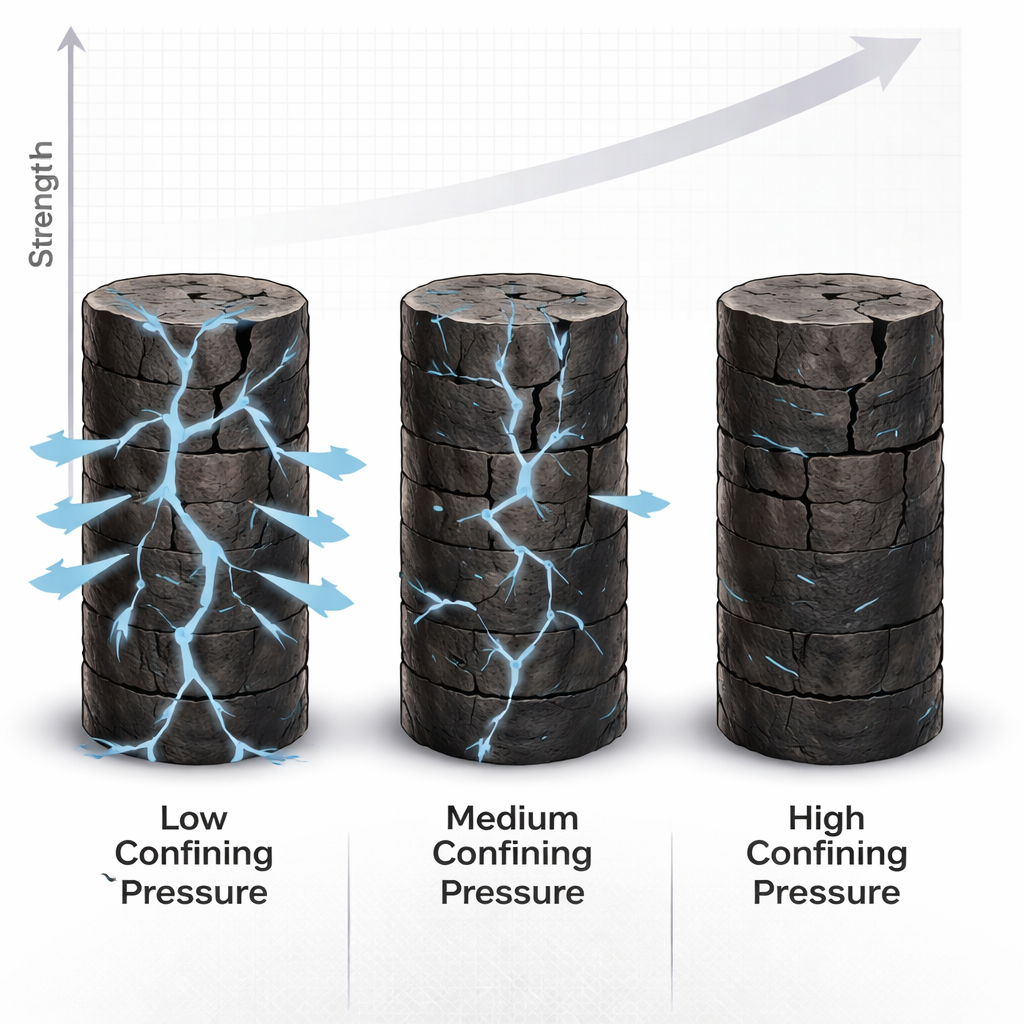
A tug-of-war between squeezing and shaking
By comparing all the tests, the researchers describe a competition between confining pressure and stress amplitude. Higher confining pressure tends to clamp cracks shut, simplify the internal fracture geometry and build up elastic stiffness, making the coal stronger but less permeable. Stronger cyclic disturbances do the reverse: they drive crack initiation and growth, increase fracture connectivity and fractal complexity, reduce strength and sharply increase permeability. The combined response is nonlinear – for example, very high confining pressure can delay damage for many cycles but then, near failure, speed up crack growth and energy release. The authors even outline a rough threshold: to counteract the crack-opening effect of a 15% stress amplitude, a confining pressure of around 10–12 megapascals may be needed.
What it means for safer and cleaner coal use
For a lay reader, the bottom line is that deep coal behaves like a system caught between a steady squeeze and repeated shaking. The squeeze can stabilize the rock and choke off gas pathways, which is good for preventing sudden failures but can trap gas and energy. The shaking from mining can reopen and extend cracks, turning the coal into a more effective gas pathway but also making it weaker and more accident-prone. This study suggests that in very deep, high-pressure zones, engineers should limit stress disturbances to within about 10% of the coal’s strength to avoid abrupt breakage. In contrast, in zones where improving gas drainage is the priority, slightly stronger controlled disturbances may be useful to open a connected fracture network. Understanding this balance helps design mines that are both safer for workers and better at managing the hidden flows of gas in the rock.
Citation: Yang, H., Qin, D., Liu, H. et al. Influence of confining pressure and stress amplitude on the mechanical properties and permeability characteristics of coal. Sci Rep 16, 6064 (2026). https://doi.org/10.1038/s41598-026-35979-4
Keywords: coal seam stability, rock fractures, gas permeability, deep mining, cyclic loading