Clear Sky Science · en
The impact of agricultural green development on common prosperity for farmers in rural areas
Why Greener Farming Matters for Everyone
How we grow food shapes not only the health of our environment but also the fortunes of millions of farm families. This study looks at "green" agriculture in China—farming that cuts pollution and uses resources efficiently—and asks a simple question with big stakes: can cleaner farming actually help rural households earn more and narrow the gap between countryside and city? Using detailed data from 270 cities over nearly a decade, the authors show how greener fields can support fairer incomes, when the right conditions are in place. 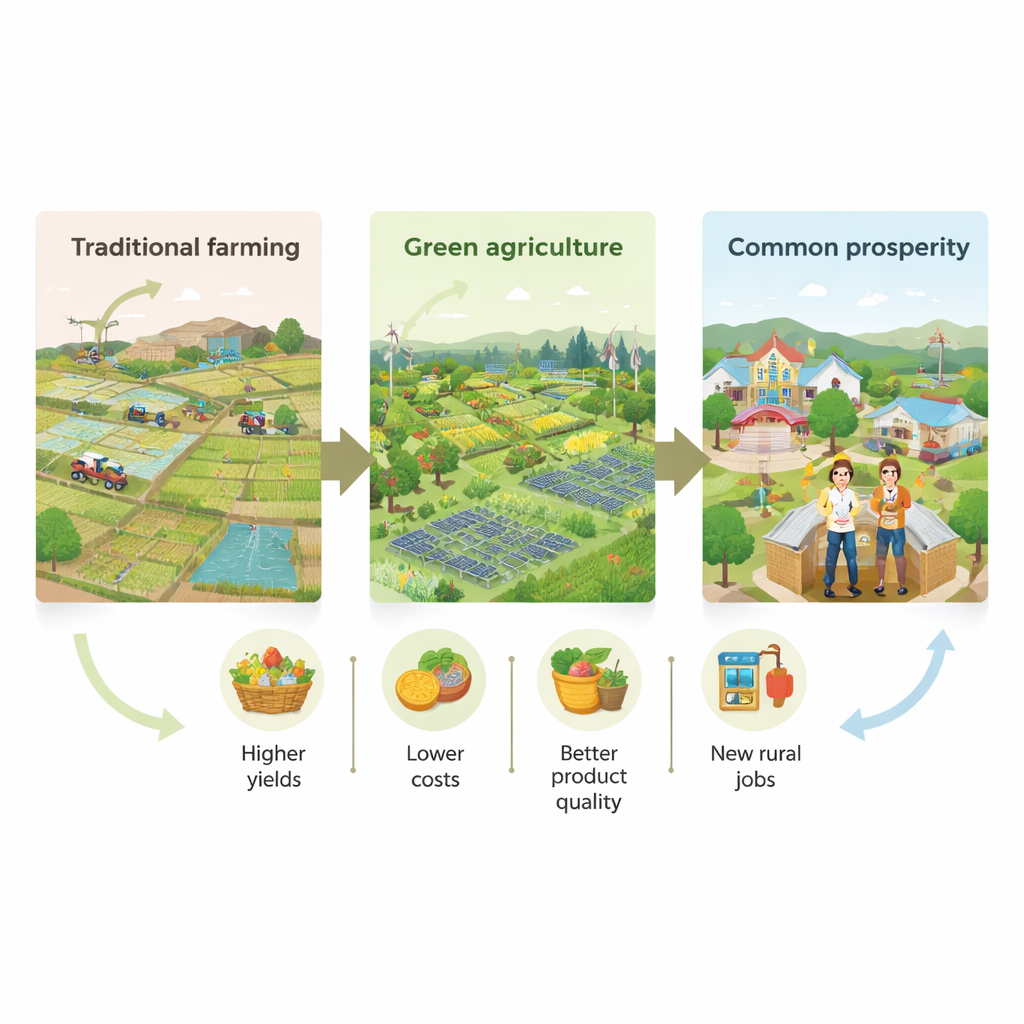
A New Look at Farming and Fairness
China has wiped out extreme poverty but now faces a tougher target: reducing the income gap between rich and poor, especially between cities and villages. Rural residents remain the most vulnerable group. The idea of "common prosperity" means not only raising incomes, but also making sure gains are shared more evenly. The study focuses on a key lever for this goal: green development of agriculture. That includes cleaner water and air around farms, smarter use of machinery and insurance, less reliance on chemical fertilizers and pesticides, and higher-value, more efficient harvests. Together, these changes form a broader green transformation that reaches from inputs to outputs, not just a single eco-label or technology.
Measuring Green Farming and Shared Prosperity
To test whether greener farming delivers fairer outcomes, the researchers built two composite measures. One tracks how green agriculture is in each city, based on sixteen indicators such as pollution levels, farm equipment, use of eco-friendly practices, and how much output is produced per unit of land, water, and energy. The other tracks “common prosperity” in rural areas by combining three pieces: the real income of farmers, the gap between urban and rural incomes, and the income gap among different rural regions. Using statistical models on data from 2013 to 2022, they studied not only the direct relationship between green agriculture and these income measures, but also the pathways and conditions that strengthen or weaken the effect.
How Greener Farming Lifts Rural Incomes
The results indicate that green development of agriculture does more than protect the environment—it raises rural living standards. Cities with more advanced green farming see higher farmer incomes and smaller gaps between rural regions and, in many cases, between cities and villages. The study finds two main channels. First, green farming encourages an extension of the agricultural industry chain: more processing, cold-chain logistics, branding, and other steps that add value beyond basic crop production. Farmers can benefit through contracts with processors and better prices for higher-quality products. Second, green farming supports new rural activities such as leisure agriculture and tourism, where visitors pay for scenic landscapes, farm stays, and local culture. These activities create extra jobs and business opportunities for local residents, including women and older villagers.
Why Place Still Matters
The gains from green agriculture are not uniform. In eastern China and in regions that are not major grain producers, green development is strongly linked to common prosperity: incomes rise and income gaps shrink. In contrast, western regions, with poorer infrastructure and weaker resource endowments, do not yet see the same broad benefits from going green. In central China and in core food-producing areas, greener farming raises farm incomes and narrows gaps between rural regions, but is not yet powerful enough to close the broader city–countryside income divide. A key factor is how clustered and mature the farm economy is. Where agricultural businesses are densely grouped—forming industrial clusters—farmers can share machinery, spread technology more easily, and buy eco-friendly inputs more cheaply. 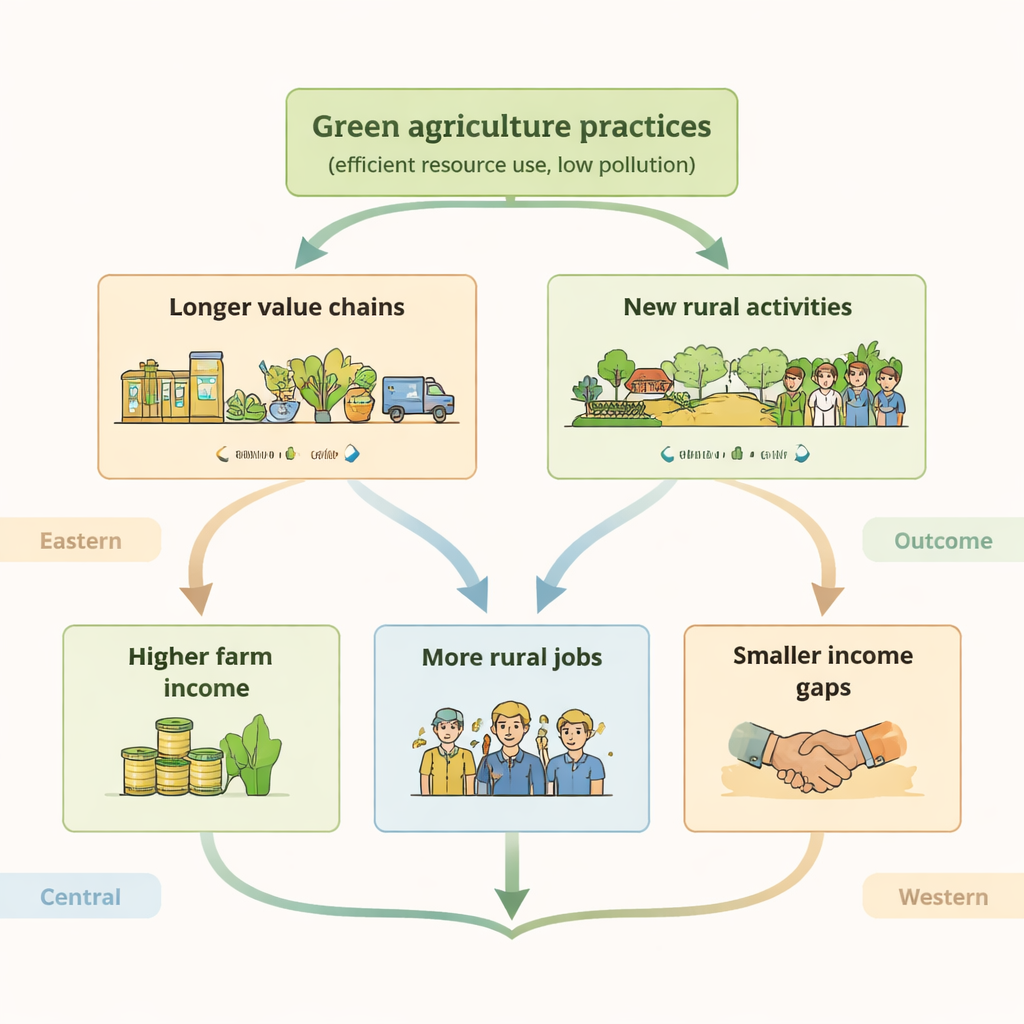
When Green Farming Becomes a Real Game-Changer
One of the study’s most striking findings is a "threshold" effect. Green agriculture always helps raise farm incomes, but it only starts to significantly reduce income gaps once the local farm sector has reached a certain level of clustering and scale. Below that level, high up-front costs and risks of green practices can blunt the benefits. Above it, shared services, stronger markets, and richer value chains boost the payoff from going green. In simple terms, cleaner, more efficient farming can be a powerful engine for fairer growth—but only if regions also build the surrounding networks of processing, services, and infrastructure that let farmers truly cash in on the ecological value of their land.
What This Means for the Future of the Countryside
For non-specialists, the message is straightforward: greener farming, done at scale and supported by local clusters of related businesses, can help farm families earn more and reduce unfair income gaps. Policies that only ask farmers to cut pollution, without building industries such as food processing, branding, and rural tourism, risk leaving money on the table. By contrast, when clean farming is paired with stronger rural industries and better local services, it can turn ecological advantages—fresh air, clean water, pleasant landscapes—into lasting income streams. That combination moves rural communities closer to a future where prosperity is not just higher, but more widely shared.
Citation: Li, Z., Shi, Q., Hu, K. et al. The impact of agricultural green development on common prosperity for farmers in rural areas. Sci Rep 16, 5844 (2026). https://doi.org/10.1038/s41598-026-35978-5
Keywords: green agriculture, rural income, common prosperity, agricultural clusters, rural tourism