Clear Sky Science · en
Dual band Notched 2-port UWB MIMO antenna reconfiguration using lumped capacitors
Why this tiny antenna matters to everyday wireless life
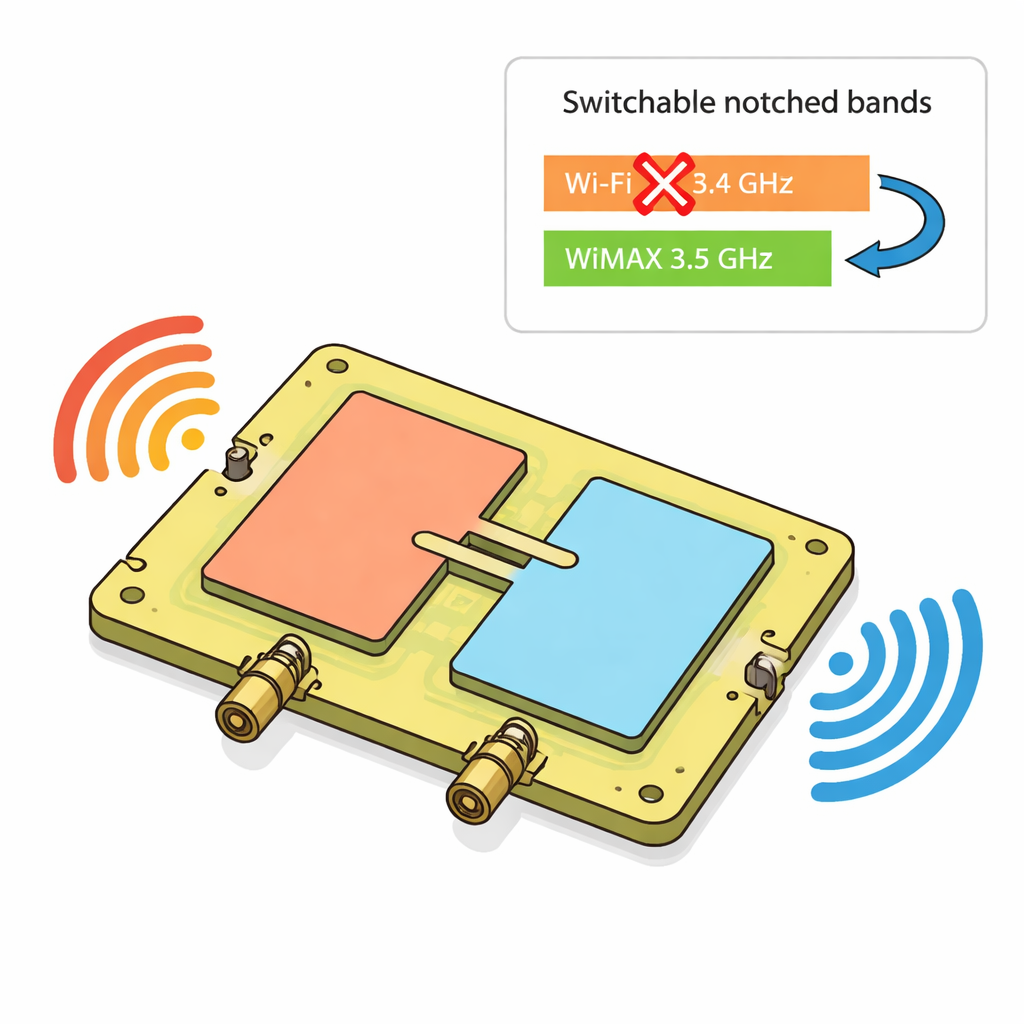
Streaming video, online gaming, and smart gadgets all compete for space in the crowded airwaves around us. Different wireless services – such as home Wi‑Fi and long‑range WiMAX links – use nearby slices of the radio spectrum, and when devices overlap in frequency, they can interfere with each other. This paper presents a very small, smart antenna that can automatically carve out narrow “quiet zones” in its operating band so it avoids clashing with these services, helping future phones, routers, and sensors connect more reliably and at higher data rates.
Making room in a crowded spectrum
Modern wireless gadgets increasingly rely on ultra‑wideband (UWB) signals, which spread data over a very broad range of frequencies to support fast, robust links. But this broad coverage can spill into frequency bands already reserved for systems like Wi‑Fi (WLAN) and WiMAX, creating mutual interference. Engineers can tackle this by building antennas that are mostly wideband but deliberately “go deaf” in narrow, unwanted sub‑bands. The authors designed exactly such an antenna: a compact two‑port device that covers roughly 3 to 10.6 gigahertz, yet can suppress signals at selected frequencies so it coexists peacefully with neighboring networks.
Two antennas in one small footprint
The heart of the design is a pair of tiny microstrip antennas printed on a credit‑card‑sized board. These two radiating elements are arranged at right angles and connected through a carefully shaped metal region on the back of the board. This layout is known as a MIMO (multi‑input–multi‑output) configuration, where two separate antennas work together to send and receive more information over the same channel. When antennas are squeezed close together, they tend to “talk” to each other and spoil this benefit. To prevent that, the authors merged an isolation structure into the ground plane, reducing unwanted coupling so that each antenna largely hears its own signal, not its neighbor’s.
Carving out unwanted frequency bands
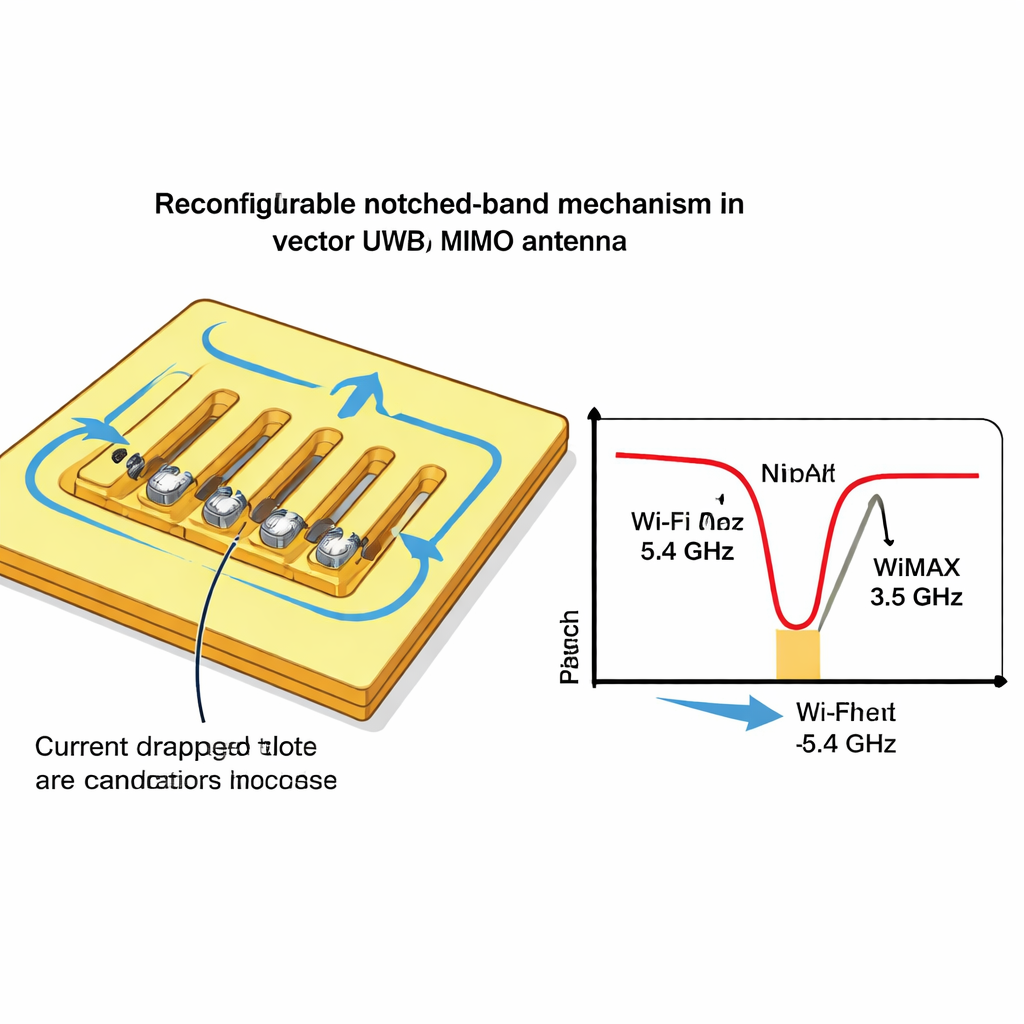
To make the antenna ignore specific frequencies, the researchers etched comb‑shaped slots into the metal patches. At most frequencies, current flows smoothly over the metal and the antenna radiates efficiently. But at one special frequency, the slots resonate like tiny tuning forks, trapping energy and cancelling radiation; this creates a sharp notch, or rejected band, in the response. With only the slots present, the antenna naturally blocks signals around 5.4 gigahertz, the band used by many Wi‑Fi systems. Measurements and simulations show a clear dip in performance at that point, while the rest of the ultra‑wideband range remains usable, and the overall radiation pattern stays close to the desirable almost‑all‑around shape.
Switching the quiet zone with tiny capacitors
The clever twist in this work is that the rejected band is not fixed. The team inserted four tiny electronic components called lumped capacitors across the notched structures. Changing the capacitor value shifts the resonant frequency of the slots, and with it, the location of the notch. By choosing appropriate values, the authors can move the quiet zone from the Wi‑Fi band at 5.4 gigahertz down to the WiMAX band around 3.5 gigahertz. In essence, the same miniature antenna can be tuned to avoid interference with one system or the other, simply by how the capacitors are set or which ones are populated on the board. Tests on a fabricated prototype confirmed that the notch moves as intended, while the two ports remain well isolated and the antenna maintains decent signal strength elsewhere.
What this means for future wireless devices
For a non‑specialist, the key takeaway is that the authors have built an antenna that is both small and adaptable. It spans a wide frequency range suitable for high‑speed links, yet can selectively ignore narrow chunks of spectrum that are already busy, and it does so for two cooperating antenna ports packed into a thin 40 × 26 millimeter board. The very low interaction between the ports and the moderate gain measured in the lab suggest that this design could be a strong building block for compact, multi‑antenna radios in phones, home gateways, and Internet‑of‑Things devices. In short, it is a practical step toward wireless hardware that can intelligently share the airwaves instead of fighting over them.
Citation: Ali, W., Azeem, M.A. Dual band Notched 2-port UWB MIMO antenna reconfiguration using lumped capacitors. Sci Rep 16, 5265 (2026). https://doi.org/10.1038/s41598-026-35976-7
Keywords: ultra wideband antenna, MIMO, reconfigurable notch, wireless interference, lumped capacitors