Clear Sky Science · en
GeneticNAS: a novel self-evolving neural architecture for advanced ASD screening
Why faster autism checks matter
For many families, getting a clear answer about whether a child is on the autism spectrum can take years. Current evaluations depend on long, in-person sessions with highly trained specialists, which are scarce in many regions. This paper describes a new artificial intelligence system that learns, on its own, how best to read subtle patterns in children’s movements during standard autism assessments. The goal is not to replace clinicians, but to give them a fast, reliable screening tool that works even on modest computers.
Turning video of play into measurable patterns
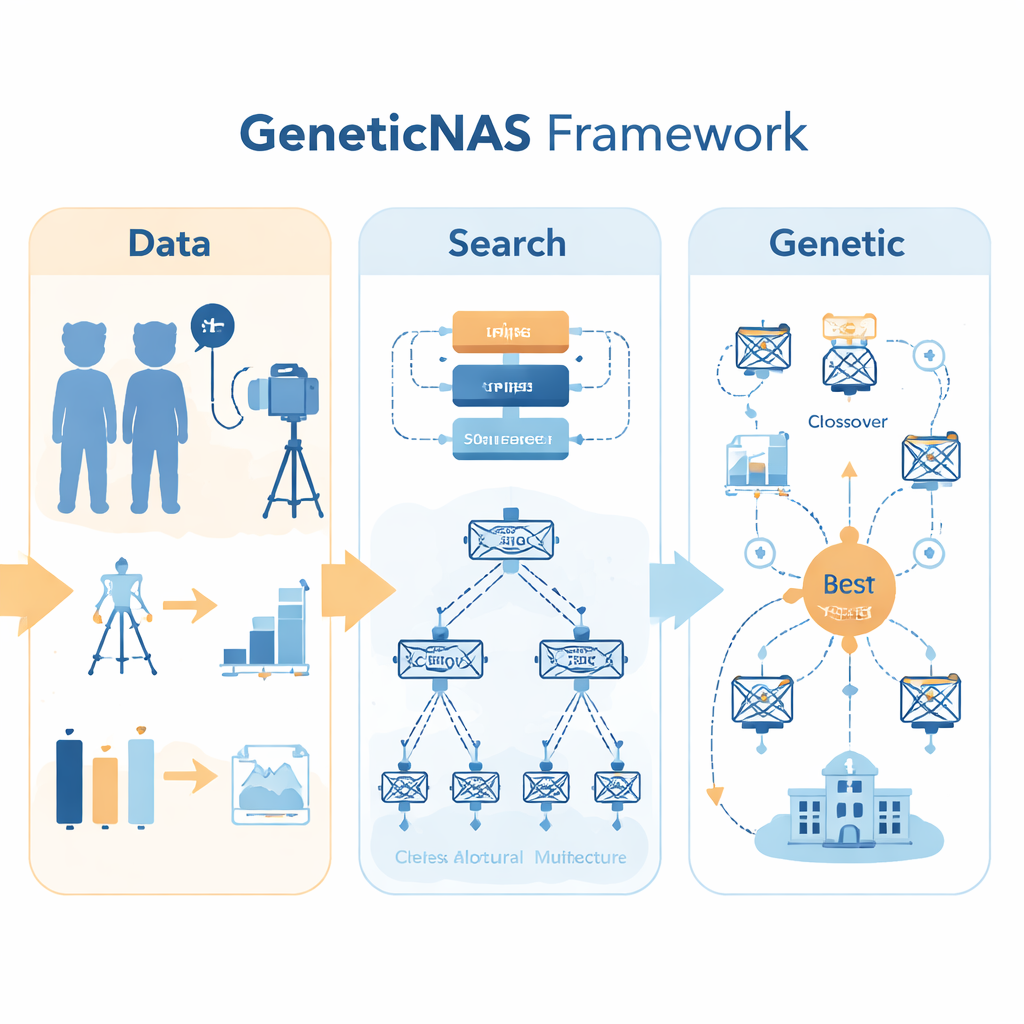
The study builds on the Autism Diagnostic Observation Schedule (ADOS), a widely used, structured play-based evaluation. Instead of having experts score behaviors by hand, the researchers start with short videos of 160 children, half with autism and half typically developing. Computer vision software tracks 33 key points on the body—such as shoulders, elbows, and head position—frame by frame. From these traces, the team constructs rich, 2,048‑value descriptions of each moment, capturing how smoothly a child moves, how their gaze and posture shift, and how these patterns evolve over time. Careful quality checks ensure the measurements are stable over many sessions and balanced between autism and non-autism groups.
Letting the computer design its own brain
Rather than hand-crafting a neural network—the layered math structure behind much of modern AI—the authors let an automated process search for the best design. They use an approach inspired by evolution: a population of candidate networks is created, each with different types of layers and settings. Some layers simply transform the data; others add shortcut connections or compress and re-expand information to highlight important signals. The system evaluates how well each candidate distinguishes autism from typical development, then “breeds” the better ones, mixing and mutating their designs over ten generations until a strong architecture emerges.
Smarter use of computing power
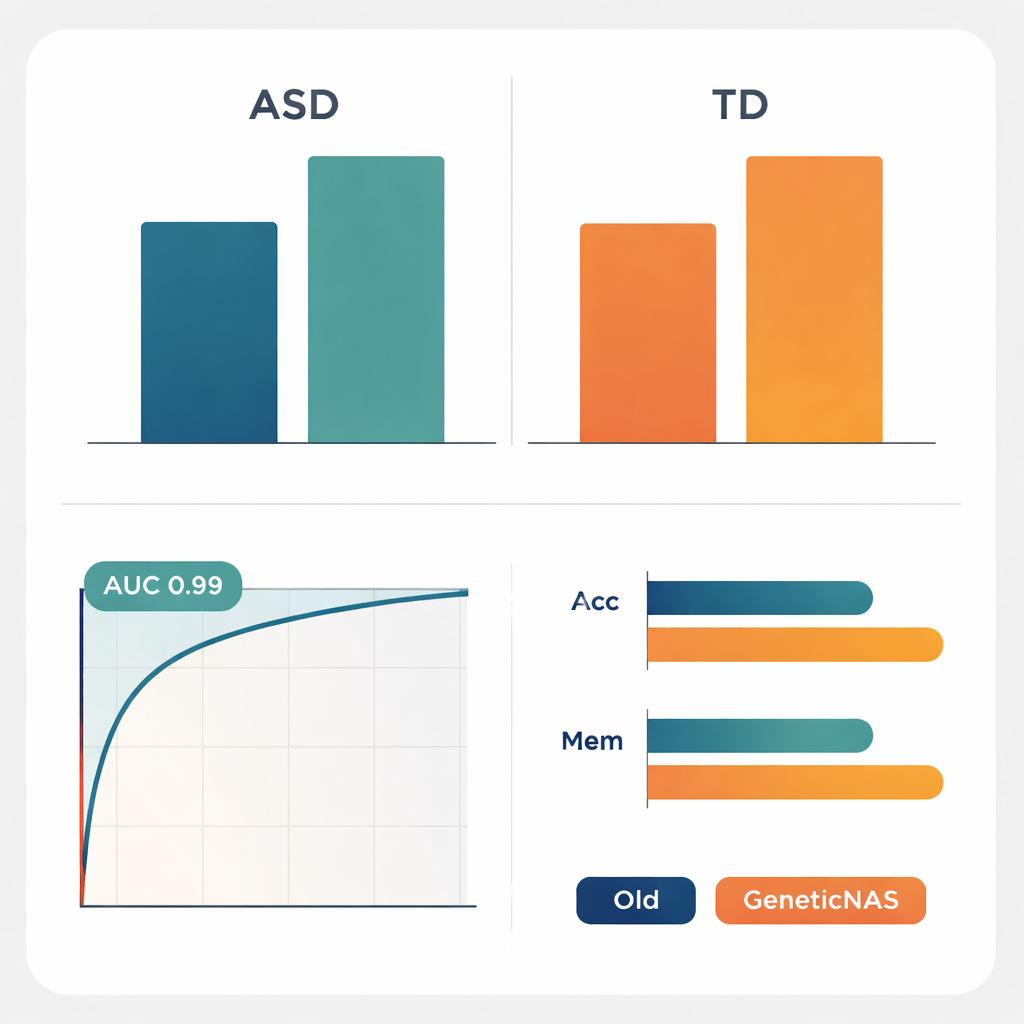
A key innovation is that the search process is built to respect real-world hardware limits. Many similar methods need high-end graphics cards with 16 gigabytes or more of memory, which most clinics do not have. Here, the search is guided not only by accuracy but also by how much memory and time each model uses. Techniques like splitting training into smaller pieces and penalizing overly heavy designs allow the system to run in about 2.1 gigabytes of memory—a 76 percent reduction compared with earlier work—while still exploring millions of possible network layouts. The final model has only 2.8 million adjustable weights and can process a child’s data in roughly 15 milliseconds per sample.
How well the system can tell children apart
When tested on more than 1.3 million unseen examples, the chosen network correctly classified about 95 out of every 100 samples, a clear improvement over strong existing deep-learning baselines. An analysis of trade-offs between missed cases and false alarms showed a very high area under the ROC curve (0.986), meaning the model can be tuned for different clinical priorities without collapsing in performance. Importantly, its success rate was nearly identical for children with autism and for typically developing children, suggesting it is not skewed toward one group. Careful statistical tests and comparisons against simpler networks confirmed that using a mix of layer types and the evolution-inspired search were both crucial to this performance.
What this could mean for families and clinics
In plain terms, the study shows that it is possible to train a compact, fast AI system to spot movement and interaction patterns linked to autism, using realistic amounts of computing power. Such a tool could help flag at-risk children earlier in the diagnostic journey, especially in places where specialists are scarce, and could support clinicians by providing an objective second opinion. The authors stress that their work has limits—it has been tested only in controlled clinic settings with children from a single country, and it does not yet explain its decisions in human terms. Still, the results suggest that self-designed neural networks may become a practical part of future autism screening, helping shorten the long wait many families face before getting answers.
Citation: Alzahrani, A.R., Alboaneen, D. & Alzahrani, I.R. GeneticNAS: a novel self-evolving neural architecture for advanced ASD screening. Sci Rep 16, 6304 (2026). https://doi.org/10.1038/s41598-026-35972-x
Keywords: autism screening, neural architecture search, genetic algorithms, pose estimation, clinical AI