Clear Sky Science · en
The Athabasca River regulates methylmercury burdens of waterbirds breeding downstream
Why a Remote River Matters to Our Health
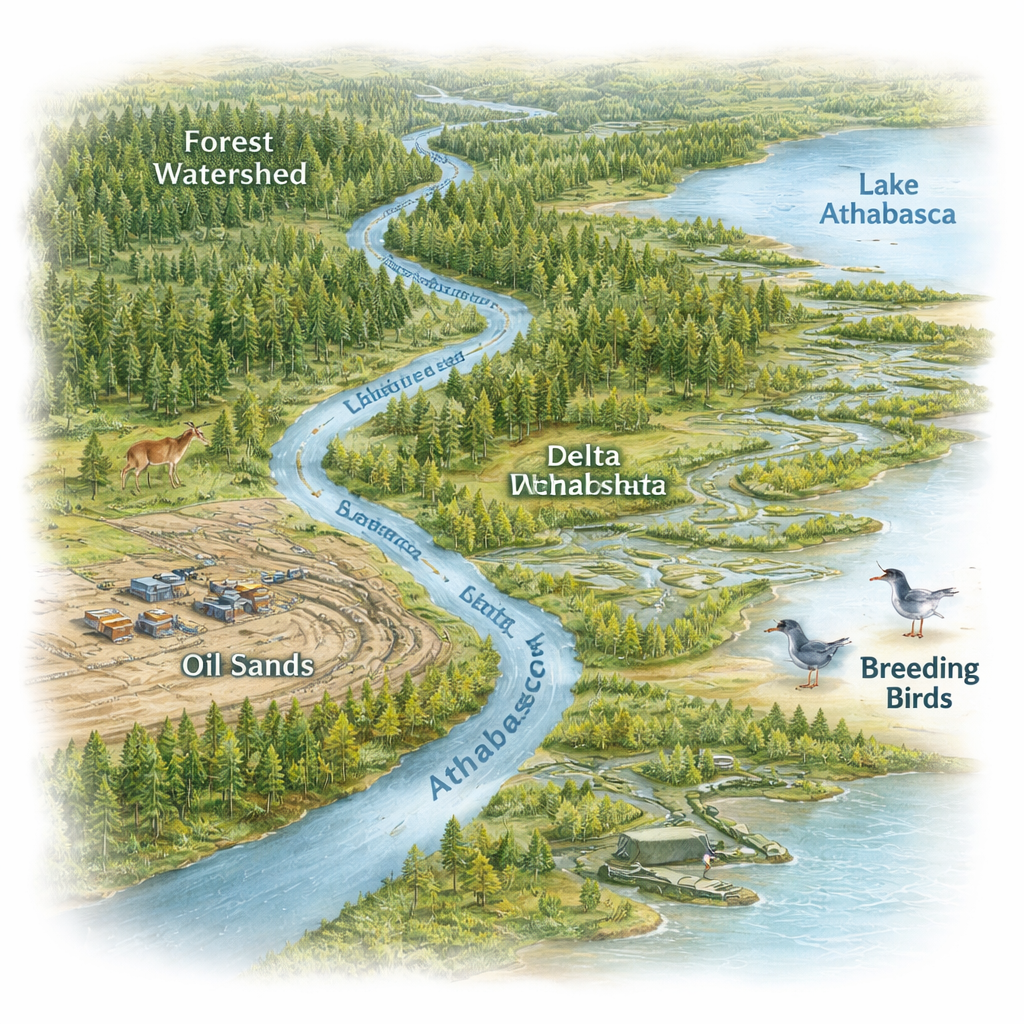
The Athabasca River flows through a vast sweep of northern forest and wetlands before emptying into Lake Athabasca and the Peace-Athabasca Delta, a globally important bird habitat. This study asks a simple but pressing question: how does mercury, a toxic metal that can harm wildlife and people, travel down this river system and end up in the eggs of fish‑eating birds? By following subtle chemical fingerprints of mercury, the researchers show that what happens upstream along the Athabasca strongly shapes contamination in birds nesting hundreds of kilometers downstream.
A Hidden Pollutant Riding the Current
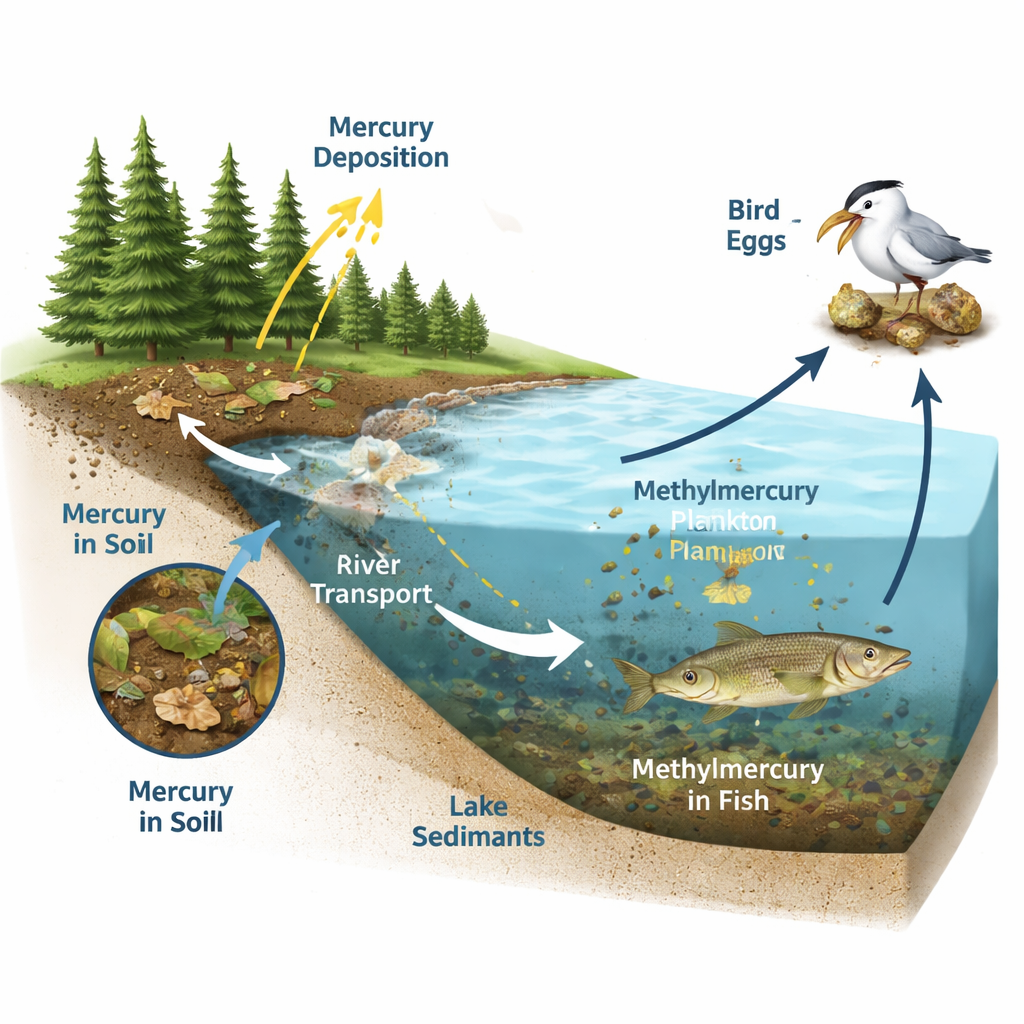
Mercury reaches northern landscapes mainly from the air, where it settles onto trees, soils, and wetlands. In waterlogged, low‑oxygen environments, certain microbes convert some of this mercury into methylmercury, a form that builds up in food webs and can damage the brain and nervous system. The Athabasca River drains a large boreal watershed that also contains Canada’s major oil sands developments, then feeds the Peace-Athabasca Delta and western Lake Athabasca—areas rich in fish and nesting waterbirds that Indigenous communities rely on. Earlier work had hinted that bird eggs in these downstream areas carried more mercury than those from neighboring regions, especially after years of high river flow, but the exact pathways were unclear.
Reading Mercury’s Fingerprints in Wildlife
To untangle the story, the team turned to mercury stable isotopes—slightly different forms of the same element that act like barcodes for where the mercury came from and what it experienced. They measured these isotopes in fish from the Athabasca River and Lake Athabasca, in river otter muscle, and in eggs from terns and gulls that eat fish. Because methylmercury keeps its isotopic signature as it moves up the food chain, values in fish and eggs preserve the signal of the water where the mercury first entered the food web. The scientists also analyzed mercury in sediments, air, natural bitumen seeps, and industrial oil‑sands samples, and combined all of these data with long‑term records of river flow and mercury levels in water.
The River as the Main Conveyor Belt
The isotopic “mixing models” showed that most of the mercury accumulating in downstream wildlife came from the Athabasca River itself. For river otters in the delta and terns nesting there, 78–94% of their mercury traced back to the river. In western Lake Athabasca, river‑derived mercury accounted for roughly two‑thirds to more than four‑fifths of the mercury in fish and tern eggs. Years with higher river flow delivered larger loads of methylmercury, and in those years the total mercury in tern eggs in western Lake Athabasca roughly doubled compared with low‑flow years. Measurements of lake sediments and plankton along a 60‑kilometer transect from the river mouth showed clear gradients: closer to the inflow, sediments contained more total and methylmercury and plankton carried higher levels, reinforcing the picture of a powerful river plume feeding mercury into the lake’s food web.
Land, Not Just Industry, Feeds the Mercury Supply
The isotope patterns also revealed where the mercury likely originated before entering the river. River fish showed signatures matching soils, leaf litter, and sediments—materials produced by the surrounding forests and wetlands and eroded into streams—rather than rainwater alone. Natural bitumen seeps and samples from oil sands operations had isotope values that overlapped strongly with these terrestrial sources, making it impossible to cleanly separate industrial contributions using isotopes alone. Other monitoring work cited in the paper has not detected strong increases in water or fish mercury directly tied to the oil sands, and estimated mercury loads from small, mine‑affected tributaries are much smaller than those carried by the Athabasca itself. Overall, the results point to mercury that has been taken up by vegetation, transformed in soils and wetlands, and then flushed into the river during high‑flow periods as the dominant source to downstream ecosystems.
What This Means for Birds, Lakes, and People
By following mercury’s chemical trail from air to land to waterbirds, the study shows that the Athabasca River acts as a giant conveyor belt of methylmercury into the Peace-Athabasca Delta and western Lake Athabasca. When river flows are high and more methylmercury is carried downstream, fish‑eating birds such as Caspian Terns can lay eggs with mercury levels at or above thresholds linked to reproductive harm. Because fish and wildlife in these waters are important traditional foods, the findings matter not only for conservation but also for Indigenous health and food security. The core message is straightforward: anything that increases mercury loads in the Athabasca River—whether climate‑driven changes in hydrology, land disturbance, or shifts in wetland processes—is likely to raise mercury levels in fish and birds far downstream, underscoring the need to manage the entire watershed, not just the lake shores.
Citation: Chételat, J., Hebert, C., Demers, J. et al. The Athabasca River regulates methylmercury burdens of waterbirds breeding downstream. Sci Rep 16, 5630 (2026). https://doi.org/10.1038/s41598-026-35970-z
Keywords: mercury pollution, Athabasca River, methylmercury, waterbirds, boreal lakes