Clear Sky Science · en
Negr1 deficiency alters glutamate signalling and kynurenine pathway in a mouse model of psychiatric disorders
Why this brain study matters
Many common mental illnesses, from depression to schizophrenia, are linked to subtle changes in how brain cells talk to each other. This study looks at one risk gene, called NEGR1, in mice to see how its loss changes brain chemistry and behavior. By following how these mice move after a drug that briefly disrupts a key brain receptor, and by measuring related brain chemicals, the researchers uncover how genetics, sex, and brain metabolism may combine to shape vulnerability to psychiatric disorders.
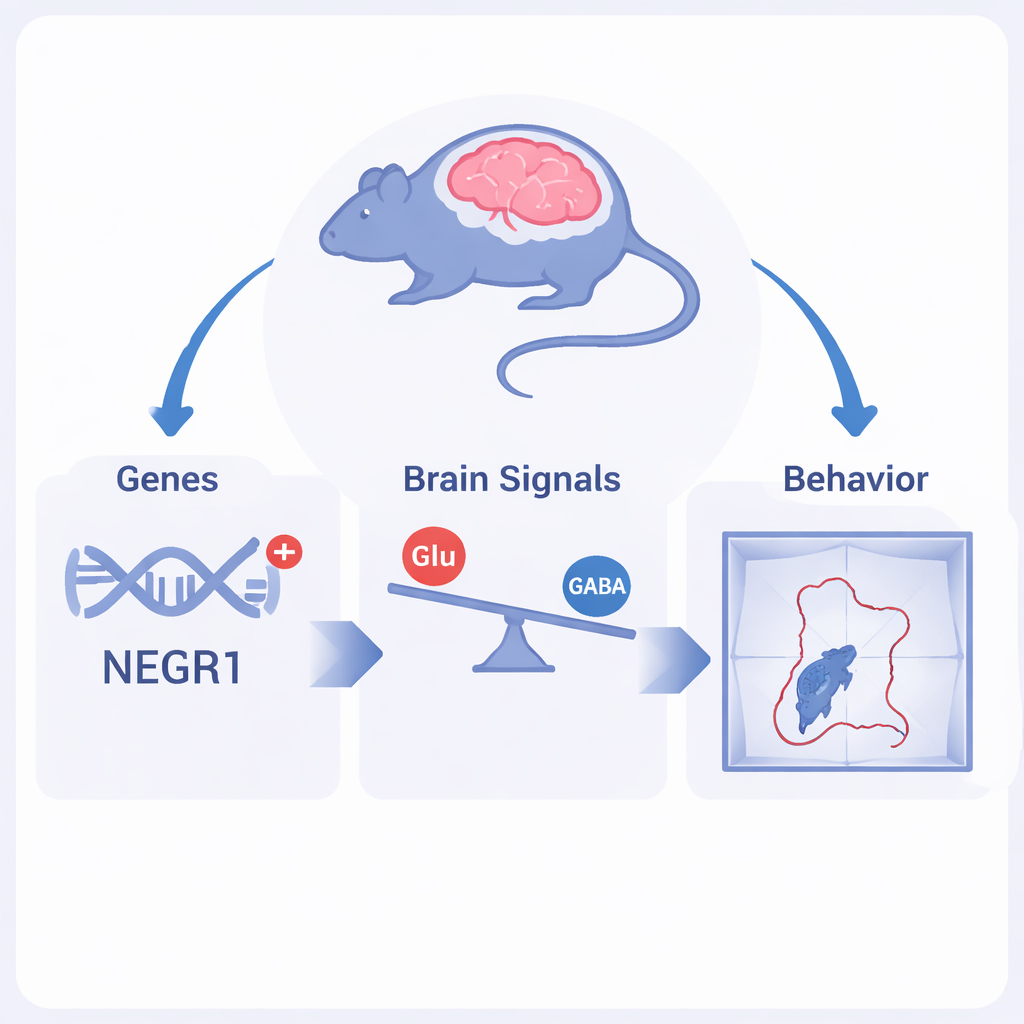
A gene that keeps brain signals in balance
The NEGR1 gene makes a cell-surface protein that helps nerve cells form and stabilize connections. Earlier work showed that removing this gene in mice alters brain structure, reduces certain calming (GABA) connections, and changes responses to dopamine-linked drugs like amphetamine. Because these changes point to a shift toward stronger excitatory signals, the team focused on another major excitatory system: glutamate and its NMDA receptors, which are central for learning, memory, and flexible behavior. They also examined the “kynurenine pathway,” a metabolic route that breaks down the amino acid tryptophan into compounds that can either boost or block NMDA receptors.
Testing behavior with a mind-altering drug
To probe NMDA receptor function, the researchers used MK-801, a well-known drug that briefly blocks these receptors and can mimic aspects of glutamate imbalance seen in psychiatric conditions. Male and female mice either carried the normal Negr1 gene or lacked it entirely. The animals received daily injections of MK-801 and were tested in an open field arena, where their total movement, time in the corners, and spinning-like rotations were automatically tracked. In drug‑naive males, a single dose of MK-801 produced a stronger burst of activity in Negr1-deficient mice than in normal mice, suggesting that their brains were unusually sensitive to this disruption of glutamate signaling.
A surprising pattern of fast tolerance
When MK-801 was given repeatedly, the pattern changed. In males, activity surged on some days but dropped on every second day, forming a zig‑zag pattern that suggested rapid, partial tolerance to the drug’s effects. Over nine days, normal males showed a rising response consistent with sensitisation, whereas Negr1-deficient males showed a blunted build‑up of activity and milder changes from day to day, pointing to altered NMDA receptor sensitivity. Females of both genotypes adapted even more quickly: by about day five, MK-801 no longer produced strong behavioral effects, so treatment was stopped. Across measures, sex had a major influence, and clear genotype effects appeared mainly in males.
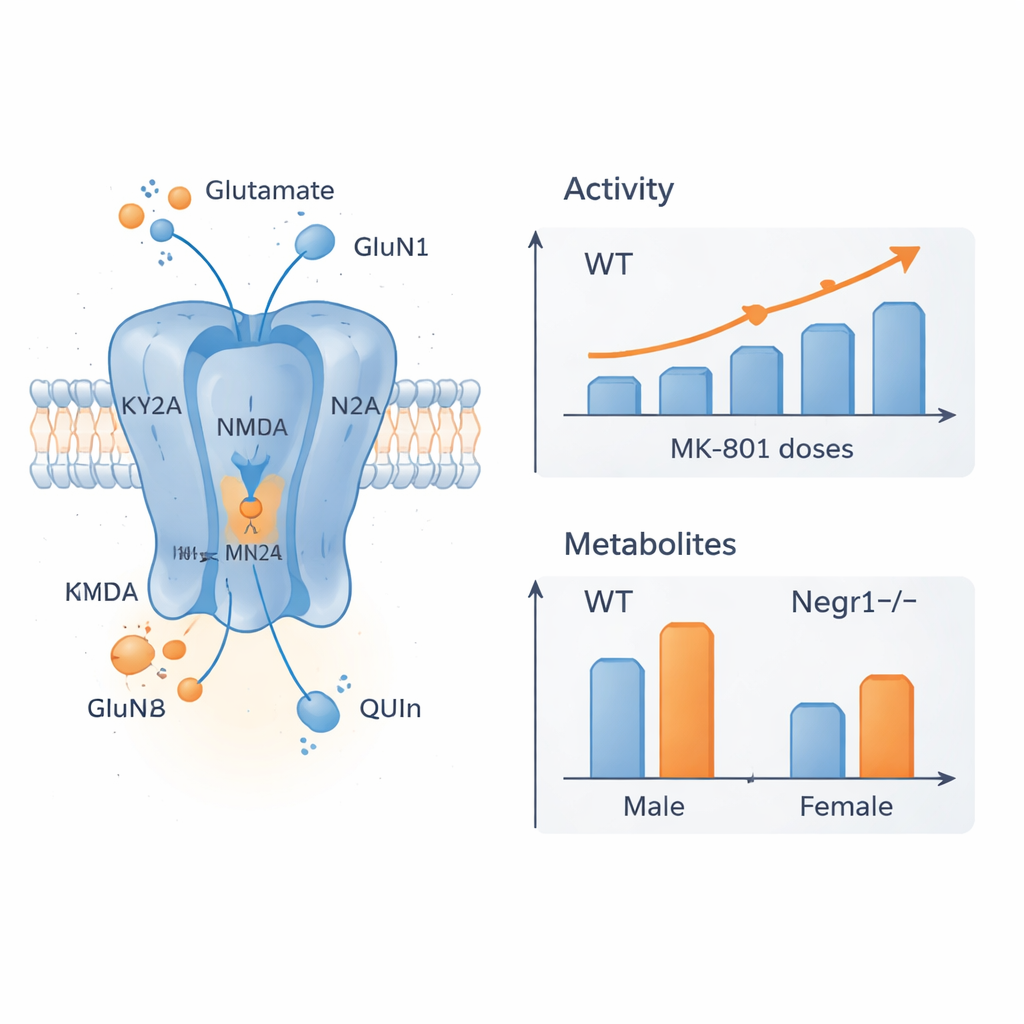
Shifts in receptors and brain chemicals
To uncover what lay behind these behavioral differences, the team measured gene activity for key NMDA receptor subunits and for an enzyme that produces D‑serine, a co‑signal for these receptors. They focused on brain regions crucial for mood and cognition: the frontal cortex and hippocampus. In the frontal cortex, female Negr1-deficient mice treated with MK-801 showed reduced expression of core receptor subunits, hinting that their brains adjust receptor makeup in response to both the mutation and the drug. In the hippocampus of males, Negr1-deficient mice showed higher baseline expression of certain NMDA subunits, in line with earlier evidence for more available receptors; MK-801 treatment then pulled these levels back toward normal. In parallel, detailed chemical analyses of blood and multiple brain regions revealed that several kynurenine pathway metabolites and glutamate itself were altered in a sex‑ and region‑specific way, with the frontal cortex most affected and some changes becoming more marked with age.
What this means for understanding mental illness
Together, these findings portray NEGR1 as a molecular organizer that helps keep excitatory and inhibitory brain signals in balance, partly by shaping NMDA receptor function and tryptophan metabolism. When Negr1 is missing, mice respond differently to NMDA receptor blockade, show sex‑dependent shifts in brain chemicals, and gradually develop tolerance in unusual ways. For a lay reader, the key message is that a single risk gene does not act in isolation: its effects depend on sex, brain region, and metabolic state. This work strengthens the idea that targeting pathways linked to NEGR1—rather than only single receptors—may eventually help tailor treatments for mental illnesses marked by glutamate imbalances.
Citation: Kuuskmäe, C., Mikheim, K., Mohammadrahimi, N. et al. Negr1 deficiency alters glutamate signalling and kynurenine pathway in a mouse model of psychiatric disorders. Sci Rep 16, 5317 (2026). https://doi.org/10.1038/s41598-026-35968-7
Keywords: NEGR1 gene, NMDA receptor, glutamate signaling, kynurenine pathway, psychiatric disorders