Clear Sky Science · en
Identifying and predicting gait stability metrics in people with stroke in uneven-surface walking using machine learning
Why Staying Steady Outdoors Matters After Stroke
For many people recovering from a stroke, the real test of walking is not in the clinic but outside—on cracked sidewalks, grassy paths, and uneven curbs. These everyday surfaces quietly raise the risk of tripping and falling. This study explores how tiny motion sensors and modern computer algorithms can reveal who is most likely to struggle on such uneven ground and how well simple, indoor walking tests can predict outdoor stability.
Uneven Ground as a Hidden Challenge
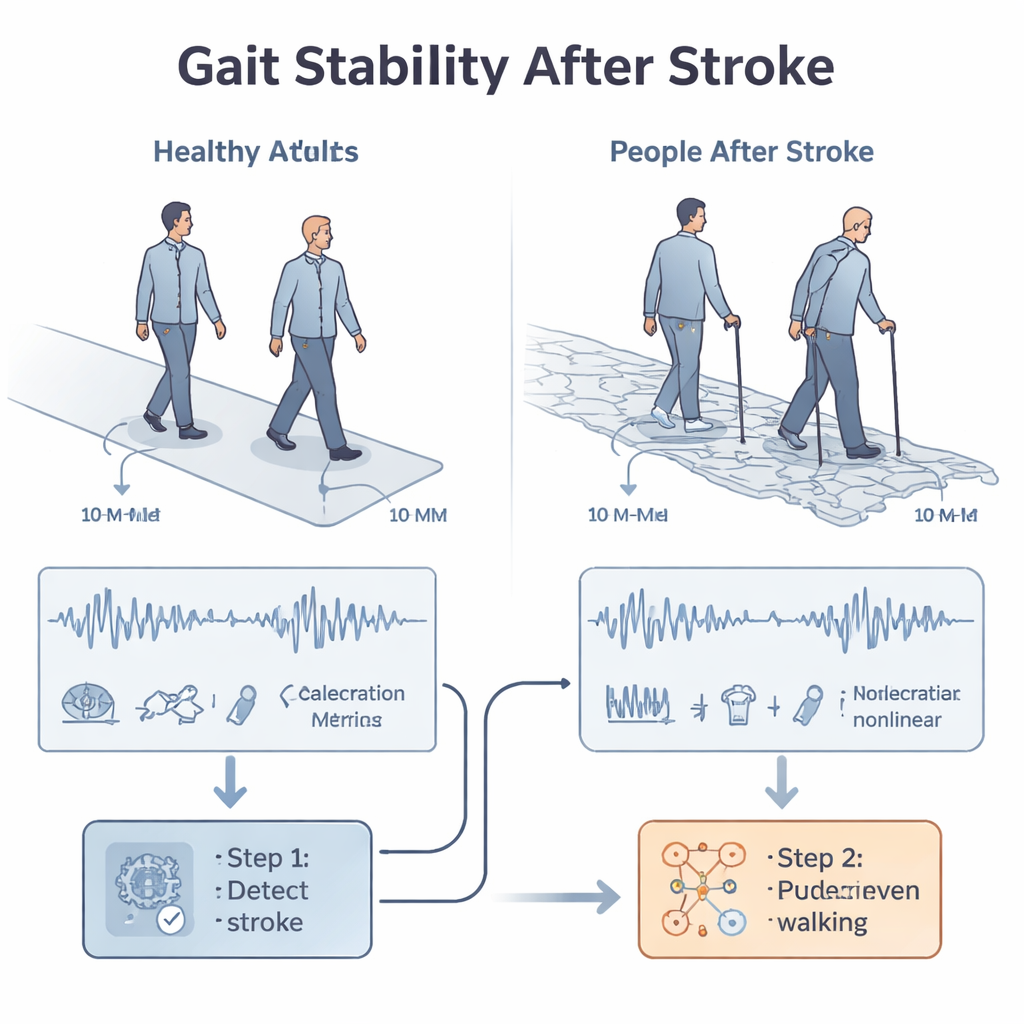
Outdoor mobility is central to independence and social life after stroke, yet many survivors report that walking outdoors is difficult and frightening. Uneven surfaces introduce small, unpredictable bumps that constantly test the body’s balance system. People with stroke often have weaker muscles and slower reactions, which can make these subtle disturbances harder to handle. Despite this, most routine assessments still focus on smooth, indoor floors, leaving a gap between what is measured in the clinic and what people face in daily life.
Wearing Sensors to Capture Real-World Walking
The researchers studied 71 people with stroke and 39 healthy adults of similar age. Each person walked back and forth along both a smooth 10-meter walkway and an uneven 10-meter path while wearing a small motion sensor on the lower back. This sensor measured how the trunk moved up and down, side to side, and forward and backward. From these signals, the team calculated several measures that describe how steady or irregular the walking pattern was—some simply describe how large the movements are, while others capture how smooth and rhythmic the steps are over time.
Letting the Computer Find the Most Telling Signals
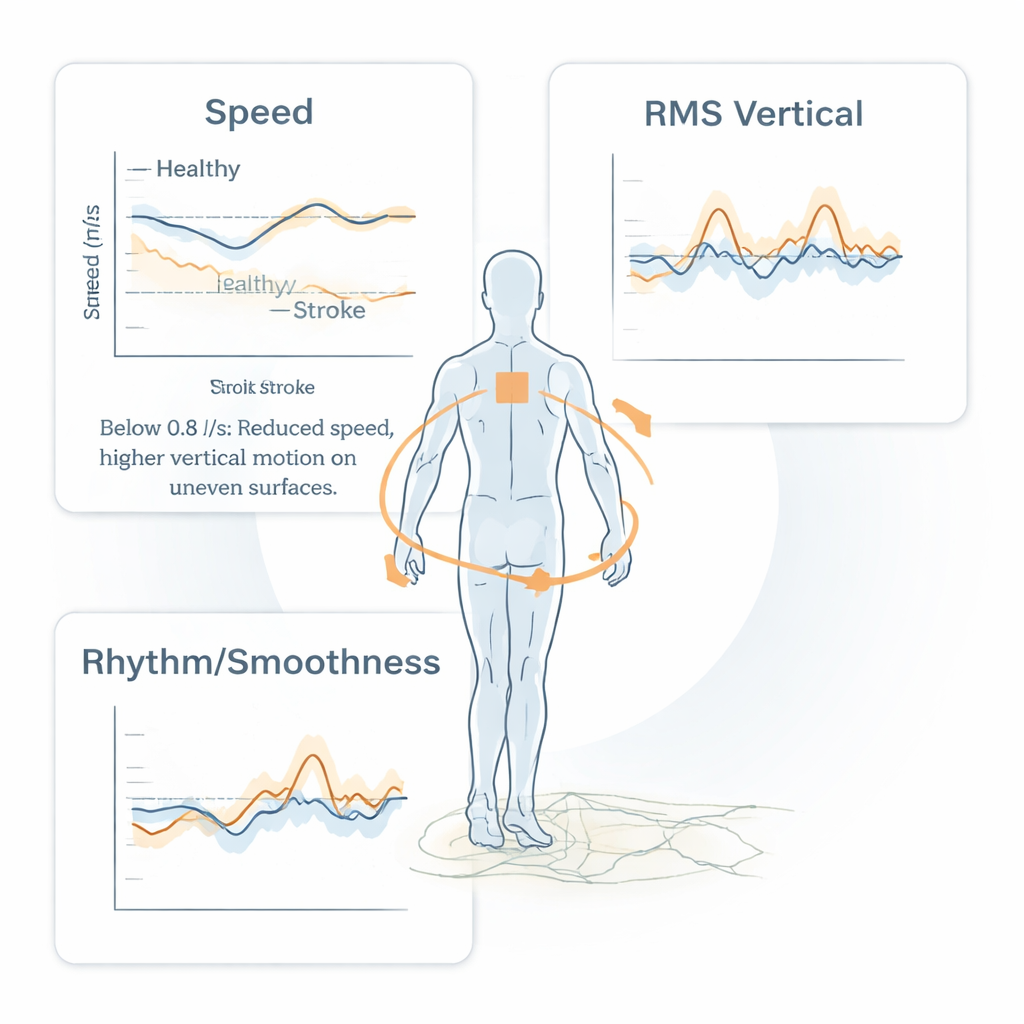
Instead of looking at each measure one by one, the team used machine learning, a type of computer analysis that can sift through many variables at once and find the most informative ones. They first trained computer models to tell apart people with stroke from healthy adults based only on the sensor data from uneven walking. These models reached more than 95% accuracy. Three signals stood out as especially powerful: how strong the up-and-down trunk movement was (called vertical RMS), how irregular the front–back motion was over time (sample entropy), and how smooth and rhythmic the steps were in the front–back direction (harmonic ratio). Together, they painted a clear picture of reduced stability after stroke.
Predicting Outdoor Stability from Indoor Tests
In the next step, the researchers asked whether they could estimate these key uneven-surface measures—and walking speed itself—using only data from easy-to-perform, even-surface walking. They combined simple measures like indoor walking speed with information on joint angles, muscle activity, and sensor readings, then trained computer models to predict what would happen on the uneven path. Indoor walking speed turned out to be especially important. People with stroke who walked slower than about 0.8 meters per second on a smooth surface tended to slow down even more and show larger up-and-down trunk movements on uneven ground, suggesting difficulty adapting to the challenge. The regularity and smoothness of trunk motion on uneven surfaces were also partly predicted by how the ankle moved at foot contact and by how smooth the person’s gait already was on level ground.
What This Means for Rehabilitation and Daily Life
To a layperson, the message is straightforward: a small wearable sensor on the lower back, combined with indoor walking tests and smart computer analysis, can reveal who is most likely to lose stability on bumpy sidewalks after stroke. People who already walk quite slowly on flat ground—especially below about 0.8 meters per second—are more likely to move less confidently and more shakily on uneven surfaces. By tracking simple sensor-based markers of how much the trunk bounces and how smooth the steps are, therapists may be able to design more personalized training programs, focus on trunk and ankle control, and monitor progress over time. In the long run, such “digital biomarkers” could help make outdoor walking safer and more achievable for many stroke survivors.
Citation: Inui, Y., Takamura, Y., Nishi, Y. et al. Identifying and predicting gait stability metrics in people with stroke in uneven-surface walking using machine learning. Sci Rep 16, 5618 (2026). https://doi.org/10.1038/s41598-026-35966-9
Keywords: stroke rehabilitation, gait stability, uneven walking, wearable sensors, machine learning