Clear Sky Science · en
Association between reduced chewing-induced brain blood flow and cognitive performance in mandibular prognathism patients in a pilot study
Why chewing and thinking are surprisingly connected
Most of us take chewing for granted, but scientists have learned that the simple act of breaking down food sends a powerful wake-up call to the brain. People with certain jaw deformities, such as mandibular prognathism (when the lower jaw sticks out), live for years with inefficient chewing. This study asks a deceptively simple question with far-reaching implications: does growing up with a poor bite quietly change how the brain works and how well we think?
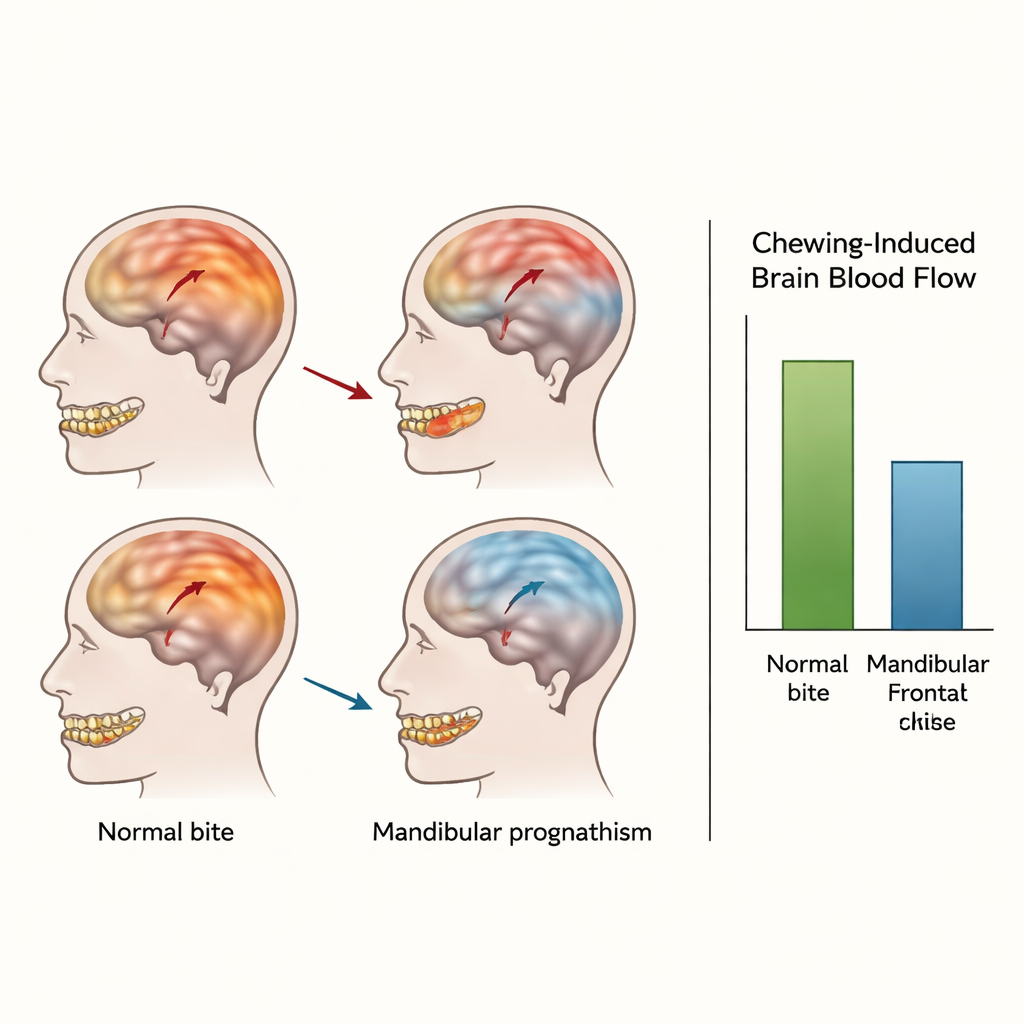
A common jaw problem with hidden consequences
Dentofacial deformities affect up to one in twenty people and can greatly reduce chewing efficiency, making it harder to crush and mix food properly. Earlier research showed that poor chewing in older adults is linked to memory problems and a higher risk of dementia. Chewing normally boosts blood flow in brain regions involved in planning, attention, and memory. In people with mandibular prognathism, the teeth do not meet properly, the chewing muscles work less effectively, and previous work by this team suggested that the usual brain “chewing boost” is blunted. Yet no one had thoroughly tested whether these patients actually show measurable changes in thinking skills.
Measuring brain blood flow while people chew
The researchers recruited patients with mandibular prognathism and compared them with people who had a normal bite. They used a noninvasive technique called near-infrared spectroscopy to monitor blood flow changes in the front part of the brain while volunteers chewed a soft material. As a benchmark, the same people also did a mental arithmetic task, which is known to strongly activate the frontal lobes. In both the right and left inferior frontal gyrus—an area important for decision making and self-control—chewing caused a much smaller increase in blood flow in the jaw-deformity group than in those with normal teeth alignment. This confirmed that the brains of these patients respond less vigorously to chewing, even though they are generally young and otherwise healthy.
Testing thinking skills with eye movements
To find out whether this reduced brain response translated into real-world cognitive problems, the team used a tablet-based eye-tracking test called Mirudake. By precisely following where and how quickly the eyes move during short tasks, the system can estimate performance in six areas: memory, executive function (planning and flexibility), attention, visuospatial skills, language, and orientation in time and place. Scores from 44 mandibular prognathism patients were compared with data from 59 healthy adults. Overall, global cognitive scores were very similar between groups, and detailed comparisons showed no meaningful deficits in any domain for the jaw-deformity group. In fact, their orientation scores were slightly higher than those of controls.
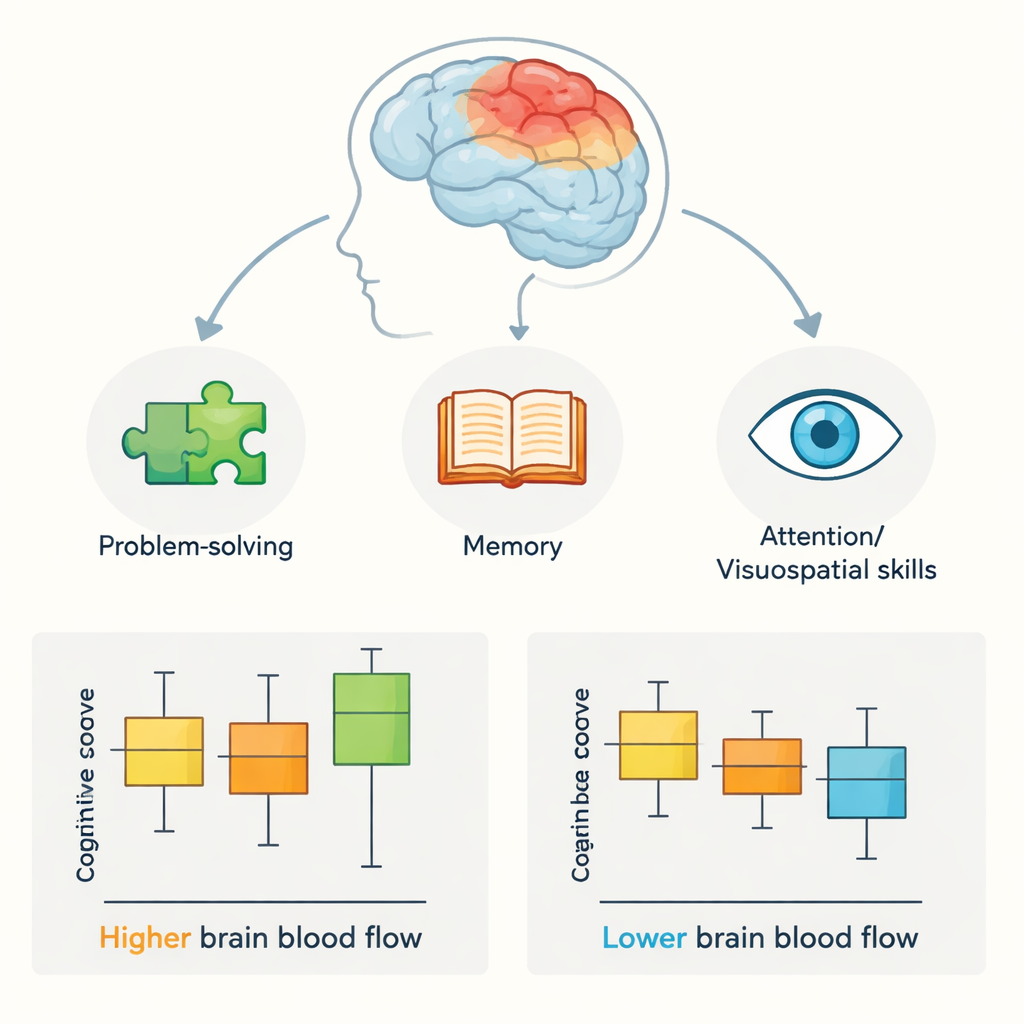
Subtle links between chewing, blood flow, and thinking
Even though the mandibular prognathism patients did not show obvious cognitive impairment, the strength of their chewing-related brain blood-flow response still mattered. When the researchers pooled data and looked at correlations, people with larger increases in frontal blood flow during chewing tended to perform better on global cognitive scores and especially on memory tests. Some specific skills, such as visuospatial abilities and executive function, also tracked with blood-flow levels in one side of the frontal region. A separate analysis suggested that blood-flow measurements had modest power to distinguish people with lower cognitive scores from those in the normal range, hinting that this physiological signal might one day serve as a helpful add-on in cognitive screening—though it is not accurate enough to stand alone.
What this means for patients and future care
For people with mandibular prognathism, this pilot study offers a cautiously reassuring message: despite clearly weaker brain activation during chewing, they do not appear to suffer broad thinking problems as a group. At the same time, the observed link between chewing-induced brain blood flow and cognitive performance suggests that how well our jaws work could influence brain health over the long term. The authors argue that restoring efficient chewing through orthodontic or surgical treatment might ultimately support brain function, particularly if done during key developmental years. Larger, long-term studies that follow patients before and after jaw-correcting surgery will be needed to learn whether fixing the bite can also help protect the mind.
Citation: Inagawa, Y., Kanzaki, H., Kariya, C. et al. Association between reduced chewing-induced brain blood flow and cognitive performance in mandibular prognathism patients in a pilot study. Sci Rep 16, 5310 (2026). https://doi.org/10.1038/s41598-026-35964-x
Keywords: chewing and brain, mandibular prognathism, cognitive function, jaw surgery, brain blood flow