Clear Sky Science · en
Effect of neck-specific exercises on trapezius muscle function in chronic whiplash-associated disorders: a longitudinal case–control study using ultrasound and speckle-tracking analyses
Why lingering neck pain after a car crash matters
Many people walk away from a car crash thinking they were lucky to avoid serious injury, yet up to half of those with whiplash go on to struggle for years with neck pain, headaches, and fatigue. This study explores whether a targeted neck exercise program can not only ease symptoms but also change how a key shoulder–neck muscle, the trapezius, actually works during everyday arm movements.
A closer look at neck and shoulder teamwork
The neck is supported by a layered system of muscles. Deep muscles close to the spine help keep the head steady and guide precise movements, while larger surface muscles, like the trapezius, help lift the shoulders and arms. After a whiplash injury, this teamwork can break down: the deep stabilizing muscles tend to switch on too late or too little, and the surface muscles are forced to work harder. That overuse may explain why people with chronic whiplash-associated disorders (WAD) often report pain and stiffness in the upper trapezius, especially during repeated arm lifting, a movement used in many daily tasks.
How the study was set up
To investigate these problems, the researchers recruited 34 adults with long-lasting WAD and 34 healthy people of similar age and sex. Using non-invasive ultrasound, they measured how the upper trapezius on the right side changed length while participants repeatedly raised a light weight to shoulder height in time with a metronome. A special technique called speckle-tracking allowed them to follow tiny patterns within the muscle on the ultrasound image and calculate how much the muscle shortened and lengthened—its "deformation"—during movement. Participants with WAD also reported their pain, neck-related disability, and neck muscle fatigue before and after the test. 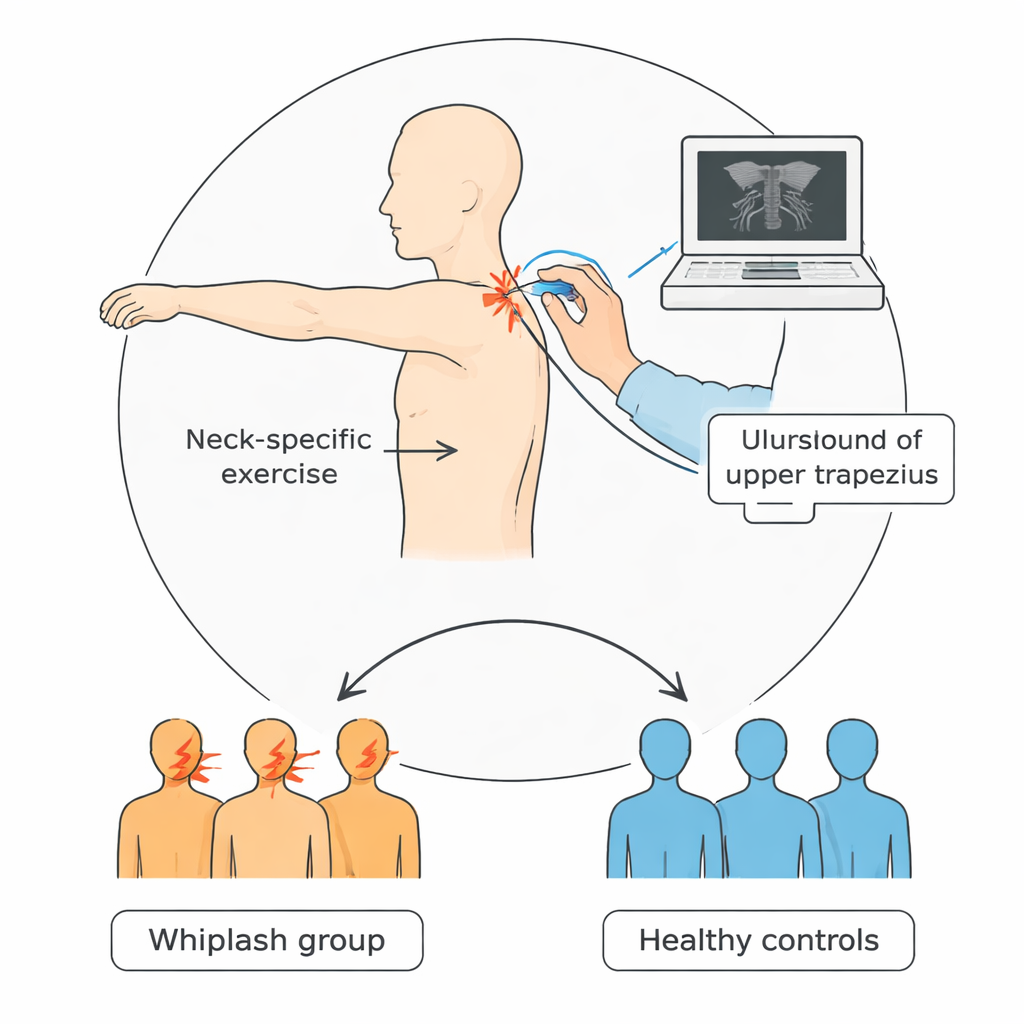
The neck exercise program
People in the whiplash group then completed a three‑month neck-specific exercise program guided by physiotherapists, either mostly at home with internet support or through regular clinic visits. The program started with gentle exercises to wake up and precisely control the deep neck muscles, based on prior research on retraining these stabilizers. As participants improved, they progressed to endurance training within their pain limits. The idea was that stronger, better-timed deep muscles would share the workload more effectively, so the overworked trapezius would not need to strain as much when lifting the arm.
What the researchers found
At the start, the trapezius muscle in people with WAD changed length more during arm lifting than in healthy controls, especially by shortening more. This suggests that their surface muscle was working harder and less efficiently for the same task. After three months of neck-specific exercises, the overall difference between the whiplash group and the healthy group was no longer statistically significant: on average, trapezius behavior in the whiplash group moved closer to normal. However, when the researchers looked only within the whiplash group over time, the changes in muscle deformation did not reach the strict threshold used to call them clearly different. In contrast, patients’ neck disability scores, pain ratings, and feelings of neck muscle fatigue all improved meaningfully, with medium to large effect sizes. 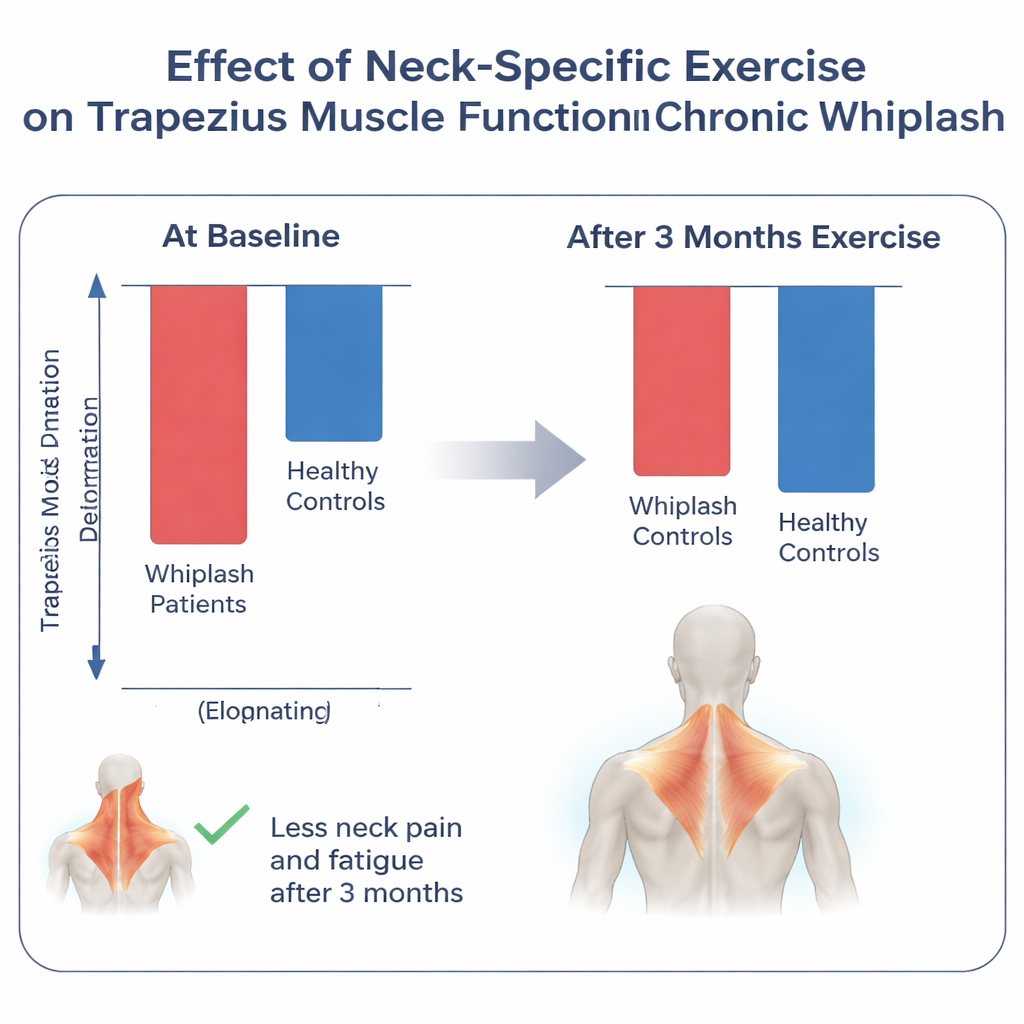
What it means for people living with whiplash
For someone living with chronic whiplash, these findings offer cautious but encouraging news. A focused neck exercise program that targets the deep stabilizing muscles appears to lessen pain, reduce fatigue, and may help the overworked trapezius move more like it does in people without whiplash, even though the measured muscle changes were modest. The results suggest that helping the deep neck muscles do their job better can ease the load on sore surface muscles, but additional strategies—such as specific strengthening, relaxation techniques, or hands‑on therapy—may still be needed to fully restore trapezius function.
Citation: Peterson, G., Andersson, E., Jönsson, M. et al. Effect of neck-specific exercises on trapezius muscle function in chronic whiplash-associated disorders: a longitudinal case–control study using ultrasound and speckle-tracking analyses. Sci Rep 16, 7725 (2026). https://doi.org/10.1038/s41598-026-35963-y
Keywords: whiplash, neck pain, trapezius muscle, rehabilitation exercises, ultrasound imaging