Clear Sky Science · en
Cluster analysis reveals increasing plume-like magmatism during progressive rifting in Afar (Ethiopia)
A hidden engine beneath a ripping continent
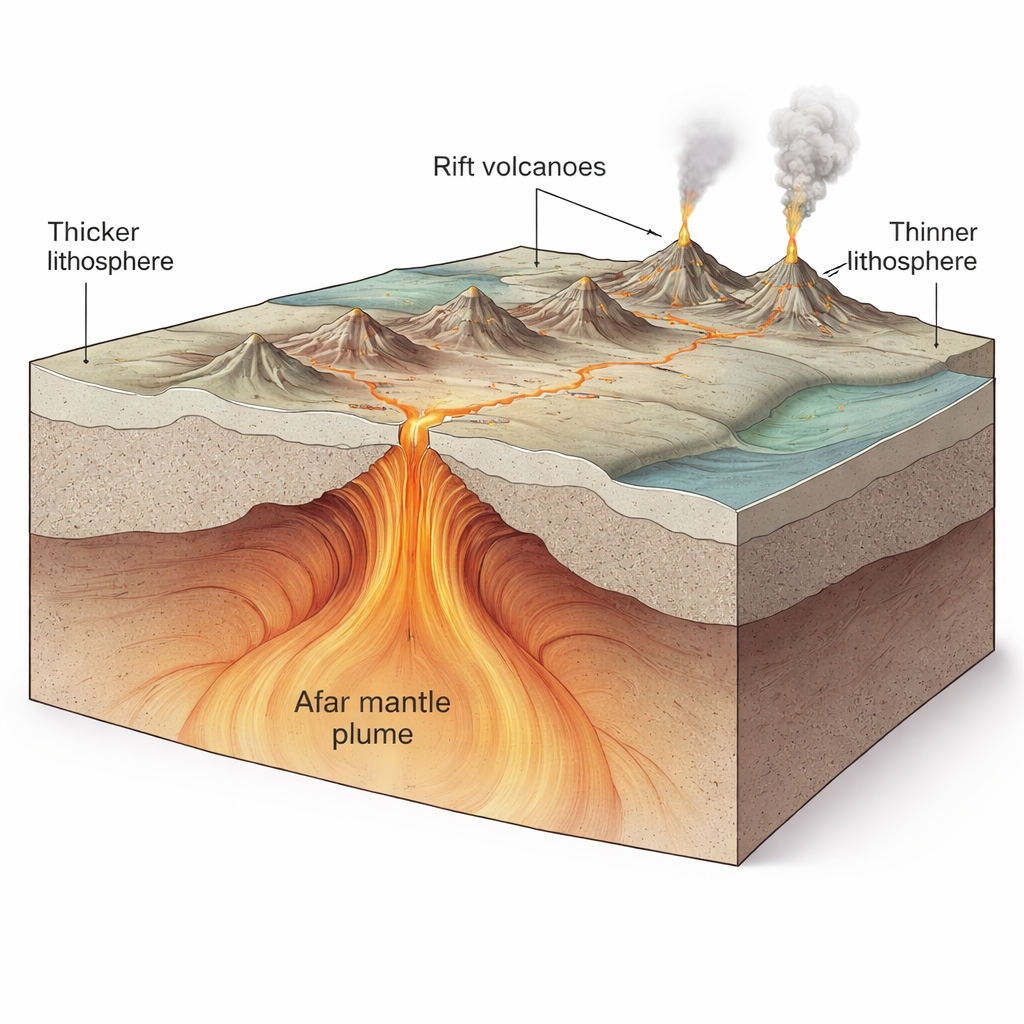
In northeastern Africa, the Earth’s crust is being pulled apart so vigorously that a new ocean is expected to form. The Afar Depression in Ethiopia and Djibouti is one of the few places on land where we can watch this process in action. This study asks a deceptively simple question with big implications: as a continent breaks up, how does the molten rock feeding its volcanoes change, and how much of that magma comes from a deep, hot mantle plume rather than from more ordinary parts of Earth’s interior?
Reading Earth’s past from frozen lava
When volcanoes erupt, their lavas cool into rocks that preserve a chemical memory of where and how they formed. In Afar, eruptions have been occurring for tens of millions of years, from early, widespread lava plateaus to the younger, narrow volcanic ridges seen today. The authors assembled a large database of more than a thousand rock samples from across the region. Each sample had detailed measurements of major elements, trace elements, and isotopes—different chemical fingerprints that together can reveal the depth of melting, the types of minerals left behind, and whether the source magma was tapped from deep mantle plumes, depleted mantle like that beneath mid-ocean ridges, or chunks of older continental roots.
Letting the data group itself
Traditionally, geologists have sorted such data by eye, plotting two or three variables at a time and assigning groups based on location or age. Here, the team instead used unsupervised machine learning—cluster analysis—to let the data sort itself. They applied two clustering methods, hierarchical and K-means, and compared their agreement with a statistical measure called the Dice Similarity Coefficient to decide how many distinct groups were truly present. Separate tests were run for major elements, for key trace element ratios sensitive to melting conditions, and for isotopic ratios that trace long-lived mantle reservoirs. This approach reduced human bias and made it possible to search for subtle but consistent patterns across the entire rift.
Different depths, different flavors of magma
The clustering confirmed that most Afar magmas evolve along a common path controlled by the gradual crystallization and removal of minerals such as olivine, pyroxene, and feldspar as the magma cools. But the trace element clusters revealed something more: Central and Southern Afar lavas fall into two main groups that reflect changes in the depth where melting occurs. Older lavas tapped deeper parts of the mantle, while younger “axial” magmas feeding the modern rift segments come from shallower levels. This fits with the idea that, as rifting progresses and the crust thins, the zone where rocks first begin to melt moves upward.
A surprising surge of deep-plume influence
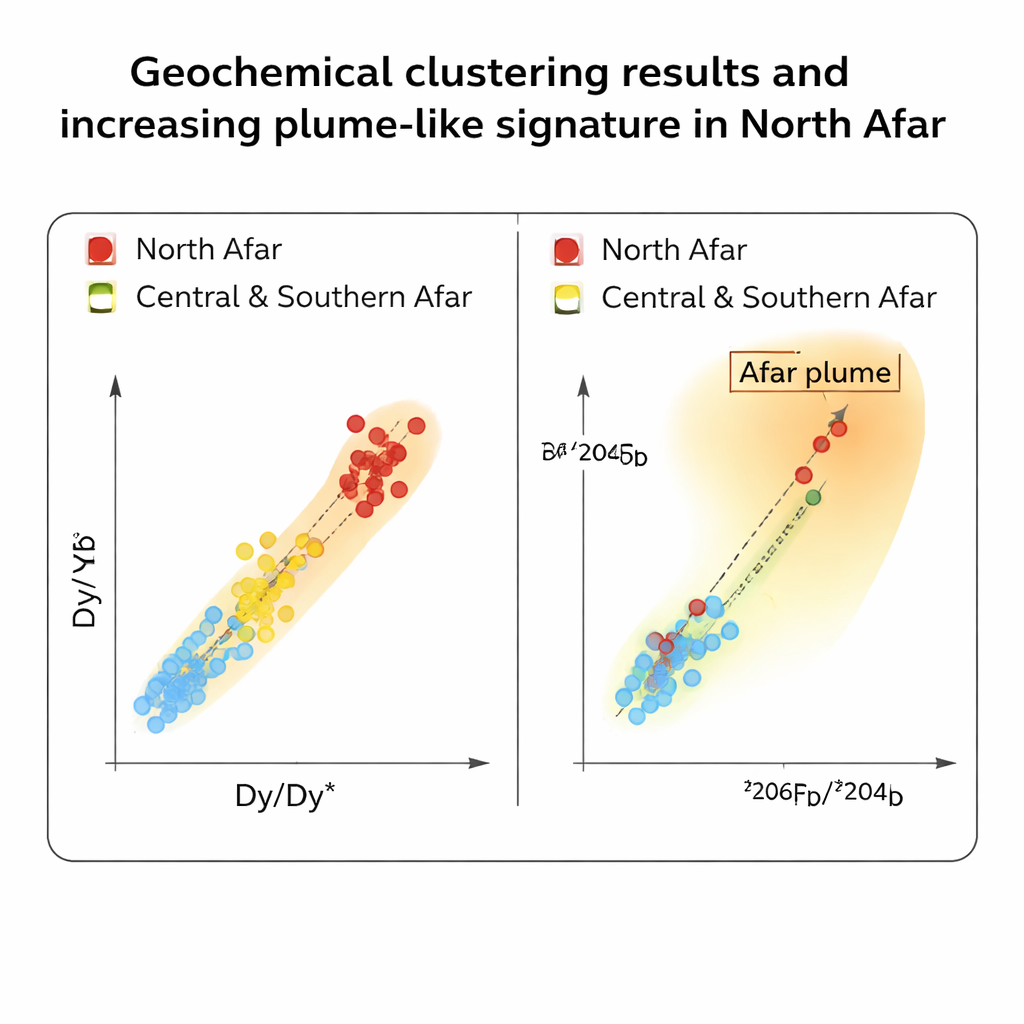
North Afar, however, told a different story. There, cluster analysis of both trace elements and isotopes grouped the lavas into a distinct set characterized by strong “plume-like” signatures: higher ratios of certain lead isotopes and trace element patterns resembling those of ocean-island basalts, which are typically linked to mantle plumes. The chemistry indicates more extensive melting of mantle that has been modified by water‑bearing minerals such as amphibole, likely introduced by the Afar mantle plume. Instead of trending steadily toward the more uniform, depleted compositions seen at mid-ocean ridges, the magmas in this most highly stretched part of the rift become more plume-dominated as breakup approaches.
What it means for the birth of a new ocean
For a non-specialist, the key takeaway is that continental breakup is not a smooth, one‑way transition from “plume-dominated” to “ordinary oceanic” magmatism. In Afar, the deep mantle plume appears to focus beneath the thinnest part of the continental lid, intensifying its chemical influence right at the final stages before a full ocean basin forms. In other words, as Africa’s crust there is pulled apart and weakened, it becomes an ever more efficient funnel for hot, plume-fed magma to reach the surface. This finding suggests that deep plumes may play an active, sustained role in tearing continents apart and shaping the chemistry of the newborn ocean floors they leave behind.
Citation: Tortelli, G., Crescenzi, P., Pagli, C. et al. Cluster analysis reveals increasing plume-like magmatism during progressive rifting in Afar (Ethiopia). Sci Rep 16, 6843 (2026). https://doi.org/10.1038/s41598-026-35961-0
Keywords: Afar rift, mantle plume, continental breakup, magma chemistry, machine learning geology