Clear Sky Science · en
Labour market patterns among women and men following the uptake of their first parental leave benefit in Sweden
Why this research matters for families and work
Becoming a parent often means pressing pause on work, but what happens afterward can shape careers and household finances for years. This Swedish study followed nearly 90,000 mothers and fathers for nine years after they first took paid parental leave, asking a simple but crucial question: do women and men find their way back into stable work in the same way, or do their paths diverge—and who is most at risk of being left behind?
Following parents over almost a decade
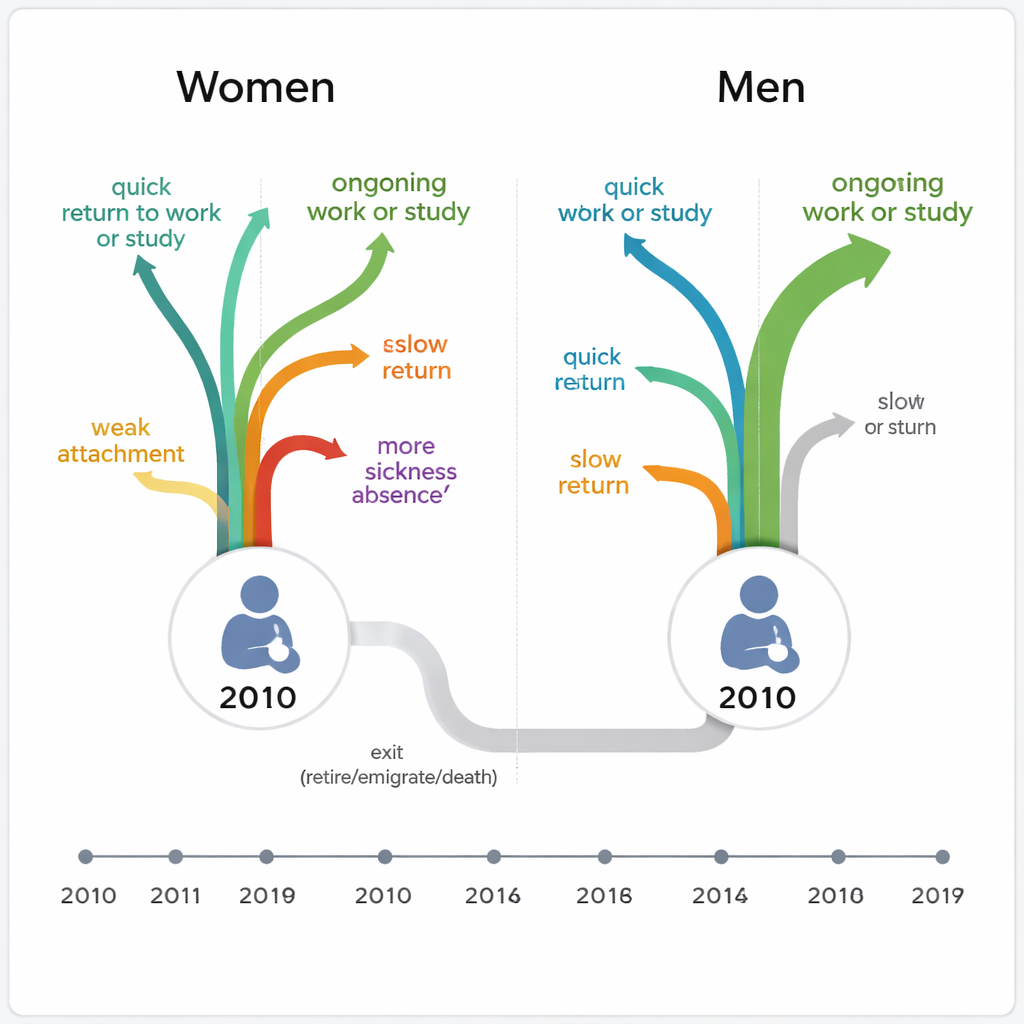
The researchers used detailed national registers to track every woman and man in Sweden who took a parental leave benefit for the first time in 2010. All were between 16 and 64 years old and had lived in Sweden for several years. For each of the next nine years, they classified each person’s main situation: working or studying, on parental leave, on long-term sickness absence or disability pension, out of the labour market for other reasons (such as unemployment or income support), or having left Sweden’s workforce entirely through retirement, emigration, or death. Instead of looking at just one outcome—like employment at one point in time—they used a method that follows the order and length of these different states to uncover typical life-course patterns.
Different paths back to work for mothers
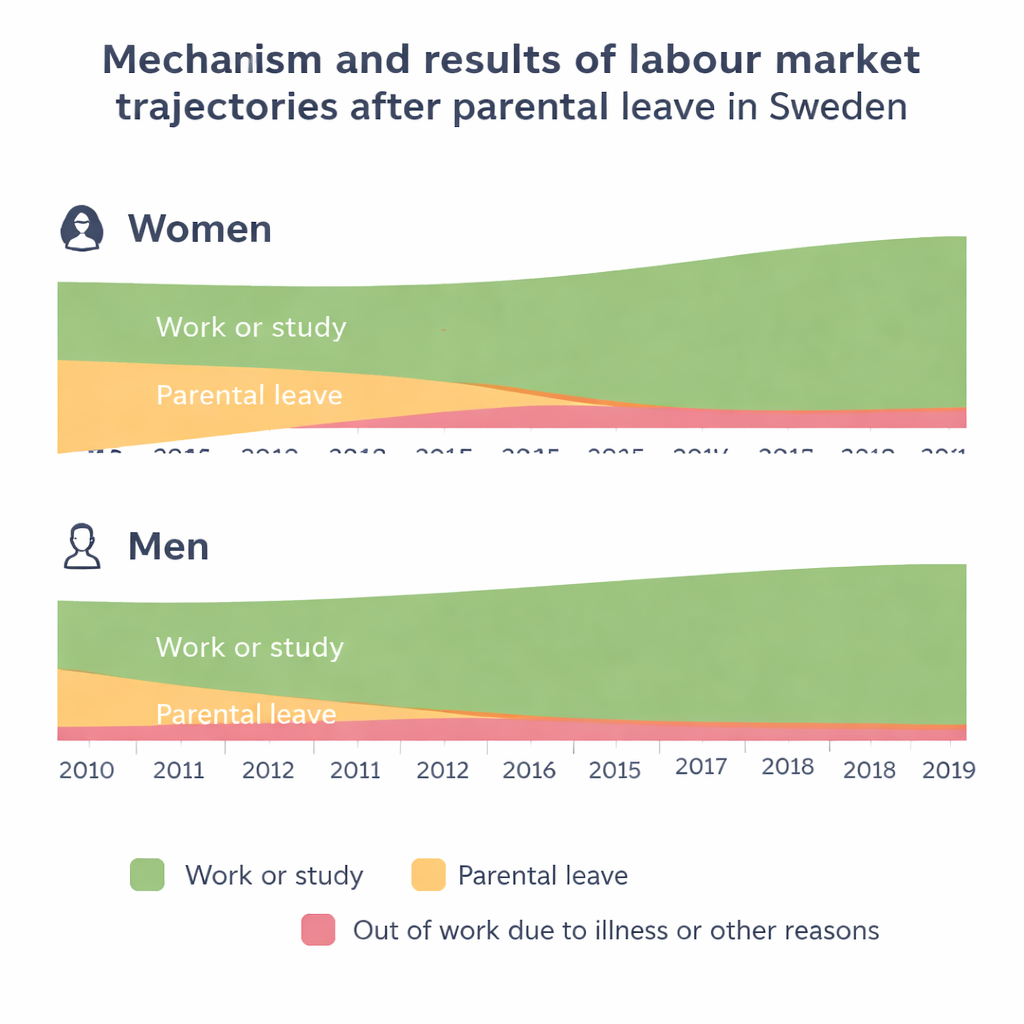
Among women, the analysis revealed six main patterns. Just under a quarter followed an “ongoing work or studies” path, with very quick return to work and few interruptions. About a third had a “quick return” but spent more of the early years on parental leave before stabilizing in employment or studies. Another fifth showed a “slow return,” staying on parental leave for several years but with roughly nine in ten eventually in work or study by the end of follow-up. Smaller groups had “weak labour market attachment,” with more time out of work, or “increasing sickness absence or disability pension,” signalling health problems that pushed them away from employment. A tiny group exited through retirement, emigration, or death. Overall, after nine years, about three quarters of mothers were economically active, but nearly a quarter were not, mostly due to illness or other disadvantages.
More continuous careers for fathers
For men, five patterns emerged, and one clearly dominated. Nearly three quarters followed an “ongoing work or studies” path, with steady employment and only brief or modest parental leave use. A smaller group (about 7%) formed a distinct “parental leave” pattern, with longer leave spells in the first few years followed by a strong return to work or study. Other men had “weak labour market attachment” or “increasing sickness absence or disability pension,” echoing the marginalized patterns seen among women, and a very small group exited the labour market entirely. By the end of nine years, only about one in ten fathers were no longer economically active, again mostly due to health or other serious constraints.
Who is most at risk of being left behind?
Looking at background characteristics, the study found that parents with strong, continuous ties to work tended to be older, better educated, Swedish-born, and had higher incomes and fewer signs of earlier health problems. In contrast, those in weak-attachment or health-related exit patterns were more likely to have lower education and income, an immigrant background, earlier unemployment, and a history of physical or mental illness. Among women, the group with weak labour market attachment also included many very young mothers and those living in smaller municipalities. For men, longer parental leave was most common among younger, highly educated fathers in big cities, suggesting that having strong labour market resources can make it easier to take more leave without long-term career loss.
What this means for parents and policy
The study shows that in Sweden—where paid leave is generous and jobs are protected—most mothers who spend longer at home with children still rejoin the labour market over time, and fathers mostly maintain steady work. Yet it also highlights clear inequalities: a minority of both women and men drift into illness, unemployment, or long-term detachment from work, especially those with fewer resources and prior health problems. For a layperson, the takeaway is that parental leave itself does not doom careers, but existing social and health disadvantages strongly shape who can turn leave into a temporary pause and who risks falling out of the labour market altogether. This points to the importance of not only generous family policies, but also support targeted at vulnerable parents before and after the birth of a child.
Citation: Virtanen, M., Gémes, K., Farrants, K. et al. Labour market patterns among women and men following the uptake of their first parental leave benefit in Sweden. Sci Rep 16, 2595 (2026). https://doi.org/10.1038/s41598-026-35960-1
Keywords: parental leave, gender and work, Sweden labour market, working parents, sickness absence