Clear Sky Science · en
Temperature-driven yield variation of super hybrid rice across ecological regions: mitigation by nitrogen management and genotype selection
Why Rice Harvests Depend on Heat and Fertilizer
Rice feeds more than half the world, so even modest changes in harvests can ripple through food prices and food security. This study looks at why the same “super” hybrid rice varieties give very different yields in two nearby regions of China, and how smarter fertilizer use and variety choice can protect rice harvests as temperatures rise.
Two Fields, Same Rice, Different Weather
The researchers compared three modern super hybrid rice varieties grown for two years at two sites in Hunan Province: Longhui, a cooler mountain area known for very high yields, and Changsha, a warmer lowland basin that often experiences heat stress. At both sites they used the same three varieties and four nitrogen fertilizer levels, ranging from no added nitrogen to heavy applications similar to or above typical farmer practice. This setup allowed them to tease apart how temperature, fertilizer, and genetics jointly shape the final grain harvest.
How Heat Shrinks the Harvest
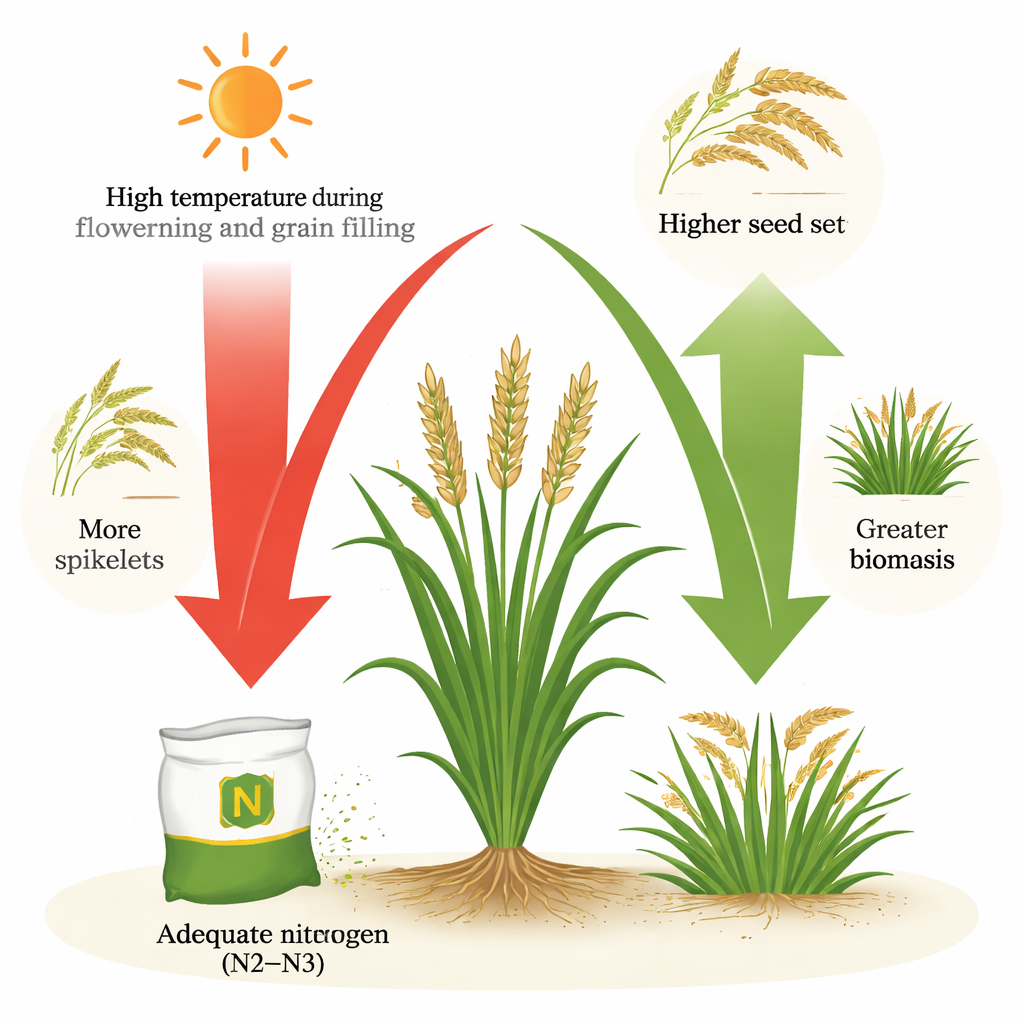
Despite identical management, Longhui consistently produced more rice: yields were about 17% higher in 2021 and 27% higher in 2022 than in Changsha. The main reason was heat during the rice reproductive period. In Changsha, temperatures during the formation of the flowering head (the panicle) and during grain filling more often climbed above 35 °C, a threshold known to damage rice flowers and shorten the time grains have to fill with starch. As a result, plants in Changsha produced fewer tiny flowers (spikelets) on each panicle, a lower share of those spikelets developed into filled grains, and the grains themselves tended to be slightly lighter. In contrast, Longhui’s cooler, more stable climate supported more spikelets, higher seed-setting rates, and heavier grains, leading to larger harvests.
Leafy Plants, Strong Growth, and the Role of Nitrogen
The study also showed that the cooler site allowed rice plants to build more green “factory” area and biomass. Longhui plants had a higher leaf area index—more leaf surface per unit ground area—and accumulated more dry matter from heading to maturity. Their crop growth rate in this late stage was often far ahead of Changsha’s, meaning more sugars and starches were available to fill developing grains. In Changsha, hotter conditions limited leaf expansion and overall growth, leaving plants more “sink-heavy”: they had many grains relative to their leaf area but not enough photosynthetic power to fill them fully. Nitrogen fertilizer helped on both sites. Moderate to high nitrogen levels boosted leaf area, plant biomass, and key yield components such as spikelet number and seed set. Importantly, adding nitrogen narrowed the yield gap between the two regions from more than 40% with no nitrogen to about 14–15% when fertilizer was applied, partly offsetting the damage caused by high temperatures.
Choosing Resilient Super Rice Varieties
Not all super hybrid rice varieties responded to temperature and nitrogen in the same way. One variety, Y-liangyou-900, delivered the highest yields overall, especially in the favorable cooler site, by producing abundant biomass and large grain heads. However, its performance dropped more sharply in the hotter environment. Another variety, Y-liangyou-1, did not always reach the very top yields, but it showed the most stable harvests across sites and fertilizer levels. Its growth rate and biomass changed less from one environment to another, making it more dependable under variable weather. By combining field measurements with statistical models, the authors found that traits such as total dry weight at maturity, leaf area at heading, and growth rate after heading strongly influenced yield differences between sites, because they supported more spikelets and a higher seed-setting rate.
What This Means for Future Rice Fields
For non-specialists, the core message is straightforward: when critical stages of rice development coincide with hot spells, harvests can drop sharply, even for advanced high-yielding varieties. However, farmers and breeders are not powerless. Applying nitrogen at well-chosen rates and selecting varieties with stable growth and good grain filling can offset a large fraction of heat-related losses without endlessly increasing fertilizer use. In regions with warming climates similar to Changsha’s, pairing climate-smart nitrogen management with resilient super hybrid rice varieties could help keep bowls full while limiting environmental impacts.
Citation: Li, J., Zhang, X., Guo, Z. et al. Temperature-driven yield variation of super hybrid rice across ecological regions: mitigation by nitrogen management and genotype selection. Sci Rep 16, 7671 (2026). https://doi.org/10.1038/s41598-026-35957-w
Keywords: rice yield, heat stress, nitrogen fertilizer, hybrid rice, climate-resilient crops