Clear Sky Science · en
Remote collaboration in virtual reality induces physiological synchrony comparable to face-to-face interaction
Why our hearts matter in online meetings
From remote work to online classes, much of our social life has moved onto screens. We know video calls can feel flat compared with being in the same room, but what is happening inside our bodies during these different kinds of meetings? This study asks whether people’s hearts "sync up" in virtual reality the way they do face-to-face—and what that might mean for how connected, energized, and creative we feel when we collaborate at a distance.

Three ways to meet: room, headset, or screen
The researchers brought together small groups of three students and asked them to solve creative tasks, such as coming up with as many unusual uses for a brick as possible. Each group worked in only one of three settings: sitting together around a real table (face-to-face), meeting by standard video conference on separate screens, or gathering in a shared virtual office while wearing virtual reality headsets and seeing one another as avatars. Apart from the medium, the tasks and timing were the same, and everyone wore heart-rate sensors throughout the session.
Hidden rhythms of connection
Instead of just counting heartbeats, the team focused on heart rate variability—the tiny ups and downs in the time between beats, which are shaped by the body’s stress and relaxation systems. When people interact smoothly and share attention or emotions, these patterns can become aligned, a phenomenon called physiological synchrony. The scientists calculated how similar the heart variability signals were among group members over time: the smaller the distance between signals, the stronger the synchrony. They then compared this measure across the three kinds of meetings.
Virtual reality feels closer to “being there” than video
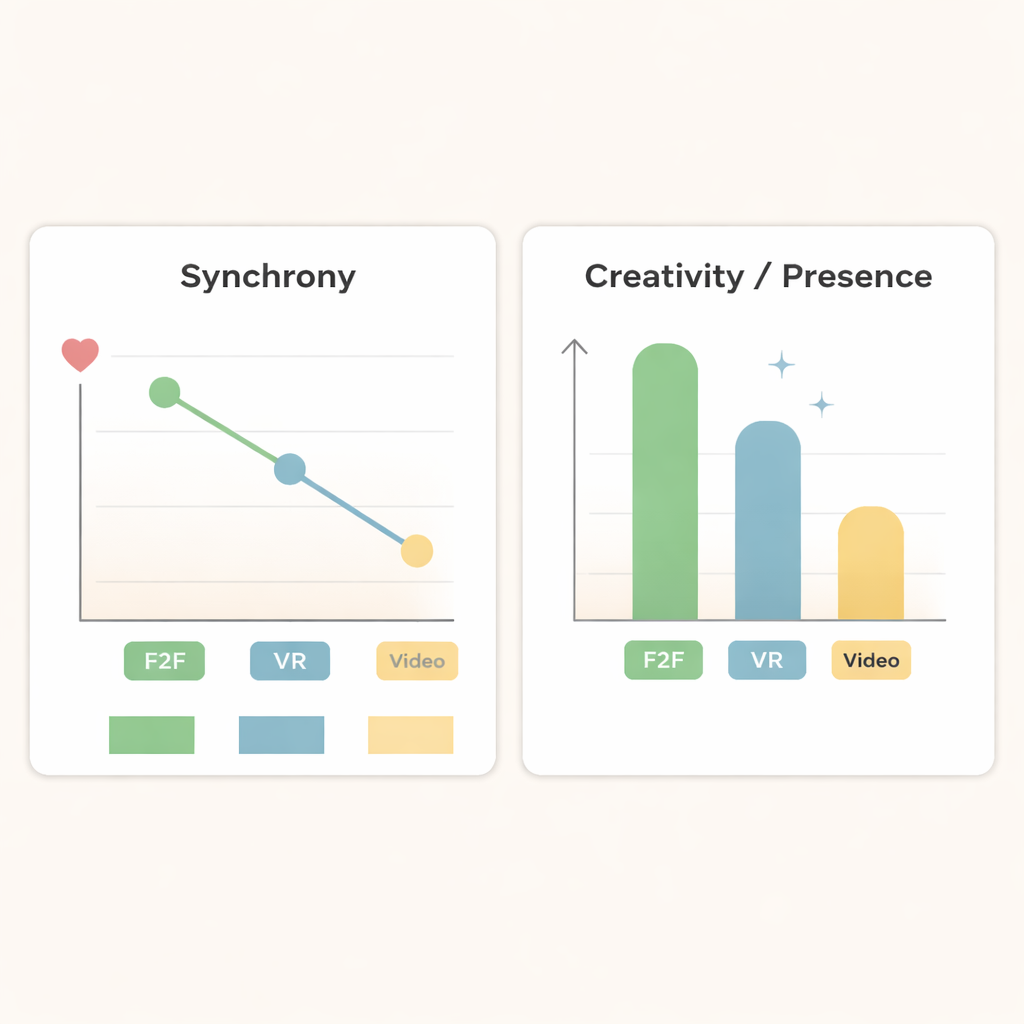
The result was striking. Groups meeting face-to-face showed strong physiological synchrony, as expected from rich in-person interaction. Video meetings, however, showed much weaker synchrony: the heart rhythms of participants stayed more out of step with one another. Surprisingly, virtual reality looked far more like the in-person condition than like video. Even though VR still lacked some natural cues—such as eye and full-face movements—the avatars, shared virtual space, and ability to gesture were enough to produce heart synchrony comparable to sitting together in the same room and clearly higher than on video calls.
Creativity and feeling “present” still favor the real room
The researchers also examined how many ideas groups generated, how varied those ideas were, and how strongly people felt "present" in the shared space and aware of one another. On these more conscious measures, face-to-face meetings still came out on top: groups in the same room were generally more flexible and fluent in their ideas and reported the strongest sense of being together. VR and video both scored lower, with VR typically in the middle—better than video for feeling located in a shared space, but not fully matching real-life interaction. Importantly, across conditions, groups whose heart rhythms synchronized more tended to perform better on the creativity tasks, especially in face-to-face meetings.
What this means for the future of remote work
For everyday users, the study suggests that not all digital meetings are equal. Standard video calls may be convenient, but they seem to blunt the subtle bodily coordination that supports trust, ease, and creative flow—possibly helping explain why "Zoom fatigue" feels so draining. Virtual reality, in contrast, can restore much of this hidden synchrony, even with today’s imperfect avatars, and may be a better choice when teams need to brainstorm, solve open-ended problems, or build strong social bonds at a distance. While nothing yet fully replaces being in the same room, adding richer cues such as eye and face tracking in VR could narrow the gap. Measuring heart-based synchrony offers a promising new way to understand and improve how we connect in our increasingly virtual social world.
Citation: Streuber, S., Rogula, S., Quirós-Ramírez, M.A. et al. Remote collaboration in virtual reality induces physiological synchrony comparable to face-to-face interaction. Sci Rep 16, 3721 (2026). https://doi.org/10.1038/s41598-026-35955-y
Keywords: virtual reality collaboration, video conferencing, physiological synchrony, remote teamwork, group creativity