Clear Sky Science · en
Geochemical, radiological, and heat-production characteristics of the ElGara granitoids (Southwestern Desert)
Rocks That Warm the Earth and Glow Ever So Slightly
Deep beneath Egypt’s Southwestern Desert, ancient bodies of granite quietly release heat and faint radiation. This study explores those rocks—the El Gara El Hamra and El Gara El Soda granitoids—to ask two very practical questions: how much do they warm the crust, and what do they mean for people who might live with buildings made from them?
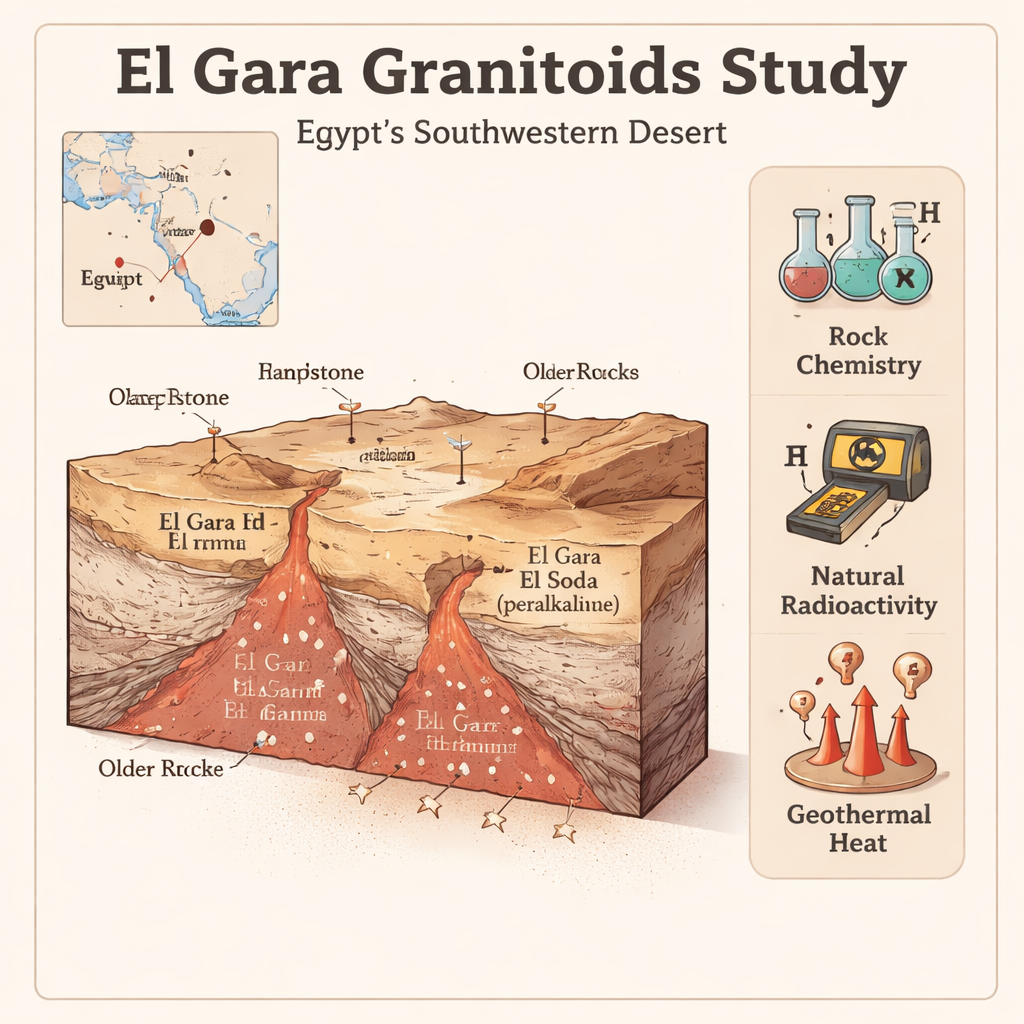
Ancient Intrusions in a Desert Landscape
The El Gara granitoids are remnants of magma that solidified about 580–600 million years ago, during a period when the Earth’s crust in this region was stretching and relaxing after a major mountain‑building event. Today they stand as low hills surrounded by younger sandstones. Geologists mapped these intrusions, documented their visible minerals under the microscope, and showed that they are rich in light-colored feldspar and quartz with accessory grains such as zircon, monazite, and allanite—tiny mineral “vaults” that store uranium (U), thorium (Th), and potassium (K). These elements naturally emit radiation and produce heat as they slowly decay over geological time.
How the Rocks Were Sampled and Tested
To capture the full behavior of these granites, the team collected 15 samples from different parts of both intrusions, targeting varied rock types and degrees of alteration. In the lab, they crushed and powdered the samples under carefully controlled conditions to avoid contamination. Chemical analyses using X‑ray fluorescence and mass spectrometry revealed the major and trace elements, including rare earth elements that are especially sensitive tracers of how magmas form and evolve. A high‑purity germanium detector then measured the tiny gamma rays emitted by the rocks to determine how much U, Th, and K they contain. From these data, the researchers calculated key radiological indices—such as dose rates and hazard factors—as well as the rate of radiogenic heat production inside the rocks.
Hot Rocks with a Complex History
The results show that the El Gara rocks belong to a class called A‑type granitoids, which typically form in regions where the crust is stretched rather than compressed. Within this broad family, El Gara hosts two contrasting flavors: peraluminous rocks that likely came from melting of older continental crust, and peralkaline rocks that carry a stronger imprint of deep, mantle‑derived magmas. Both are enriched in heat‑producing elements, but in different ways. Thorium and potassium are especially high in the peralkaline suite, while some peraluminous samples hold very elevated uranium and thorium in their accessory minerals. This chemical diversity points to multiple magma sources and strong crystal‑sorting processes, all of which helped concentrate the elements responsible for heat and radiation.
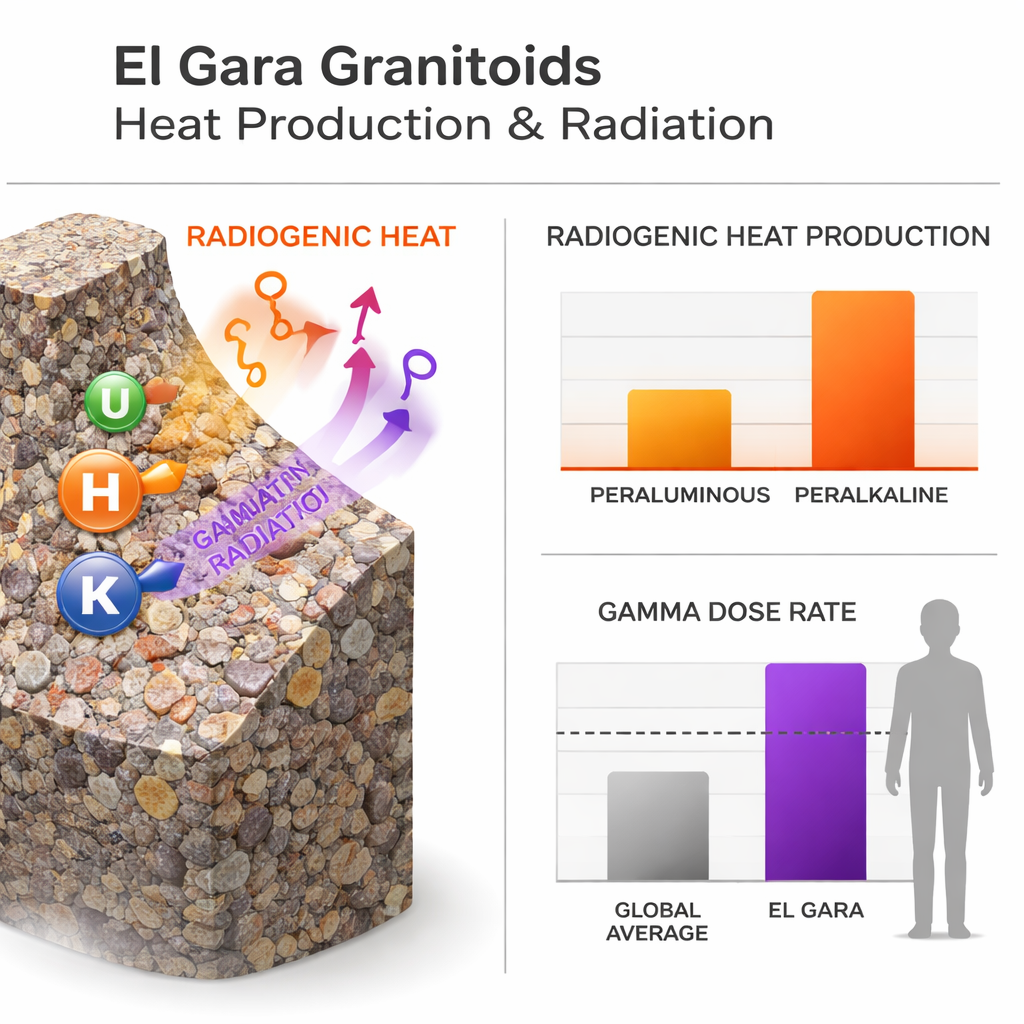
Radiation, Heat, and What They Mean for People
Because U, Th, and K decay, they generate both heat and low‑level natural radioactivity. For the El Gara granitoids, calculated heat production ranges up to about 10 microwatts per cubic meter—high enough to influence local temperature gradients in the crust and make these rocks attractive targets for shallow geothermal exploration. On the radiation side, several samples exceed worldwide average values used by international agencies, and some surpass recommended limits for building materials under conservative assumptions. Dose estimates suggest that, in worst‑case long‑term indoor scenarios, the bone marrow, lungs, and digestive tract would receive the greatest share of exposure. However, the authors emphasize that real‑world risk depends strongly on how much rock is used, how it is cut and ventilated, and how much time people actually spend indoors, not just on the raw radioactivity of the stone.
Looking Ahead: Energy Opportunities and Safe Use
In plain terms, these desert granites are both warm and mildly “hot” in a radiological sense. Their elevated U, Th, and K contents mark them as promising contributors to geothermal resources in the region, potentially supporting low‑temperature energy systems. At the same time, their use as unrestricted building stone should be screened carefully: while the rocks are not acutely dangerous, certain varieties could push long‑term exposure above standard guidelines if used extensively indoors. The study closes by noting that future work—ranging from more detailed mapping of heat‑producing zones to exploring radiation‑tolerant microbes for environmental management—could help harness the thermal benefits of these rocks while keeping people’s exposure safely in check.
Citation: Salaheldin, G., Seddeek, M.K., Ameen, F. et al. Geochemical, radiological, and heat-production characteristics of the ElGara granitoids (Southwestern Desert). Sci Rep 16, 5646 (2026). https://doi.org/10.1038/s41598-026-35954-z
Keywords: natural radioactivity, granite heat production, geothermal potential, building stone safety, Arabian–Nubian Shield