Clear Sky Science · en
Continuance intention to use mobile learning among college students: integrating quality factors and the expectation confirmation model
Why staying with learning apps matters
College students around the world now carry a powerful classroom in their pockets. Yet downloading a mobile learning app is easy; sticking with it over months and years is much harder. This study asks a simple but crucial question: what makes students keep using mobile learning, instead of drifting back to old habits or more entertaining apps? By following real undergraduates in China, the researchers uncover which parts of a mobile learning experience truly matter for long‑term use—and which surprisingly do not.
What the researchers set out to explore
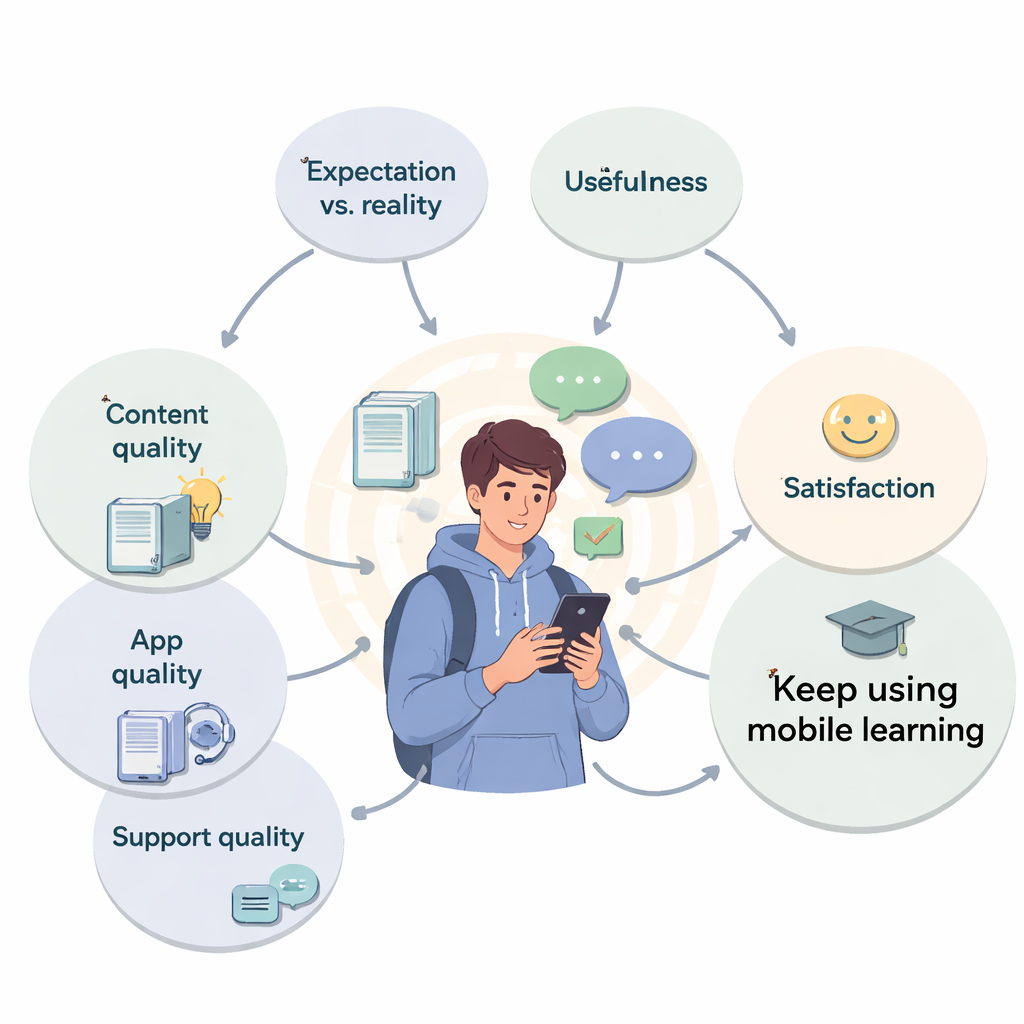
The team focused on “continuance intention,” a term that means students’ willingness to keep using mobile learning after the novelty has worn off. They built their work on a well‑known idea from consumer research: people compare what they expected with what they actually experienced. If the experience matches or exceeds expectations, they feel satisfied and see the tool as useful, which in turn makes them want to continue. The researchers combined this expectation–experience logic with three straightforward quality dimensions of any learning system: the quality of the information or content, the quality of the app itself, and the quality of the support services around it.
How the study was carried out
Using an online survey platform, the authors collected responses from 278 full‑time undergraduates at three universities in Jiangxi Province, China. All had used a mobile learning system for at least one semester, ensuring that they answered from real experience rather than first impressions. Students rated statements about how useful mobile learning was for their studies, how satisfied they felt, whether their expectations had been met, and how they viewed the content, the app’s design and reliability, and the help they received when problems arose. The team then used a statistical technique designed for complex cause‑and‑effect models to see how these factors fit together.
What most strongly keeps students coming back
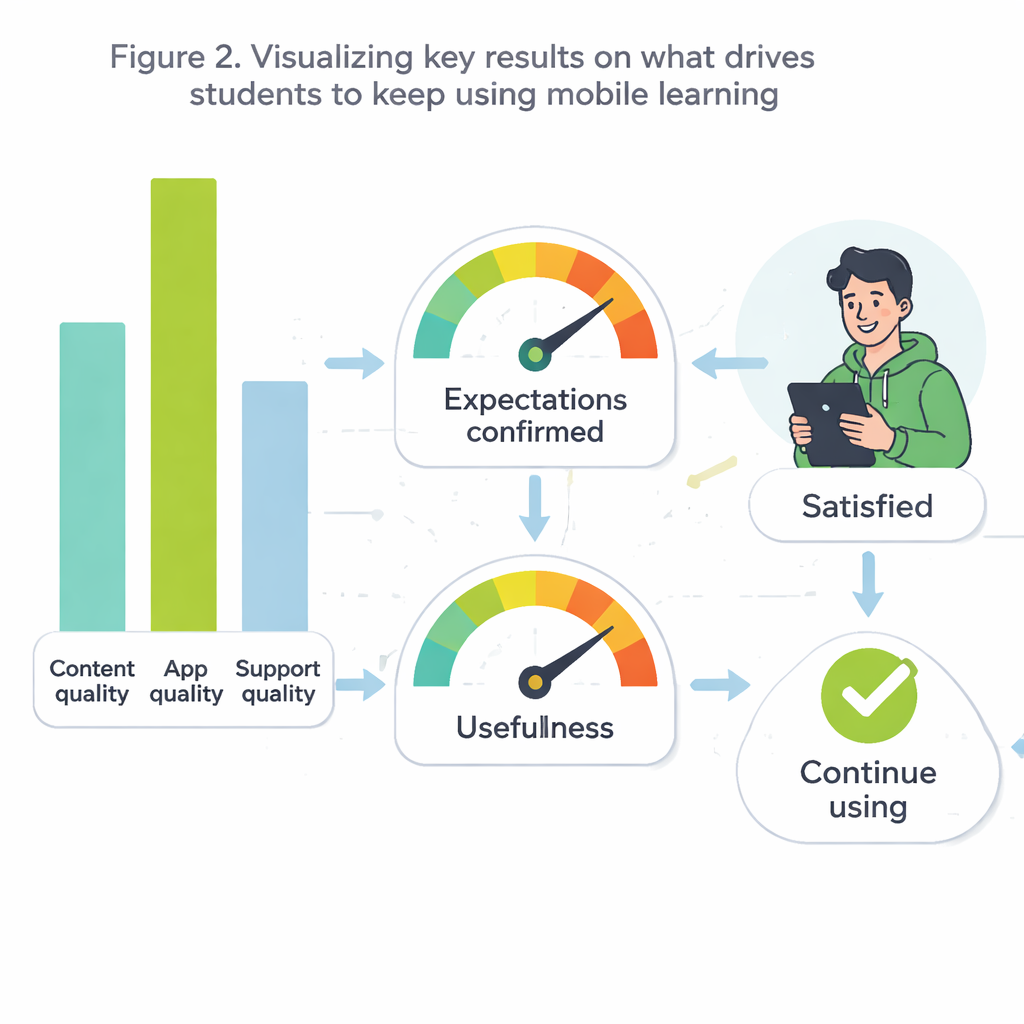
The results show a clear chain. Students are more likely to stick with mobile learning when they believe it genuinely helps them study better and when they feel satisfied with the overall experience. These two feelings together explained about 85 percent of the differences in students’ intention to keep using their mobile learning systems—a remarkably high share for social science research. Satisfaction itself was fueled mainly by the degree to which reality matched or exceeded expectations, and by how useful students found the system. In other words, delivering on promises is central: when an app performs at least as well as students hoped, they both value it more and feel happier using it.
Which parts of quality matter most
Not all aspects of quality played the same role. High‑quality learning content—information that is accurate, clear, interesting, and relevant—directly boosted students’ sense that mobile learning was useful. By contrast, the technical quality of the app (such as being easy to navigate) and the quality of support services (such as responsive help when problems occur) mainly shaped how far expectations were confirmed, rather than usefulness itself. These technical and service features helped students feel that the system lived up to what they had been led to expect. Surprisingly, once other factors were considered, they did not significantly raise perceived usefulness on their own. The study also tested whether male and female students responded differently to usefulness and satisfaction; it found no meaningful gender differences in how these feelings translated into the intention to keep using mobile learning.
What this means for students and educators
For a non‑specialist, the message is straightforward: students keep using mobile learning when it delivers high‑quality content, works as expected, and clearly helps them learn. Eye‑catching features or elaborate support channels matter less than making sure lessons are trustworthy, engaging, and easy to understand, and that the app reliably does what it promises. Because the patterns are similar for men and women, designers and universities do not need entirely different versions for different genders; instead, they should invest in strong content, honest expectations, and a smooth learning experience for everyone.
Citation: Qiu, X., Wu, J. & Li, H. Continuance intention to use mobile learning among college students: integrating quality factors and the expectation confirmation model. Sci Rep 16, 5691 (2026). https://doi.org/10.1038/s41598-026-35949-w
Keywords: mobile learning, student satisfaction, continuance intention, education technology, app quality