Clear Sky Science · en
Evidence for topological contribution to spin shift current in antiferromagnetic Ti $$_{4}$$ C $$_{3}$$
New Ways to Harvest Light
Solar panels today are built around p–n junctions—paired layers of semiconductors that push light‑excited charges in opposite directions. That design is reaching hard efficiency limits. This study explores a completely different route to turning light into electricity, one that relies not on built‑in electric fields, but on the subtle quantum structure of electrons in a new two‑dimensional material. The work shows that magnetism and topology together can generate a strong, spin‑selective photocurrent, hinting at solar and optoelectronic devices that work in ways conventional panels cannot.
Electric Current Without Wires or Junctions
In certain crystals, shining light can create a direct current even when there is no battery or p–n junction. This "shift current" comes from how an electron’s charge cloud shifts in real space when it absorbs a photon. For it to occur, the crystal must lack a perfect center of symmetry, so that electrons are nudged more in one direction than the other. The resulting current can travel long distances and may bypass some efficiency limits faced by standard solar cells. Until now, most known shift‑current materials relied purely on their geometric arrangement of atoms; any deeper, topological origin of the effect has been mostly theoretical.
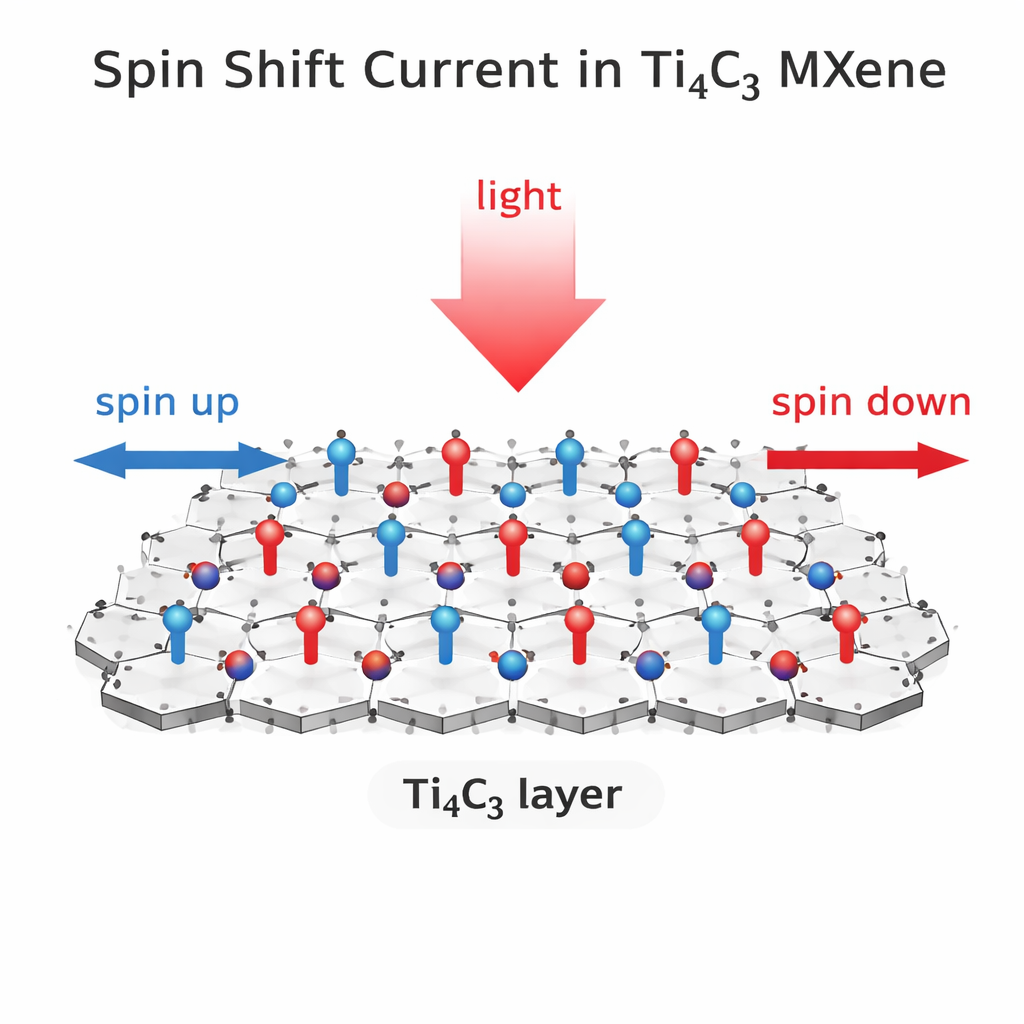
A Magnetic Twist in a Flat Crystal
The authors focus on a newly synthesized member of the MXene family, a flat crystal called Ti4C3. As a bare lattice, Ti4C3 is actually symmetric: for every atom and bond there is a mirror image. But when the electrons’ spins arrange themselves in an antiferromagnetic pattern—neighboring layers of titanium atoms carrying opposite spin directions—that magnetic ordering silently breaks inversion symmetry even though the atoms stay put. Using first‑principles quantum calculations, the team shows that this antiferromagnetic pattern is the most stable one and that Ti4C3 behaves as a narrow‑gap semiconductor. The electronic states near the band edge are dominated by titanium d‑electrons, and spin‑orbit coupling, which often complicates magnetic materials, plays only a minor role here.
Hidden Topology Beneath the Surface
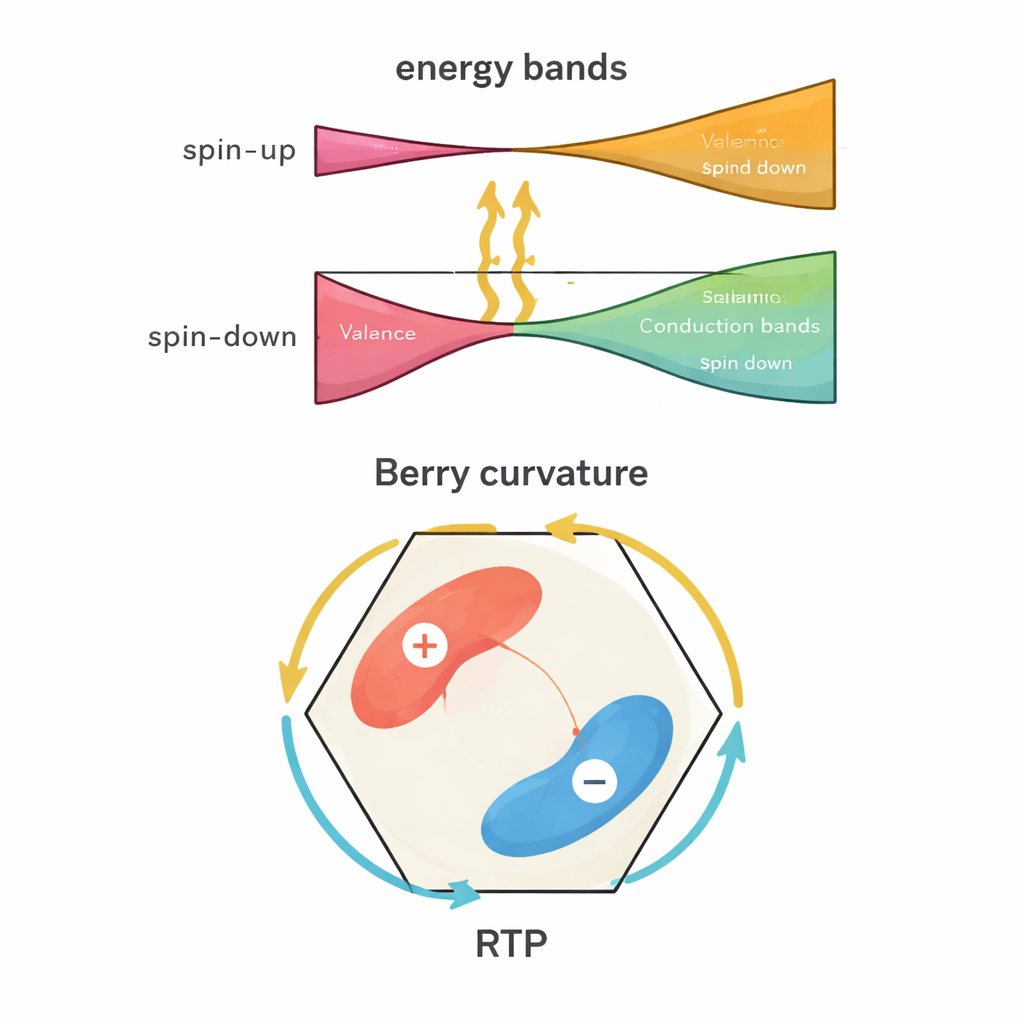
Beyond its basic electronic structure, Ti4C3 harbors more exotic behavior encoded in its band topology. The researchers calculate how the quantum phase of electrons winds across momentum space and how this gives rise to Berry curvature, a measure of how strongly electrons are deflected in a given region. Although the overall Berry curvature averages to zero—so there is no ordinary quantum Hall response—each spin channel separately displays large, oppositely signed regions. The edges of the material host mid‑gap states, signaling nontrivial band connections. By tracking how the Berry phase evolves across half of the Brillouin zone, the team identifies the fingerprint of a "reverting Thouless pump," a recently proposed topological pattern in which the phase winds forward in one half of momentum space and unwinds in the other. Coupling to additional, more conventional bands spoils exact quantization, leaving behind what is known as fragile topology: the topological character is real but easily masked.
Spin‑Selective Photocurrents
With this topological and magnetic background in place, the authors compute how Ti4C3 responds to light beyond the usual linear regime. They focus on the shift current for each spin channel when the crystal is illuminated with linearly polarized light. Remarkably, they find that the spin‑up and spin‑down electrons generate large photocurrents of equal size but opposite direction. The net charge current can cancel, but the material carries a sizeable flow of spin— a "spin shift current." Its magnitude in the infrared and visible ranges rivals or exceeds the best theoretical candidates previously proposed for conventional shift‑current solar materials. The results connect the strong response to the underlying Berry curvature landscape and to the reverting Thouless pump pattern in the bands.
Why This Matters Going Forward
In simple terms, this work shows that a perfectly symmetric crystal can still act like a powerful, light‑driven spin battery once its spins line up in an antiferromagnetic pattern. The combination of fragile topology and magnetic order in Ti4C3 produces a robust, spin‑resolved shift current without needing traditional junctions or strong spin‑orbit effects. If confirmed experimentally, such materials could underpin future devices that harvest light while directly manipulating spin, from next‑generation solar cells to quantum information technologies. The study also points to a broader design rule: look for antiferromagnetic two‑dimensional crystals where magnetism, not the lattice itself, breaks symmetry to unlock new forms of nonlinear photocurrent.
Citation: Sufyan, A., Abdullah, H.M., Larsson, J.A. et al. Evidence for topological contribution to spin shift current in antiferromagnetic Ti\(_{4}\)C\(_{3}\). Sci Rep 16, 5753 (2026). https://doi.org/10.1038/s41598-026-35948-x
Keywords: shift current, MXene Ti4C3, antiferromagnetism, topological insulator, spin photocurrent