Clear Sky Science · en
Mechanism of reverse deformation increase in the virgin coal rib compared to the pillar rib of the gob-side entry in an extra-thick coal seam
Why underground tunnels can suddenly squeeze shut
As coal mines dig deeper and chase thicker seams, engineers carve long tunnels beside vast empty cavities left after mining. These passages must stay open for air, people and machinery, yet they sit in rock under enormous pressure. This study investigates a puzzling and dangerous behavior seen in a Chinese mine: instead of the tunnel wall beside the mined-out void failing the most, the supposedly stronger "solid" coal wall on the other side deformed even more. Understanding why this happens is vital for safer, more efficient underground mining.
A new kind of tunnel squeezing
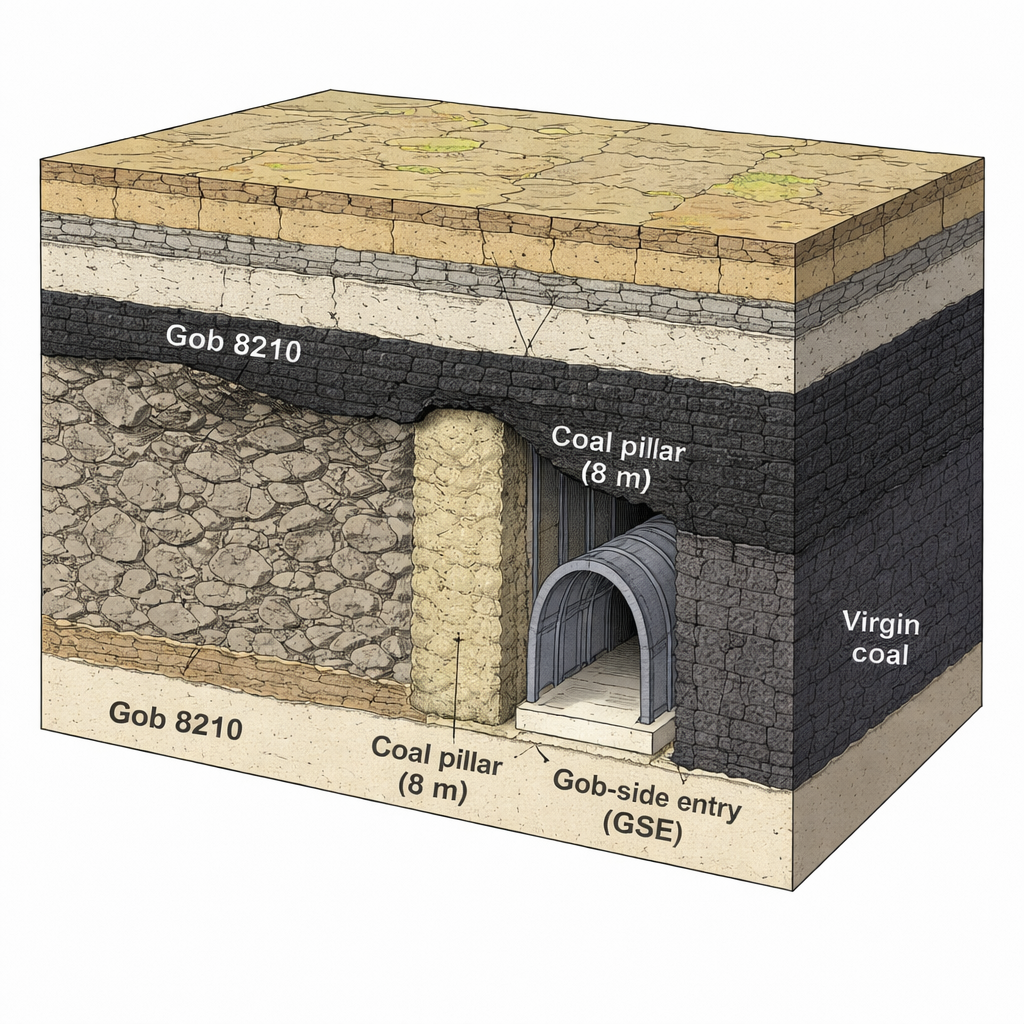
In modern Chinese coal mines, extra-thick coal seams over 15 meters are often mined using fully mechanized top-coal caving. After a panel of coal is removed, the overlying rock collapses into the empty space, forming a rubble zone called gob gangue. New tunnels, known as gob-side entries, are then driven close to this gob with only a narrow pillar of coal left as a buffer. Traditionally, engineers expect the tunnel wall facing the gob (the coal pillar side) to deform more than the wall facing untouched rock (the virgin coal side). However, monitoring in Panel 8211 of a 15.1‑meter-thick seam showed the opposite: after about 50 days, the wall in the virgin coal began to move inward more than the coal pillar side, a pattern the authors term “reverse deformation increase” (RDI).
Watching the rock slowly fail
The team first documented what was happening underground. They measured how much each tunnel wall converged over time, examined damage to bolts, cables and support frames, and used cameras in boreholes to see how deeply the coal had fractured. Both sides of the tunnel showed strong damage, but the entire 8‑meter coal pillar was cracked through, while the virgin coal had a heavily broken outer zone about 4.3 meters deep and a stronger inner core. Stress meters revealed that the central part of the pillar carried only modest loads, suggesting it was badly weakened, while the deeper virgin coal still carried stresses close to the original in‑situ pressure. This combination—severely damaged shallow rock on both sides but a still‑strong deeper virgin coal zone—set the stage for unexpected movements.
Computer experiments on a buried puzzle
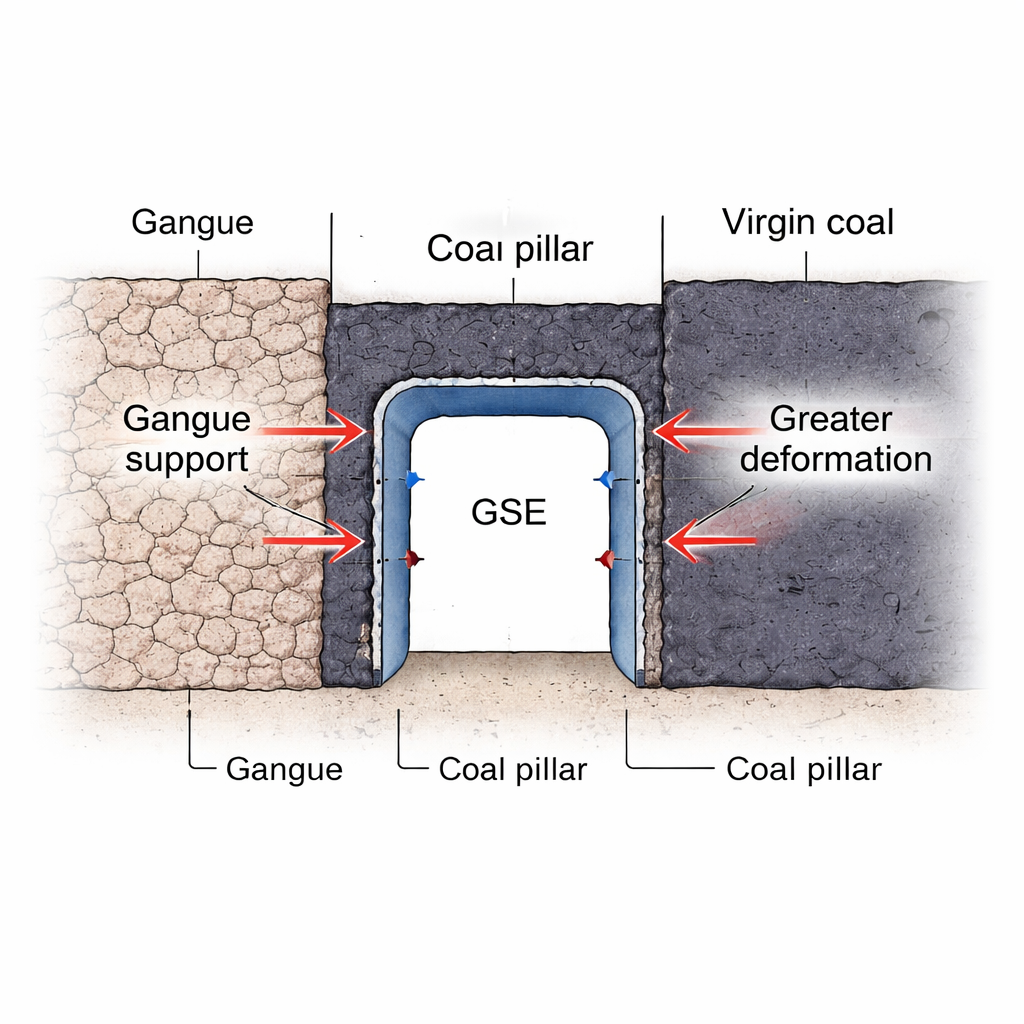
To untangle the mechanism, the researchers built a detailed 3D numerical model of the mine using realistic rock properties and mining steps. They varied three main factors: how high the collapsed gangue in the gob pressed sideways on the coal pillar, how wide the coal pillar was, and when the tunnel was excavated relative to mining above. The simulations showed that RDI appears only when the gangue is tall enough—its contact with the pillar must rise more than 20 meters. At that point, the broken rock in the gob acts like a stiff side support, bracing the coal pillar so that it deforms less toward the tunnel. Meanwhile, the still‑intact rock layers above bend downward toward the tunnel and push hardest on the virgin coal wall. The result is higher horizontal and vertical stresses in the virgin coal rib, which then squeezes farther into the tunnel than the pillar side.
What pillar size and timing really change
The width of the coal pillar and the timing of tunnel excavation turned out to modify how strong RDI becomes, but not whether it can occur. When the gangue contact height is high, a narrow pillar (for example 5–8 meters) is easily braced by the gob side and shows relatively small inward movement, while the virgin coal wall experiences much larger deformation. As the pillar becomes wider (around 30 meters or more), stresses and damage on both sides even out and the two walls move by similar amounts. Timing also matters: if the tunnel is driven soon after the upper panel is mined—while overlying rock is still settling—the pillar tends to move toward the gob, which further reduces its inward movement into the tunnel and amplifies RDI. Once the overlying strata have stabilized, RDI weakens but does not disappear as long as the gangue support height remains large.
How engineers can keep the tunnel open
Based on these insights, the authors tested several reinforcement schemes in their model and then underground. Simply adding more short bolts could not stop the virgin coal wall from deforming more. The most effective strategy was to strengthen both walls with longer bolts plus high‑capacity cables, giving the damaged outer coal a way to “lock into” deeper, stronger rock. This shared the load more evenly between the coal pillar and the virgin coal. Field measurements after installing this combined support showed that tunnel deformation stabilized within about a month, and the two walls ended up with similar, much smaller inward movements—meeting safety and operational requirements.
What this means for deep coal mining
For non‑specialists, the key message is that in very thick, deeply buried coal seams, the tunnel wall that looks safer on paper can actually be the one that fails first. Rubble in the mined‑out gob, instead of being a passive by‑product, can brace the coal pillar so well that the solid‑coal side becomes the weak link under a bending rock roof. By identifying the gangue support height as the trigger and showing how pillar size, timing, and reinforcement interact, this study offers a clearer recipe for designing supports that keep vital underground passages open and miners safer.
Citation: He, W., Chen, D. & Zhu, H. Mechanism of reverse deformation increase in the virgin coal rib compared to the pillar rib of the gob-side entry in an extra-thick coal seam. Sci Rep 16, 5724 (2026). https://doi.org/10.1038/s41598-026-35947-y
Keywords: underground coal mining, rock deformation, ground control, coal pillar design, gob-side entry