Clear Sky Science · en
Evidence incriminating Anopheles maculatus as a potential vector of Plasmodium knowlesi and Plasmodium inui
Why monkey malaria matters for humans
When we think of malaria, we usually picture a disease passed from person to person by mosquitoes. But in parts of Southeast Asia, some malaria parasites normally found in monkeys are now infecting people. This study from North Sumatra, Indonesia, asks a crucial question: could a common local mosquito, Anopheles maculatus, be helping these “monkey malarias” jump into humans—quietly complicating efforts to eliminate the disease? 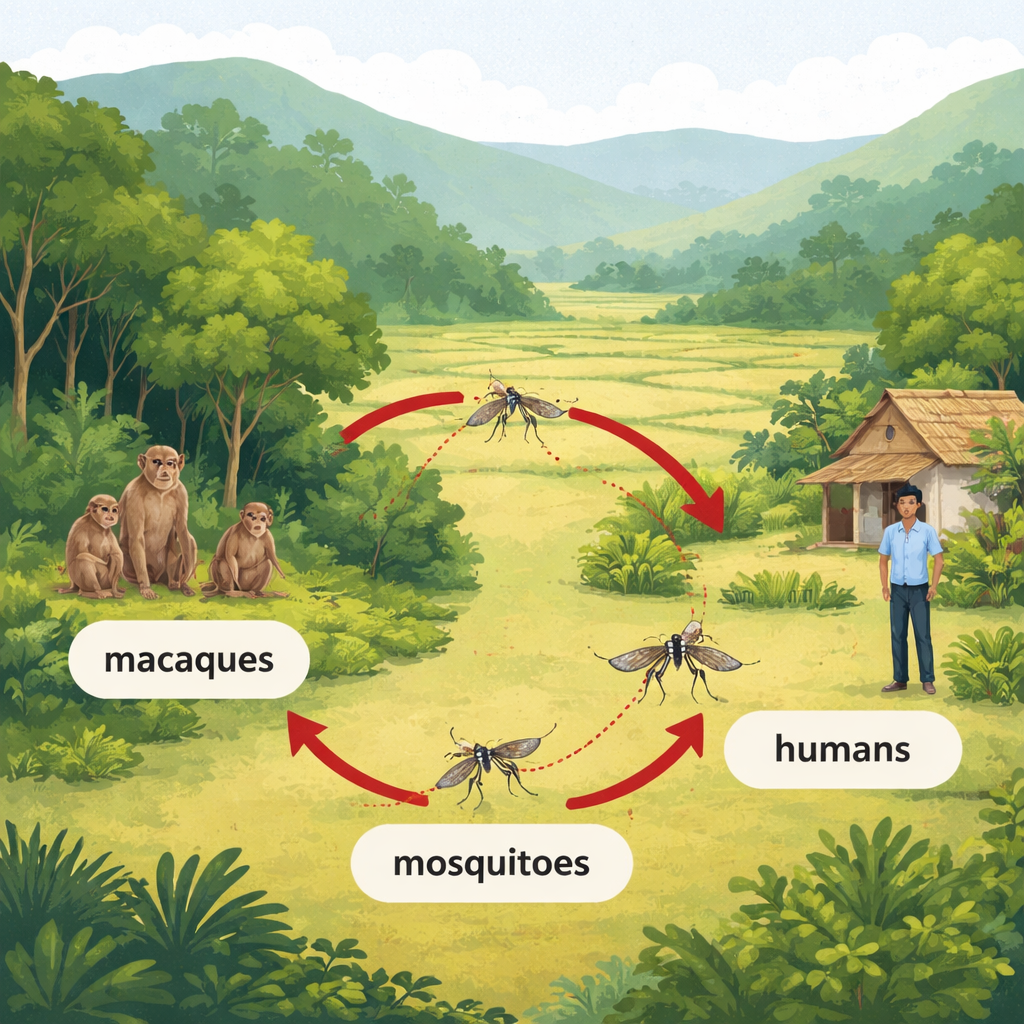
A busy mosquito in a changing landscape
Indonesia has hundreds of mosquito species, and at least 29 of them can spread human malaria. Many look almost identical, so researchers must use DNA tools to tell them apart. In hilly, partly forested areas of North Sumatra, people, macaque monkeys and mosquitoes now live in closer contact because forests have been cut back for farms and plantations. This environment is already known to host Plasmodium knowlesi, a malaria parasite that normally cycles between macaques and certain forest mosquitoes but can also infect humans.
Tracking the suspect
The researchers collected mosquitoes that tried to bite volunteers outdoors in two hamlets over a full year, from evening until dawn. They focused on the Maculatus Group, a set of closely related species that are hard to distinguish under a microscope. Using precise DNA “barcodes” from two genes (called ITS2 and cox1), they showed that all 234 suspect mosquitoes were the same species: Anopheles maculatus sensu stricto. Genetic comparisons placed the North Sumatran mosquitoes firmly within a wider family of An. maculatus found across mainland and island Southeast Asia, suggesting they belong to a well-known regional lineage rather than a newly evolved, hidden species.
Looking for hidden infections
Next, the team asked whether these mosquitoes were carrying malaria parasites. They removed only the head and chest (where infectious stages gather in the salivary glands) and used highly sensitive laboratory tests to search for Plasmodium DNA. Four mosquitoes carried traces of malaria parasites at very low levels. In one of them, follow-up tests clearly detected genetic material from both Plasmodium knowlesi and Plasmodium inui, another monkey malaria parasite. No human malaria species such as Plasmodium falciparum or Plasmodium vivax were found in these samples. 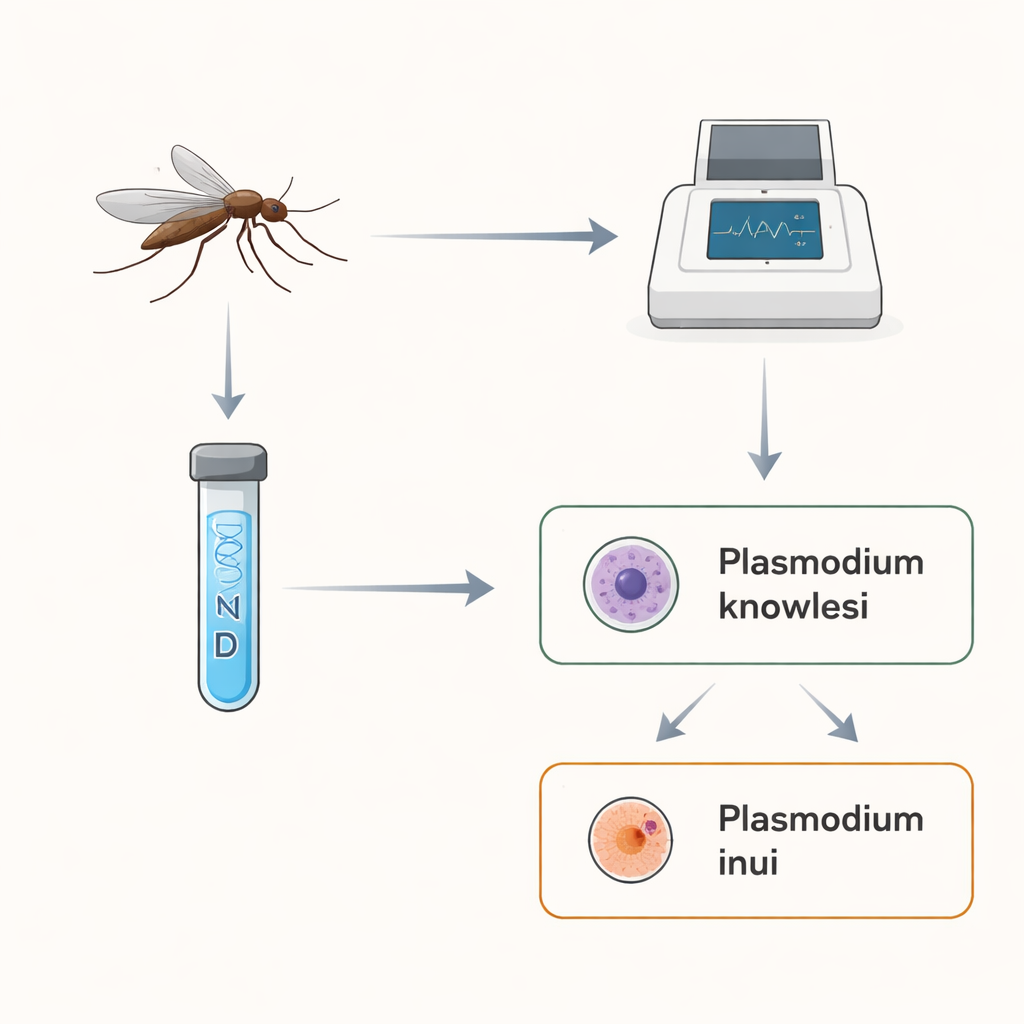
What this means for malaria control
Finding P. knowlesi and P. inui DNA in the head and thorax of a wild An. maculatus is the first such report worldwide, and it suggests that this species may sometimes pick up and carry monkey malaria parasites in nature. However, the study did not dissect salivary glands or run mosquito–to–host transmission experiments, so it cannot yet prove that these mosquitoes actually pass the infection on when they bite. Still, An. maculatus is known from other countries to feed on both animals and humans and to transmit human malaria elsewhere, making it a plausible bridge between macaques and people in North Sumatra.
A wider cast of malaria carriers
For years, scientists believed that only a narrow set of forest mosquitoes—the Leucosphyrus Group—spread P. knowlesi from macaques to humans. This study adds weight to a growing body of evidence that other mosquitoes, including An. maculatus, may also play a role. If more species can carry zoonotic (animal-to-human) malaria than previously thought, then focusing control efforts on just one or two primary vectors may not be enough. In places where people live and work near forests and plantations, and where mosquitoes freely bite both monkeys and humans, a broader and more flexible approach to surveillance and mosquito control will be needed.
Take‑home message
To a lay reader, the core message is simple: a common mosquito in North Sumatra appears capable of picking up monkey malaria parasites that can infect humans. While more work is needed to prove it is a full-fledged vector, its behavior and genetics make it a strong suspect. As Indonesia and its neighbors push toward malaria elimination, they may need to account not only for traditional human-to-human malaria, but also for infections that spill over from wildlife through a wider cast of mosquito species than once assumed.
Citation: Sebayang, B.F., van de Straat, B., Kurniawan, A. et al. Evidence incriminating Anopheles maculatus as a potential vector of Plasmodium knowlesi and Plasmodium inui. Sci Rep 16, 6515 (2026). https://doi.org/10.1038/s41598-026-35946-z
Keywords: zoonotic malaria, Plasmodium knowlesi, Anopheles maculatus, North Sumatra, mosquito vectors