Clear Sky Science · en
Lifetime risk of cancer in carriers of intermediate alleles in the HTT gene
Why tiny changes in a single gene might matter for cancer
Most of us think of our genes as fixed blueprints, but some stretches of DNA are made of short sequences that repeat, like a word typed many times in a row. In the huntingtin (HTT) gene, an expanded run of the letters CAG causes Huntington’s disease, a severe brain disorder. Curiously, people with full-blown Huntington’s disease seem to get cancer less often than expected. This study asked a question that matters to many more people: do milder, more common expansions in the same gene also change someone’s lifetime risk of cancer?
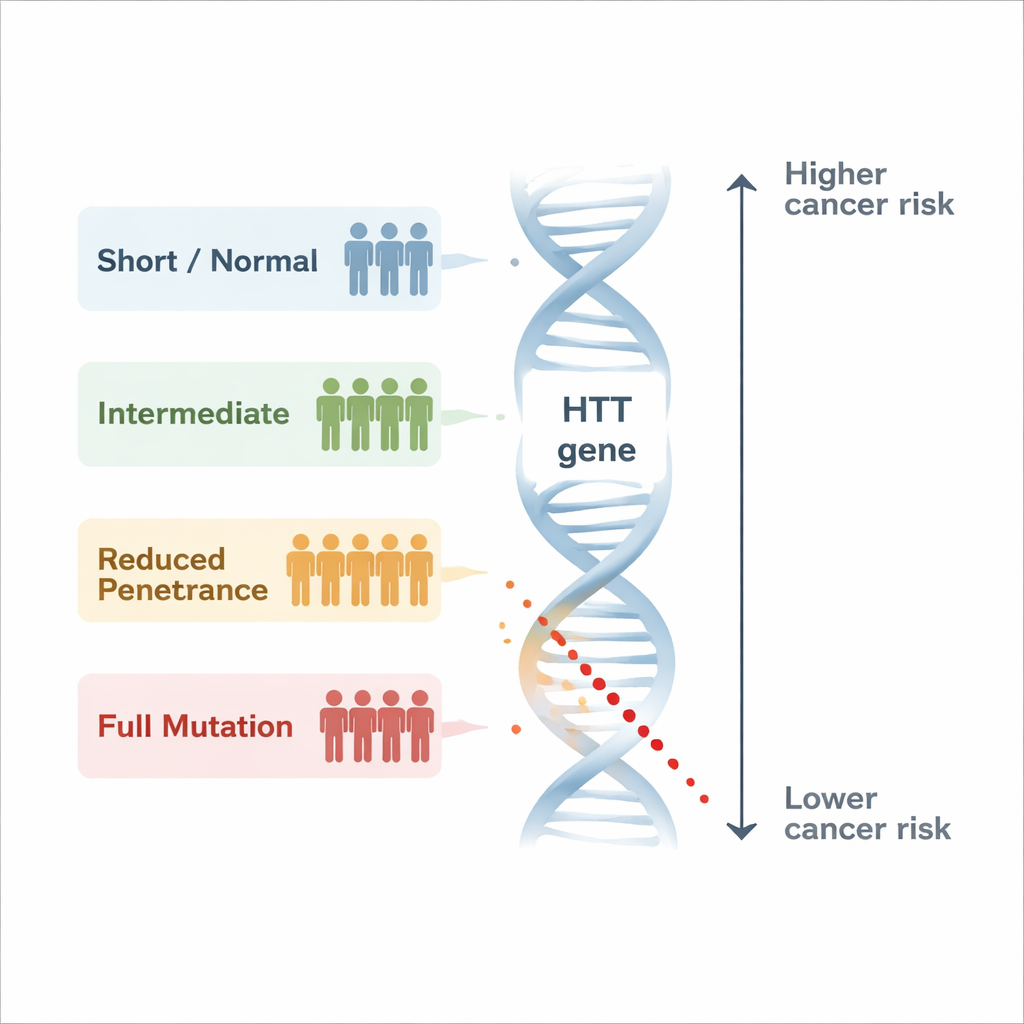
A closer look at a common gene variant
The HTT gene contains a CAG “stutter” that can vary in length from person to person. Very long stretches (40 or more repeats) almost always cause Huntington’s disease. Slightly shorter stretches, called reduced penetrance alleles (36–39 repeats), may or may not cause symptoms. Even shorter “intermediate alleles” (27–35 repeats) were once thought harmless, yet they are surprisingly common: in this Swedish population, about 7 in 100 people carried them. Because earlier work showed a striking drop in cancer rates among patients with Huntington’s disease, the researchers wanted to know whether these intermediate alleles—and the neighboring reduced penetrance range—also influence cancer risk in the general public.
Following thousands of people over a lifetime
The team drew on the Northern Sweden Health and Disease Study, which has followed residents of two counties for decades. They analyzed blood samples from 8,149 participants to measure how many CAG repeats each person carried in their HTT gene. Then they linked these genetic data to Sweden’s national registries, which reliably record cancer diagnoses, hospitalizations, and causes of death. This allowed the researchers to track who developed cancer, of what type, and at what age, while also taking into account known risk factors such as smoking, alcohol use, body weight, and sex.
Intermediate gene changes, ordinary cancer risk
Over the study period, roughly one in three participants was diagnosed with at least one cancer, a pattern that matched overall cancer statistics for Sweden. When the researchers compared groups by their HTT CAG length, people with intermediate alleles (27–35 repeats) had essentially the same lifetime cancer risk as those with typical-length alleles (17–26 repeats). The timing of first cancer diagnosis was also similar. In other words, carrying an intermediate HTT allele did not protect against cancer, nor did it appear to increase risk. This finding is reassuring for the many people who carry these variants, whether they know it from genetic testing or might discover it in the future.
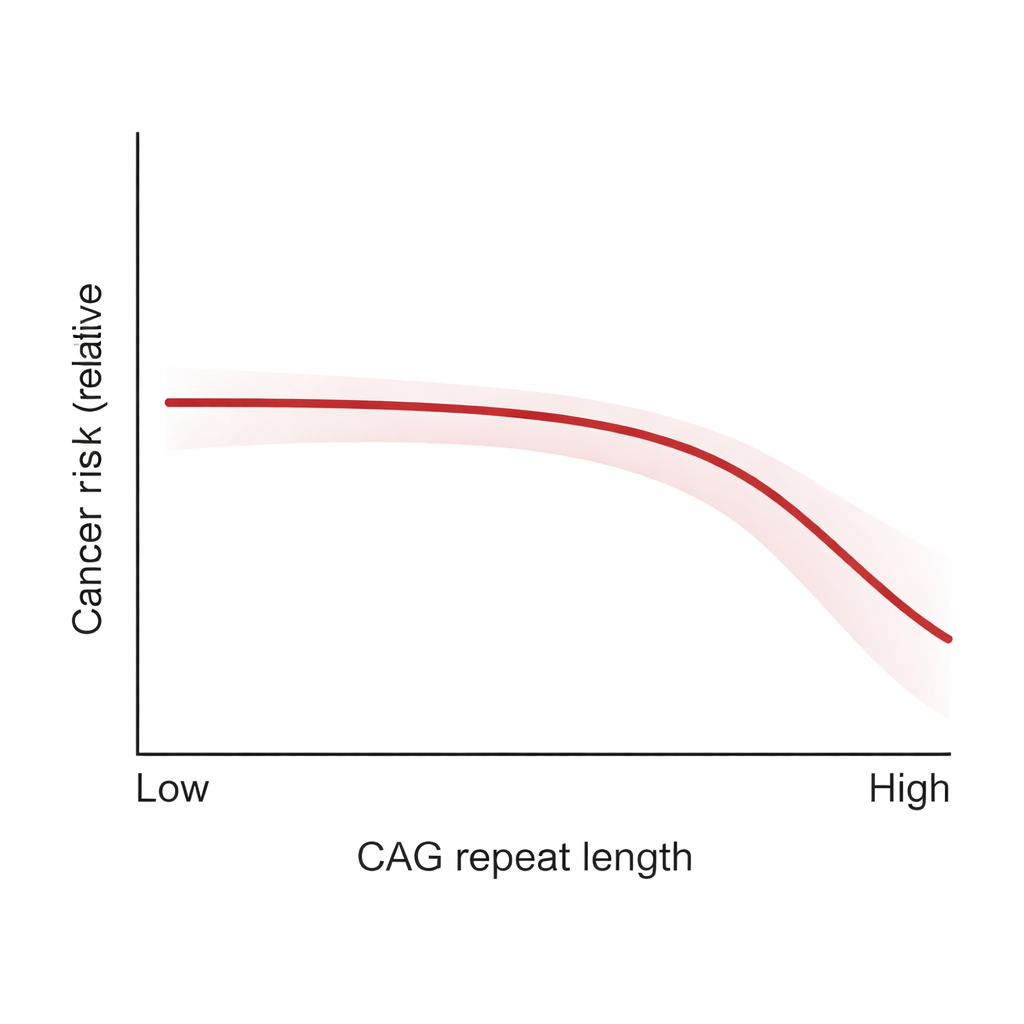
A hint of protection at the longest repeat lengths
The story became more intriguing at the high end of the repeat spectrum. Among the small group of participants with reduced penetrance alleles (36–39 repeats), there were fewer cancer cases, and statistical models suggested their cancer risk might be about half that of people with normal-length alleles. This pattern resembles what has been observed in patients with full Huntington’s disease mutations. However, because relatively few people in the study carried these long repeats, the results did not reach the level of certainty scientists require to declare a firm effect. When the researchers examined cancer types individually, they saw possible reductions in urinary tract and certain gastrointestinal cancers among some longer-repeat carriers, but those hints need confirmation.
What this means for health and future research
For now, the take-home message is straightforward: having an intermediate-length HTT allele does not appear to change a person’s overall risk of developing cancer during life. The tantalizing suggestion that longer, near-disease-length repeats might guard somewhat against cancer fits with laboratory studies linking the Huntington’s mutation to changes in cell stress pathways that can make cancer cells more vulnerable. To pinpoint where any protective threshold truly lies, and for which cancers, researchers will need even larger studies focused on people whose HTT repeat lengths cluster around the upper 20s to mid-30s. This work highlights how subtle variations in common genes can quietly shape our health, even when they do not cause obvious disease.
Citation: Sundblom, J., Bergdahl, I., Stattin, EL. et al. Lifetime risk of cancer in carriers of intermediate alleles in the HTT gene. Sci Rep 16, 2597 (2026). https://doi.org/10.1038/s41598-026-35941-4
Keywords: Huntington gene, cancer risk, CAG repeats, genetic variation, intermediate alleles