Clear Sky Science · en
Geological controls on reservoir seismic responses
Listening to Rocks Beneath the Sea
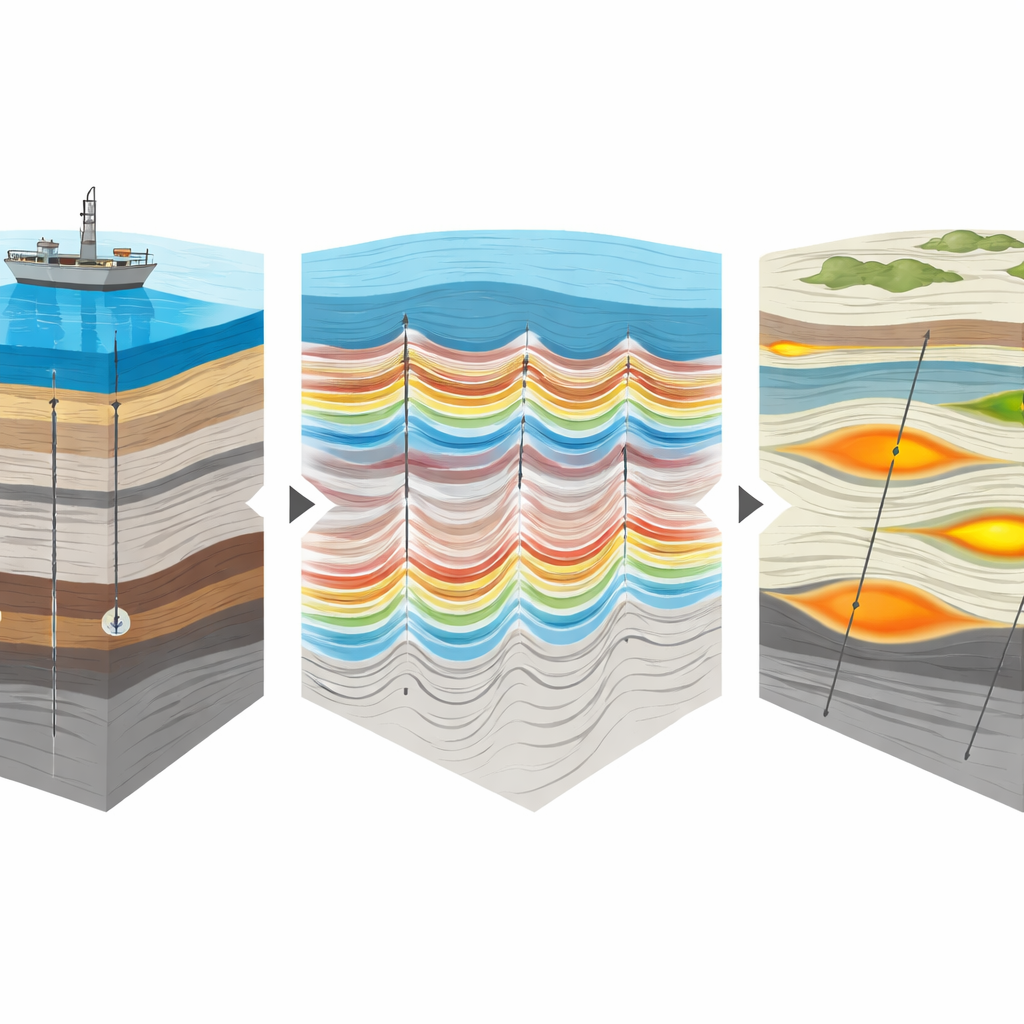
Finding gas deep below the seafloor often relies on “listening” to how sound waves bounce through buried rocks. But in some fields offshore northwestern Australia, these echoes behave in puzzling ways: strong in one well, weak in a nearby one, or changing from layer to layer. This study tackles that mystery in the Plover Formation, a gas-bearing sandstone sequence in the Poseidon Field, to learn how the rocks’ hidden history shapes the seismic signals that energy companies use to find and appraise reservoirs.
A Busy Delta Buried Offshore
The Plover Formation was laid down about 170 million years ago in a river-delta setting along the edge of what is now the Browse Basin. Sand, mud, and plant material accumulated in shifting channels and floodplains, later buried beneath kilometers of younger sediments. Today, this package of interbedded sandstone, mudstone, coal, and thin volcanic and siltstone layers hosts major gas accumulations tapped by wells such as Poseidon-1, Poseidon-2, and Kronos-1. Because the thickness and continuity of the sand bodies vary from place to place, and faults slice the area into compartments, the subsurface looks more like a patchwork quilt than a single, uniform layer cake.
Turning Seismic Echoes into Rock Stories
To untangle this complexity, the authors combined several kinds of data: three-dimensional seismic surveys, detailed measurements from the wells, core samples, and microscope images of the rock fabric. They focused on how seismic amplitudes change with distance between the sound source and the receiver—a technique called amplitude variation with offset, or AVO. Different AVO “classes” are known to hint at the presence of gas-filled sands versus water-bearing or tighter rocks. By building synthetic seismic records from the well data, then comparing them with the real seismic records, the team mapped how these AVO behaviors and related rock properties change laterally across the field.
How Rock Makeup and Burial History Change the Signal
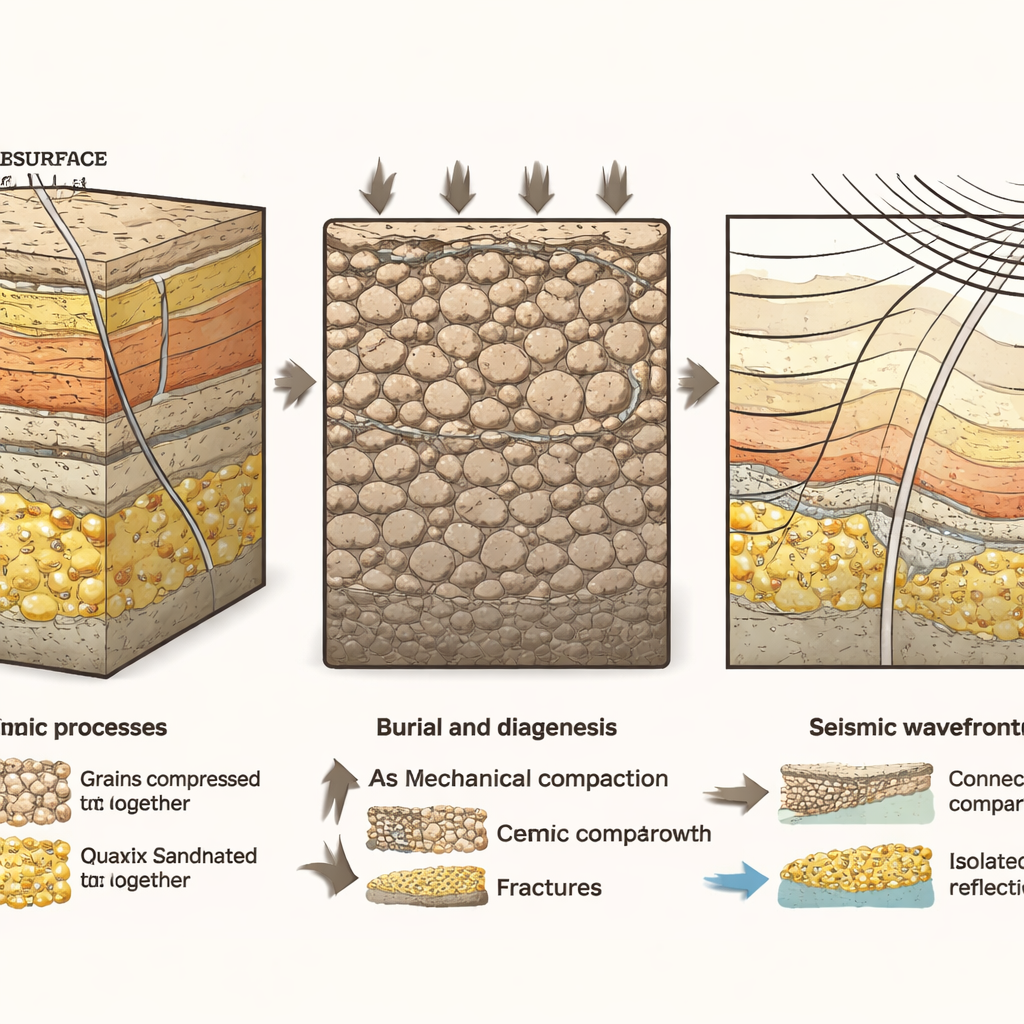
The study shows that the same gas-bearing formation can give very different seismic signatures depending on its geological surroundings and diagenetic history—the modifications rocks undergo after burial. Thin volcanic and siltstone layers above some sand bodies act as tight seals, flipping the contrast in stiffness between layers and shifting the seismic response from a “hard” to a “soft” reflector. Deeper in the sequence, long-term burial has squeezed the sands, pushing grains into tighter contact (mechanical compaction) and dissolving and re-precipitating minerals as quartz cement (chemical compaction). Under the microscope, this appears as packed grains with overgrowths that stiffen the rock and reduce pore space. These changes alter how sound travels through the rock, so two gas-saturated sands with similar thickness can look very different on seismic sections if one is more compacted or cemented than the other.
Hidden Compartments in the Subsurface
Another key finding is that faults and subtle changes in grain size and texture break the formation into separate pressure compartments. Pressure measurements in Poseidon-1 follow a single, consistent trend, suggesting connected reservoir zones, whereas Kronos-1 shows different pressures that point to isolation. Seismic inversion—mathematical processing that extracts rock stiffness and related properties from the seismic data—highlights these variations. In particular, the ratio of compressional to shear-wave velocity (Vp/Vs) and a related measure called Poisson’s ratio drop noticeably where gas is present, but their patterns also reflect where the rock has been more strongly compacted or cemented, or cut off by barriers.
Why This Matters for Finding Energy
By linking the seismic behavior of the Plover Formation to specific rock features—layering, thin sealing beds, grain contacts, cement, and faults—the authors build a framework for reading seismic amplitudes as indicators of both fluid content and reservoir quality. For a non-specialist, the lesson is that seismic surveys do more than simply show where gas might be; when calibrated with careful geological and microscopic work, they can reveal which sand bodies are likely to be porous, connected, and worth developing. This integrated approach offers a template for reducing uncertainty in other complex deltaic gas fields around the world, helping explorers distinguish truly promising “bright spots” from deceptive echoes shaped by the rocks’ deep-time history.
Citation: Farfour, M., Al-Awah, H., Moustafa, M.S.H. et al. Geological controls on reservoir seismic responses. Sci Rep 16, 8415 (2026). https://doi.org/10.1038/s41598-026-35935-2
Keywords: seismic reservoirs, gas sandstone, AVO analysis, reservoir quality, Browse Basin