Clear Sky Science · en
Comparative performance of activated sludge and waste stabilization ponds for the removal of pollutants and pathogens in full-scale wastewater treatment plants in Egypt
Why Cleaning Wastewater Matters to Everyday Life
In many dry countries, including Egypt, treated sewage is increasingly reused to irrigate crops and green spaces. This makes sense in a warming world with shrinking freshwater supplies, but it raises an important question for public health: how clean is this water, especially when it may still carry germs that cause disease? This study follows the journey of sewage through two large treatment plants in Egypt, comparing how well each one removes dirt, nutrients, and disease‑causing microbes before the water is released or reused.
Two Different Ways to Treat Dirty Water
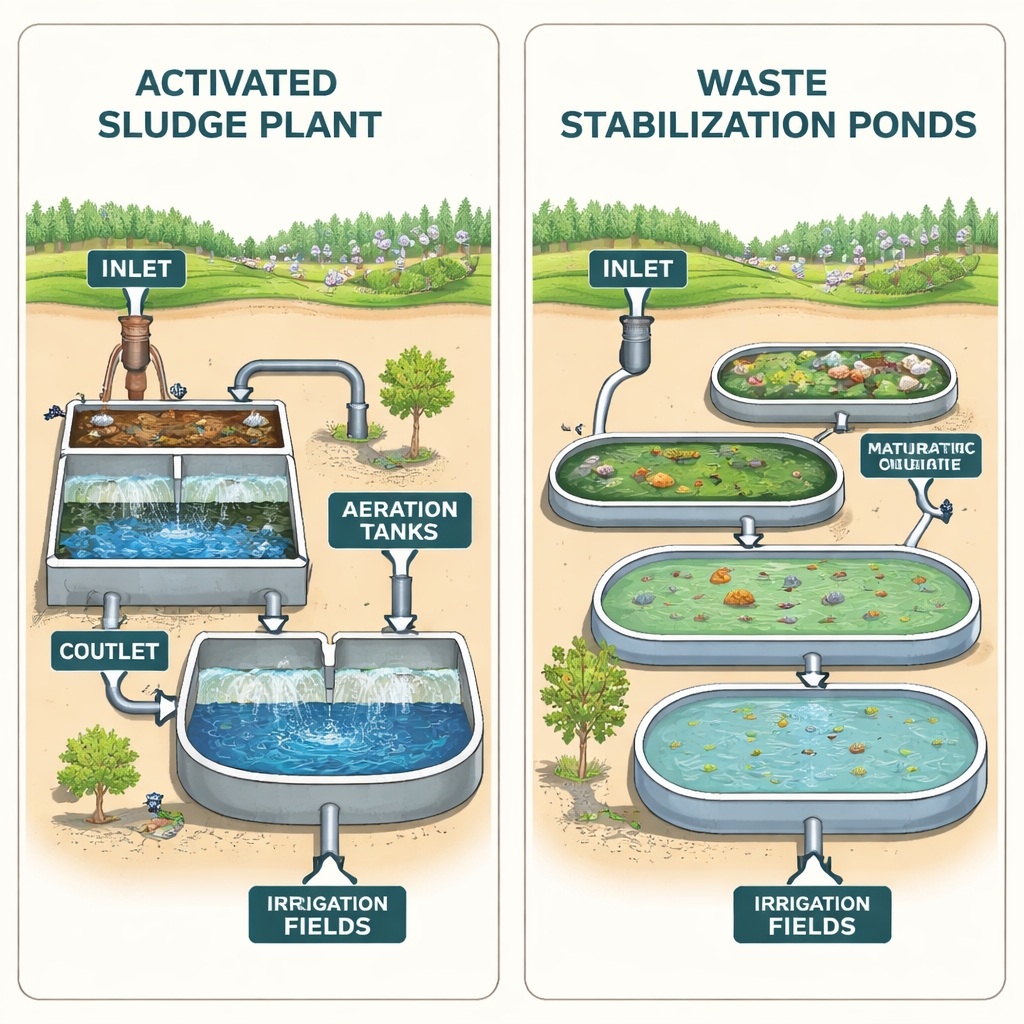
The researchers focused on two full‑scale plants that serve hundreds of thousands to millions of people. One plant, called WWTP‑A, uses an “activated sludge” system, where wastewater is mixed with oxygen and dense communities of bacteria that rapidly break down organic pollution. The other, WWTP‑B, relies on a chain of open waste stabilization ponds. In these ponds, sunlight, algae, and naturally occurring microbes slowly clean the water as it moves from one basin to the next. Both plants operate in the same general climate and handle similar types of sewage, making them ideal for a side‑by‑side comparison.
How Well Do They Remove Pollution?
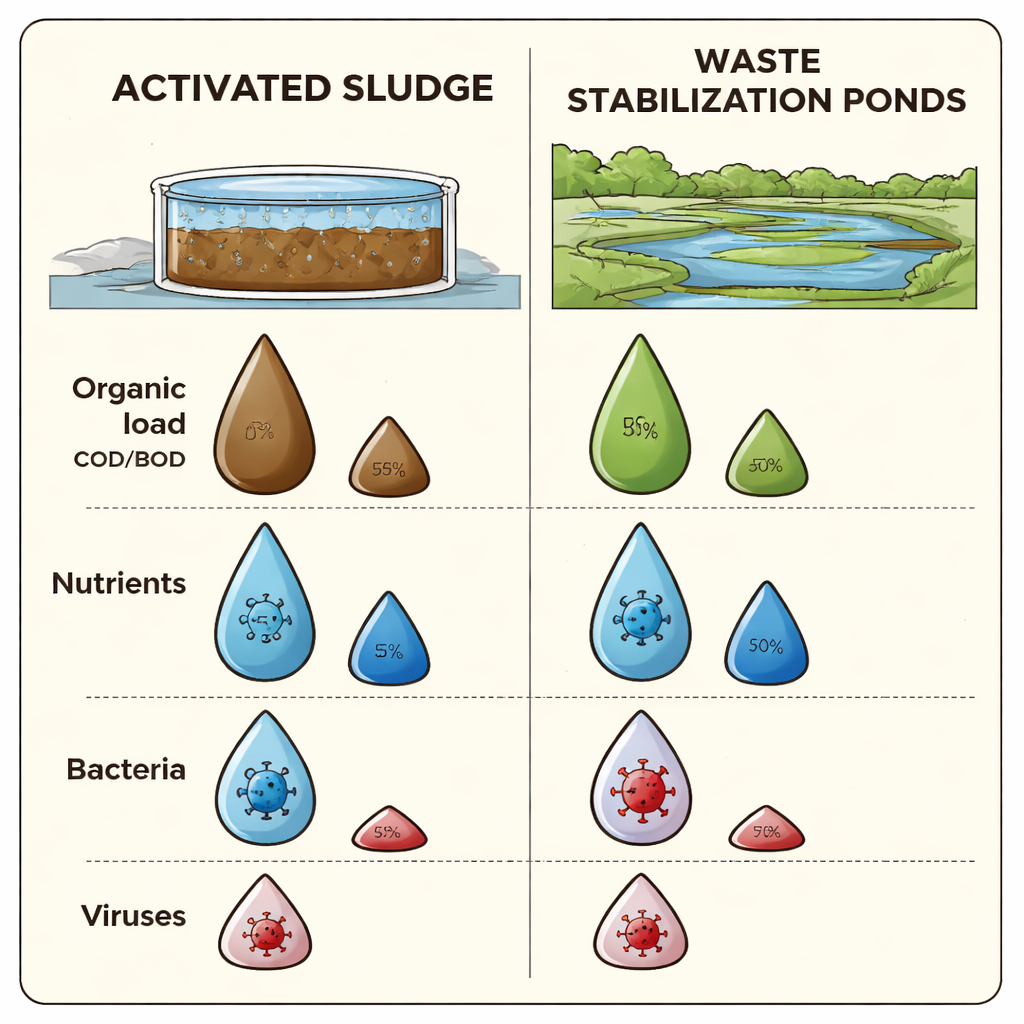
The team sampled incoming and outgoing water every month for seven months and measured common pollution indicators. These included chemical and biological oxygen demand (COD and BOD), which describe how much organic material is present, as well as nutrients such as nitrogen and phosphorus that can fuel algal blooms if released to rivers or canals. The activated sludge plant removed almost 90% of COD and more than 80% of BOD, leaving a much clearer effluent with low organic content. The pond system, by contrast, removed only about 56% of both COD and BOD on average, and its performance varied widely over time. High levels of algae and decaying plant matter in the ponds likely kept organic pollution higher at the outlet. For nutrients, both plants reduced nitrogen and phosphorus, but the activated sludge system again did better, especially for phosphorus, which it removed by both biological uptake and chemical binding.
What Happens to Harmful Bacteria?
Beyond basic water quality, the study tracked large groups of bacteria that signal fecal contamination, such as total coliforms and Escherichia coli, along with specific pathogens including Salmonella, Pseudomonas, Staphylococcus, and Listeria. Both plants cut bacterial levels by several orders of magnitude, thanks to settling, natural die‑off, and in the case of activated sludge, efficient clumping and removal of bacteria with the sludge. The activated sludge plant consistently achieved slightly higher log‑reductions than the ponds, especially for disease‑causing species that tend to cling to particles. Yet even after treatment, measurable numbers of bacteria and pathogens remained in the final water of both systems, indicating that discharge or reuse without further safeguards can still carry a risk of infection.
The Hidden Challenge: Viruses That Slip Through
Because viruses are tiny and often more resistant than bacteria, the researchers also measured several human‑related viruses and virus‑like markers, including adenoviruses, rotaviruses, a bacterial virus called crAssphage, and somatic coliphages. They found that viral levels dropped by only about one to three orders of magnitude, far less than the reductions seen for bacteria. The activated sludge plant generally performed better for some viruses, such as adenovirus, while the ponds did better for others, but neither technology consistently removed them to very low levels. Statistical tests showed that common bacterial indicators did not reliably predict how much virus remained, underscoring that “passing” current bacterial standards does not automatically mean the water is safe from viral infections.
What This Means for Safe Water Reuse
For countries that must reuse treated wastewater to cope with water scarcity, this study sends a clear message. Modern activated sludge plants can outperform simple pond systems for removing organic pollution, nutrients, and bacteria, but both approaches struggle to get rid of hardy human viruses. Relying only on traditional bacterial checks in regulations can create a false sense of security, because viruses may persist even when bacterial counts look acceptable. The authors argue that water managers should include virus‑specific targets and markers, such as crAssphage, when judging treatment performance. Adding extra treatment steps or protective measures—especially where people may touch or inhale droplets from reused water—will be essential to turn wastewater from a health hazard into a reliable resource.
Citation: Kamel, M.A., Rizk, N.M., Gad, M. et al. Comparative performance of activated sludge and waste stabilization ponds for the removal of pollutants and pathogens in full-scale wastewater treatment plants in Egypt. Sci Rep 16, 5266 (2026). https://doi.org/10.1038/s41598-026-35933-4
Keywords: wastewater treatment, activated sludge, stabilization ponds, water reuse, waterborne viruses