Clear Sky Science · en
Exogenous ascorbic acid enhances drought tolerance in Hypericum perforatum L. by modulating antioxidant defense and osmotic adjustment
Why a common vitamin matters to a famous herb
St. John’s wort is best known as a herbal remedy for mild depression, but like many crops it struggles when water is scarce. As droughts intensify with climate change, farmers and growers need simple ways to keep valuable plants alive and productive. This study asks a surprisingly down‑to‑earth question: can a cheap, familiar compound—vitamin C sprayed on leaves—help St. John’s wort cope with serious water shortage, and if so, how does it work inside the plant?
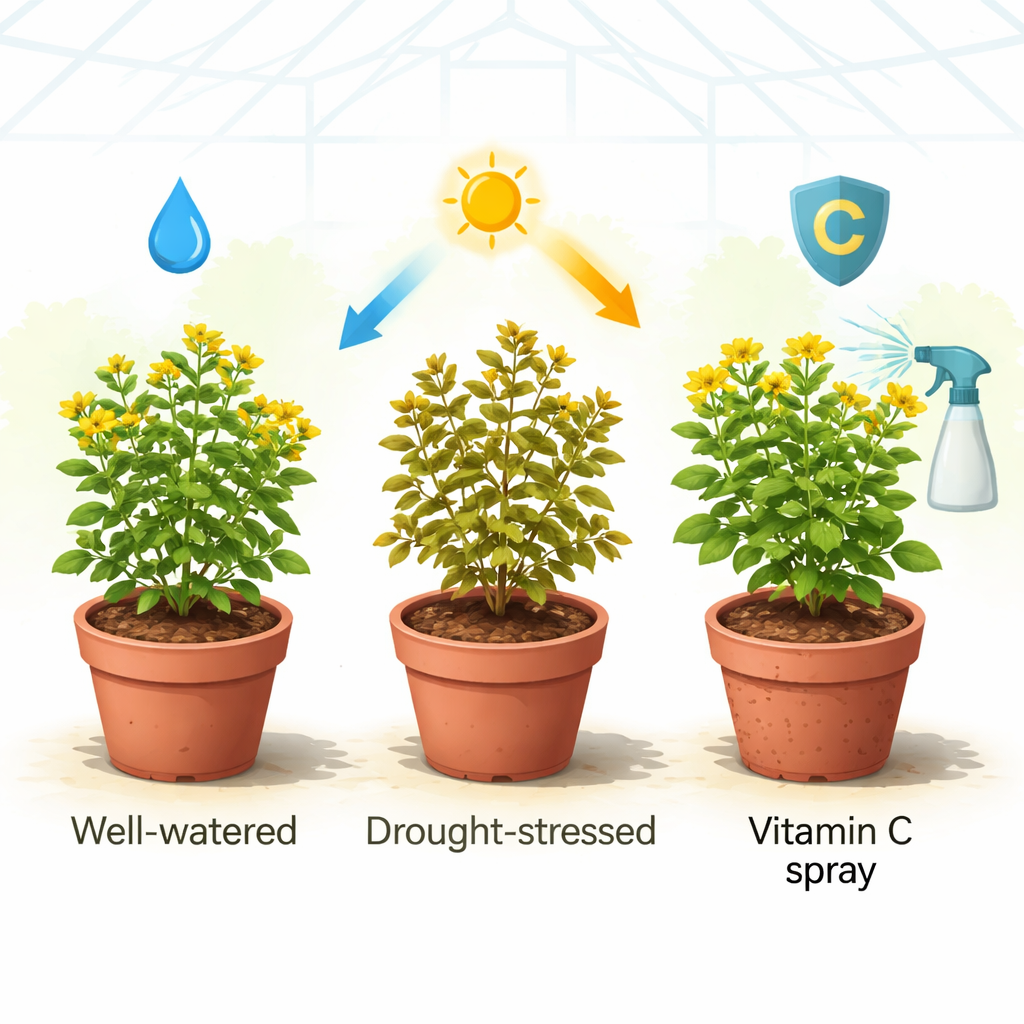
Testing plants under thirsty conditions
The researchers grew St. John’s wort plants in pots in a greenhouse and exposed them to three watering levels: full irrigation, moderate drought, and severe drought. Before the dry period began, some plants were sprayed on their leaves with solutions of vitamin C (also called ascorbic acid) at two strengths, while others were sprayed with water only. Over eight weeks, the team measured how tall the plants grew, how heavy their shoots and roots became, how much leaf area they produced, and how well their leaves held water and captured light for photosynthesis.
Growth saved by a vitamin spray
Without any vitamin C, severe drought sharply stunted the plants: they produced less biomass, smaller leaves, and shorter shoots and roots. In contrast, plants pretreated with the higher vitamin C dose (400 mg per liter) kept much of their growth even under harsh water shortage. Their shoot fresh and dry weights under severe drought were similar to well‑watered control plants, showing that the foliar spray largely cancelled out the usual drought‑driven loss of above‑ground growth. Root traits still declined overall with less water, but vitamin‑treated plants showed partial protection, especially in root dry weight, meaning they maintained more functional root tissue for taking up what little water was available.
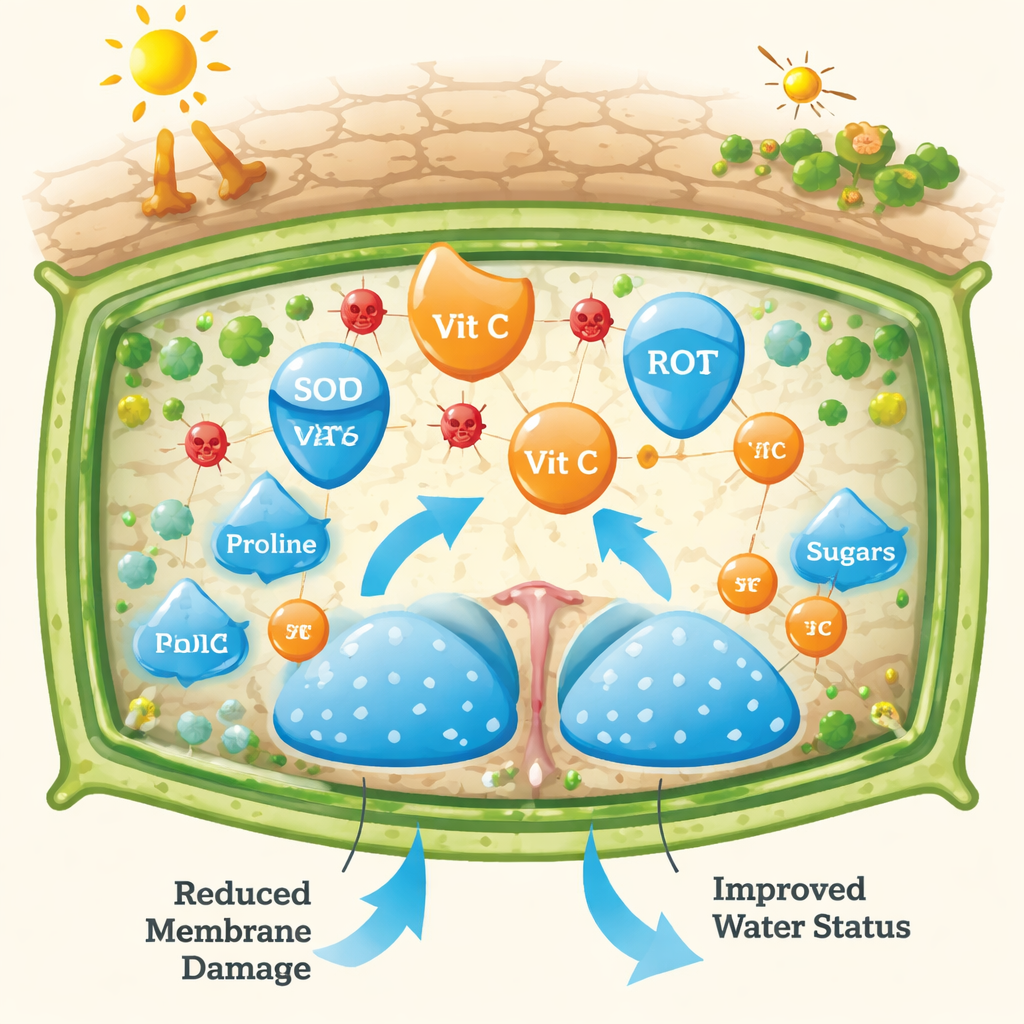
Protecting leaves, water balance, and cell membranes
Drought normally causes leaves to lose green pigments, dry out, and suffer damage to the tiny water‑filled compartments and membranes that keep cells alive. In unsprayed plants, severe drought reduced chlorophyll and carotenoid levels, lowered relative water content in the leaves, and worsened the efficiency of photosystem II, a key step in turning light into chemical energy. At the same time, markers of damage—electrolyte leakage and a breakdown product called malondialdehyde—shot up. Vitamin C sprays softened all of these blows. Treated plants under severe drought kept more chlorophyll, held more water in their leaves, and showed healthier photosystem performance. Their membranes leaked less and accumulated less malondialdehyde, clear signs that the cells were physically better preserved.
How the plant’s inner defenses are boosted
To understand why the plants were healthier, the authors looked inside at molecules that help cells ride out stress. Under drought, plants naturally build up “osmolytes” such as proline and simple sugars that help them retain water, and they ramp up antioxidants that neutralize harmful reactive oxygen species created when metabolism is disrupted. In this study, drought alone raised proline, sugars, natural vitamin C, and phenolic compounds, but spraying extra vitamin C pushed these levels even higher, especially under severe stress. Enzymes that detoxify reactive oxygen—catalase, ascorbate peroxidase, and superoxide dismutase—also became much more active in vitamin‑treated plants. Statistical analyses that considered all measurements together showed a clear pattern: drought pushed plants toward a high‑damage state, while vitamin C shifted them toward a profile dominated by strong antioxidant defenses and improved water management.
What this means for growers and herbal medicine
Put simply, foliar vitamin C acts like a priming shield for St. John’s wort facing drought. A strong spray before or during dry spells helps the plant hold onto water, keep its green machinery running, and protect its cells from internal chemical damage. The study identifies 400 mg per liter as an especially effective dose. Because vitamin C is inexpensive and already widely used in agriculture, this strategy could offer a practical way to stabilize yields of this medicinal herb—and potentially other crops—when water is limited. Future work in real fields and at the genetic level will be needed, but the message for non‑specialists is clear: a simple vitamin spray can help a sensitive but valuable plant stay greener and grow better through a drought.
Citation: Asadi, F., Etemadi, N., Amirikhah, R. et al. Exogenous ascorbic acid enhances drought tolerance in Hypericum perforatum L. by modulating antioxidant defense and osmotic adjustment. Sci Rep 16, 6822 (2026). https://doi.org/10.1038/s41598-026-35931-6
Keywords: drought tolerance, St. John’s wort, vitamin C, plant antioxidants, osmotic adjustment