Clear Sky Science · en
Transmission line fault detection and classification using bi-orthogonal wavelet transform (5.5) based signal decomposition
Keeping the Lights On
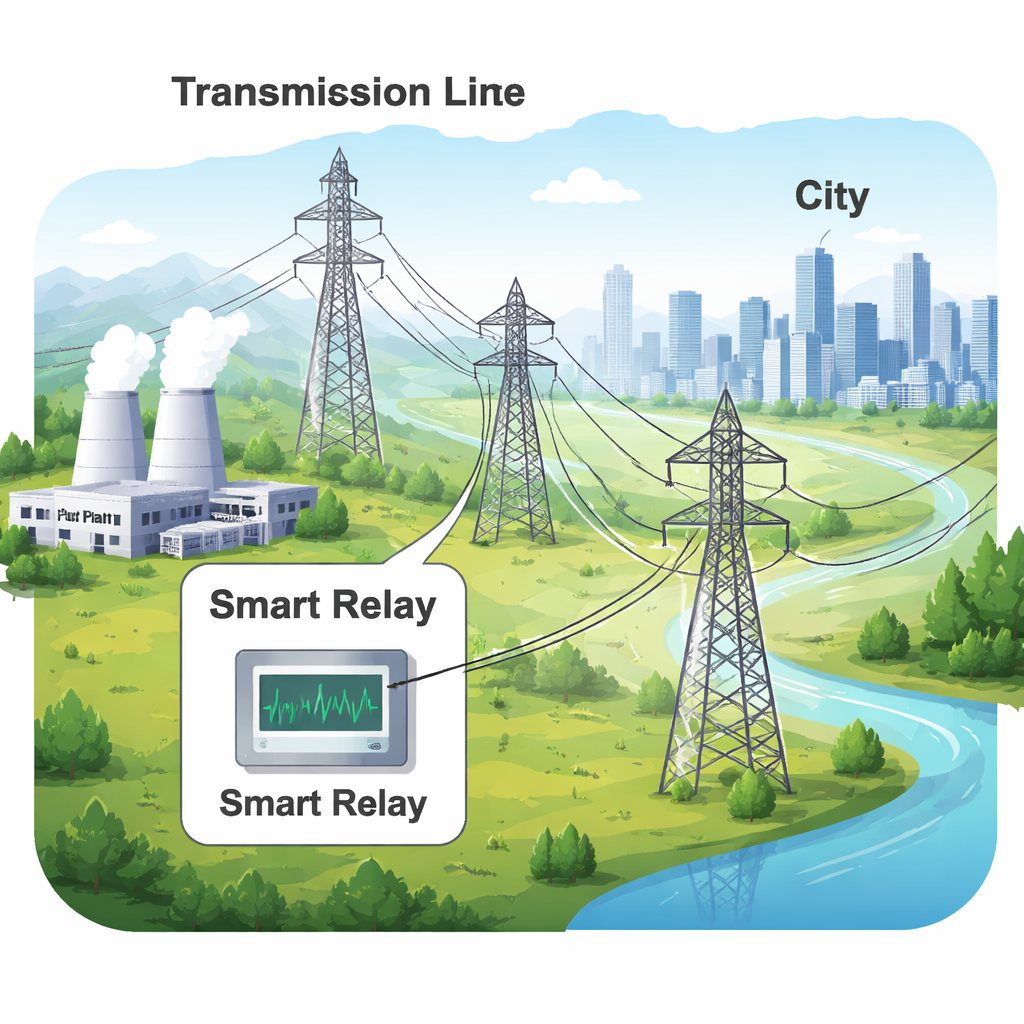
Modern life depends on electricity flowing smoothly over hundreds of kilometers of high‑voltage transmission lines. When something goes wrong on those lines—a tree branch, lightning, or worn equipment—power can flicker, blackouts can spread, and hardware can be damaged. This paper explores a smarter way to spot and pinpoint such problems almost instantly, giving grid operators a better chance to keep the lights on and protect expensive infrastructure.
Why Power Lines Are Hard to Protect
Long transmission lines are exposed to weather, pollution, and ever‑changing operating conditions. A fault can mean anything from one wire brushing against a tree to all three phases shorting together with the ground. Some faults are obvious, producing huge currents that classic protection devices can easily detect. Others are subtle: high‑resistance paths, complex series‑compensated lines with capacitors and protective components, and situations where measurement transformers or renewables distort the signals. Traditional tools like Fourier‑based methods and Kalman filters work well for smooth, repetitive waveforms, but they struggle to capture the brief, sharp disturbances that actually reveal when and where a fault has occurred.
A New Lens on Electrical Disturbances
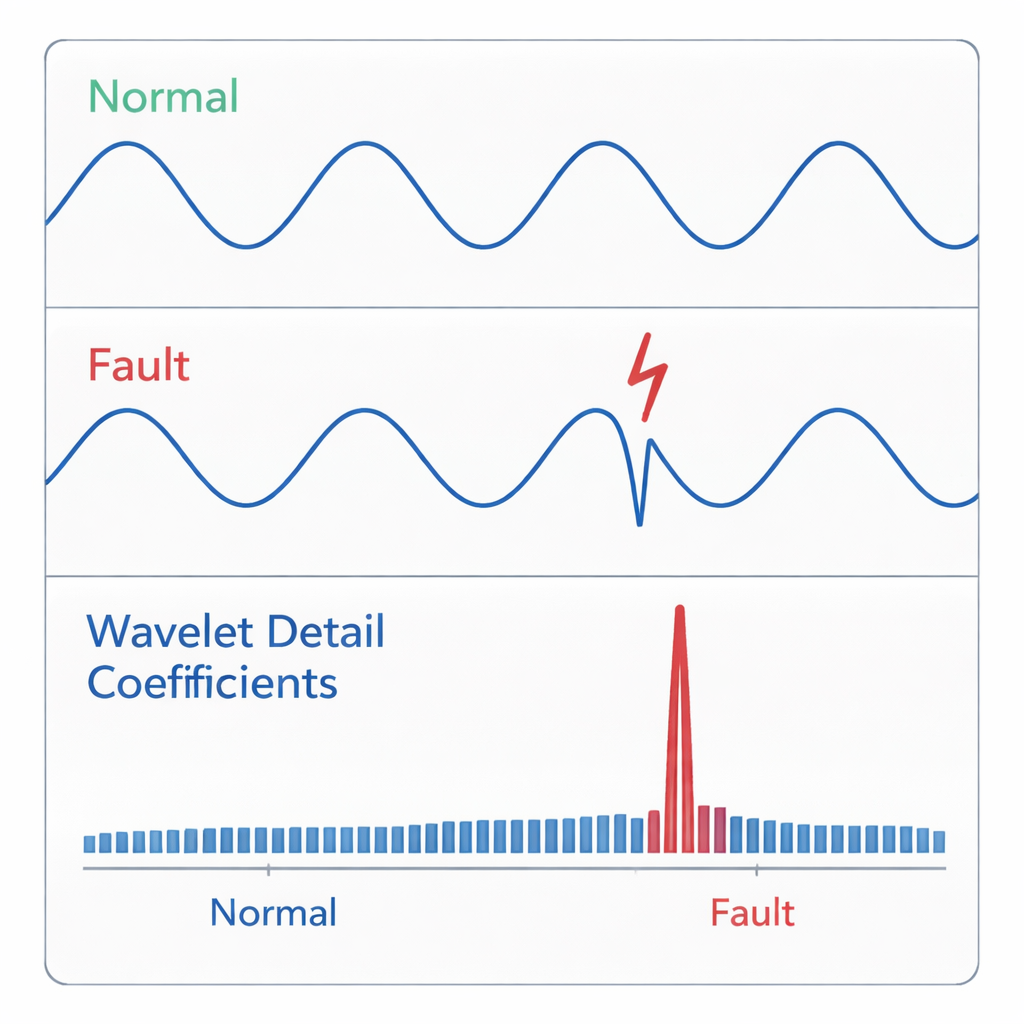
The authors turn to wavelet analysis, a signal‑processing technique that looks at both time and frequency at once. Instead of averaging over an entire cycle, wavelets zoom in on short slices of the current waveform and highlight sudden changes. After comparing 17 different wavelet “families,” they found that a specific bi‑orthogonal wavelet, known as bior5.5, was especially good at isolating the high‑frequency bursts created by faults. In particular, the first level of wavelet decomposition preserved most of the important energy in the signal while remaining simple enough for fast, real‑time use in digital relays.
How the Smart Fault Detector Works
The proposed method listens to the three phase currents and the neutral (ground) current on a model 400 kV, 300 km transmission line. Whenever a disturbance happens, the system runs a single‑level wavelet transform on these currents and measures the “detail coefficients,” which spike sharply when something abnormal occurs. By comparing the size of these spikes against carefully chosen threshold values, the algorithm can both detect that a fault exists and determine which phases and whether the ground are involved. It distinguishes ten common fault types, such as line‑to‑line, line‑to‑ground, and three‑phase faults, by examining patterns in the coefficients and by adding them into a combined index that separates balanced and unbalanced events.
Testing Tough Real‑World Conditions
To see whether this approach would hold up in practice, the researchers simulated a wide range of stresses on the line. They varied fault resistance, the position of the fault along the line, and the amount of series compensation from 0% to 70%. They also modeled the non‑linear behavior of metal‑oxide varistors (MOVs) and spark gaps that protect series capacitors, as well as realistic issues like current‑transformer saturation and current inversion. In every case, the faulty phases showed clearly higher wavelet coefficients than healthy phases, and the method remained accurate by adjusting its threshold values to match the operating scenario. When compared against more conventional tools like FFT, DFT, and the S‑transform, the bior5.5 wavelet scheme detected faults more quickly—within about 2–4 milliseconds—and with higher accuracy and better noise immunity.
From Simulation to Real‑Time Protection
Because the technique uses only a single wavelet level and simple peak‑and‑threshold logic, it is light enough to run on existing digital relay hardware without pushing processor limits. The authors estimate that the required calculations take only microseconds per sample on standard DSP or FPGA platforms, well within the time budgets used in modern protection systems. This makes the method attractive not just as a theoretical improvement, but as a realistic upgrade path for actual substations.
What This Means for Everyday Users
For non‑specialists, the bottom line is straightforward: this study shows that a carefully chosen wavelet tool can act like a highly trained “ear” on the grid, catching the faint signatures of trouble that older methods miss. By spotting faults faster and classifying them more reliably—even on long, heavily compensated lines with noisy and distorted signals—the proposed approach can help prevent cascading outages, reduce equipment damage, and support a more resilient power system. As more renewables and complex electronics connect to the grid, such smart protection schemes will be increasingly important to keep electricity safe, stable, and available.
Citation: Chothani, N., Sheikh, M., Patel, D. et al. Transmission line fault detection and classification using bi-orthogonal wavelet transform (5.5) based signal decomposition. Sci Rep 16, 5303 (2026). https://doi.org/10.1038/s41598-026-35929-0
Keywords: power transmission faults, wavelet-based protection, biorthogonal wavelet transform, high-voltage transmission lines, digital relays