Clear Sky Science · en
Application of cinnamon essential oil microcapsules in anti-fungal preservation of Spatholobi caulis
Why protecting herbal medicines from mold matters
Many people turn to traditional herbal remedies for their health, often assuming that “natural” also means “safe.” But like bread forgotten in a damp kitchen, dried medicinal plants can quietly grow mold during storage. This study focuses on Spatholobi caulis, a widely used traditional Chinese medicine for improving blood circulation, and explores whether the warm, familiar scent of cinnamon—captured in tiny protective capsules—can help keep this herb safer and more effective over time. 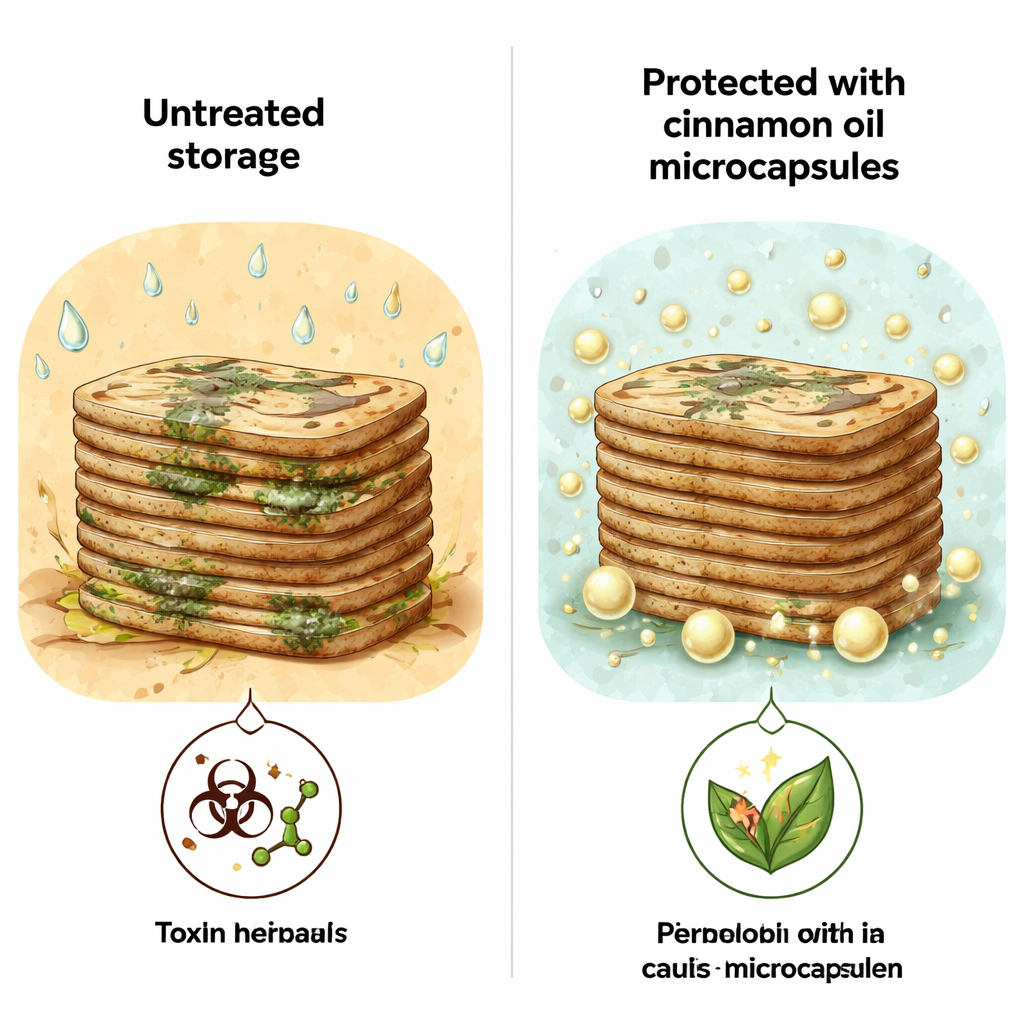
The problem with moldy medicinal herbs
Spatholobi caulis is made from dried vine stems and is used in clinics to treat problems such as poor circulation, menstrual pain, and rheumatism. Its benefits come mainly from flavonoids and other delicate plant compounds that do not age well in poor storage conditions. When the herb is kept in warm, humid air, airborne fungi quickly colonize its surface. These molds do more than make the slices look spoiled: they consume the herb’s active ingredients and can produce dangerous toxins, including aflatoxins, that may harm the liver and other organs when taken over time.
Tracking down the main mold culprits
The researchers began by collecting moldy samples of Spatholobi caulis and carefully isolating the fungi growing on them. By examining colony shape and color under the microscope and confirming identities with DNA sequencing, they pinpointed four dominant species: Penicillium implicatum, Talaromyces rugulosus, Aspergillus sydowii, and Aspergillus niger. These are common airborne molds that are already known to spoil foods, fruits, and other medicinal plants and to contribute to mycotoxin contamination. When these strains were deliberately sprayed back onto clean herb slices, all four rapidly caused visible decay within a week, confirming them as the main spoilers in storage.
Putting plant essential oils to the test
To find a safer way to control these molds, the team screened 20 plant essential oils, including garlic, oregano, rosemary, and cinnamon. In petri dish tests, they measured how well each oil stopped fungal growth and determined the lowest dose needed to halt and then kill the molds. Garlic, oregano, and cinnamon oils all showed strong activity, but cinnamon essential oil consistently worked at the lowest concentrations across all four species. This superior performance is thought to come from components such as cinnamaldehyde, which can damage fungal cell membranes and disturb their energy balance, pushing them toward cell death.
Capturing cinnamon in tiny protective shells
Pure essential oils have a drawback: they evaporate quickly and lose strength. To overcome this, the scientists used a technique called microencapsulation, trapping cinnamon oil inside ring-shaped sugar molecules called β-cyclodextrin to form microscopic solid particles. They systematically adjusted the ratio of wall material to oil, the temperature, and the mixing time, and found that a 4:1 wall-to-core ratio at about 60 °C for 2 hours gave an encapsulation efficiency of around 68%. Under the microscope, the resulting microcapsules appeared as smooth, roughly spherical particles. A 30‑day test at room temperature showed that regular cinnamon oil lost about two-thirds of its weight to evaporation, while the microcapsules lost only about one-fifth, confirming a clear slow-release, stabilizing effect. 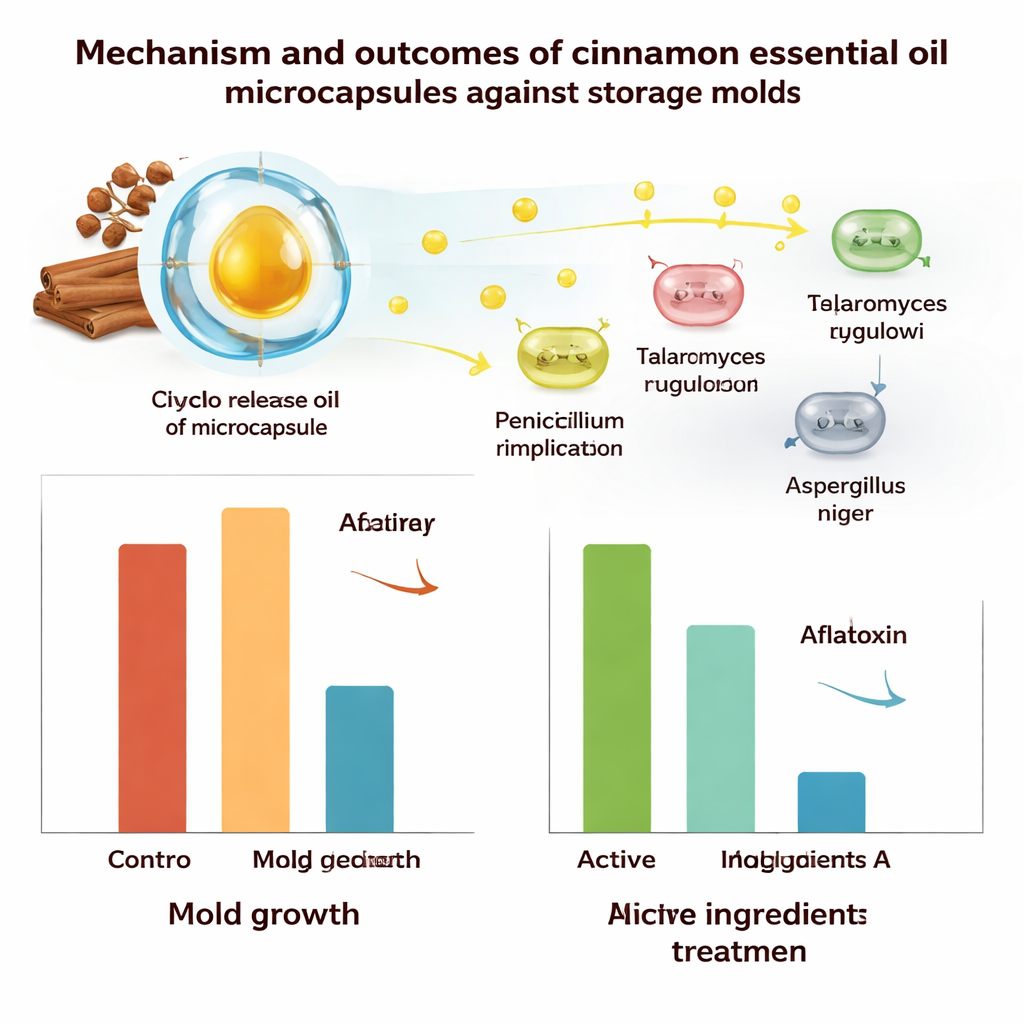
Real-world storage: fresher herbs, fewer toxins
The crucial question was whether these microcapsules would actually protect the herb during storage. The team stored Spatholobi caulis slices under warm, very humid conditions either with or without added cinnamon oil microcapsules. Over nine days, untreated slices quickly grew heavy mold, while treated slices showed little or delayed growth and remained visibly better preserved. Chemical tests revealed that key active ingredients—total flavonoids, catechin, epicatechin, and protocatechuic acid—declined in all samples as time went on, but the loss was much smaller in the microcapsule-treated group. At the same time, the level of aflatoxin A, a harmful mold toxin, climbed steadily in untreated herbs but stayed significantly lower in the treated ones at every time point.
What this means for safer herbal remedies
For non-specialists, the takeaway is straightforward: the study shows that packaging cinnamon essential oil inside microscopic carriers can turn a common kitchen spice into a gentle, slow-acting shield for stored medicinal herbs. By steadily releasing antifungal compounds, these microcapsules cut mold growth, help preserve the herb’s beneficial chemicals, and suppress the buildup of dangerous toxins. While further work is needed to scale up production and confirm safety in real-world supply chains, this approach offers a promising, more natural alternative to synthetic preservatives for keeping traditional remedies both effective and safer to use.
Citation: Gao, Y., Jiang, C., Xia, C. et al. Application of cinnamon essential oil microcapsules in anti-fungal preservation of Spatholobi caulis. Sci Rep 16, 5042 (2026). https://doi.org/10.1038/s41598-026-35927-2
Keywords: Spatholobi caulis, cinnamon essential oil, microcapsules, antifungal preservation, mycotoxin control