Clear Sky Science · en
The prognostic significance of metastasis to No. 253 lymph node in stage III rectal cancer based on a bicenter retrospective study
Why this matters for people with rectal cancer
For anyone facing rectal cancer, one of the most pressing questions is, “What are my chances in the long run?” Doctors usually answer this using broad staging systems that group many patients together. This study asks a more focused question: does cancer reaching a specific, deep lymph node group—called the No. 253 lymph nodes—signal a clearly worse outlook, and can that information be turned into a personalized, easy-to-use prediction tool?
A closer look at hidden “signal” lymph nodes
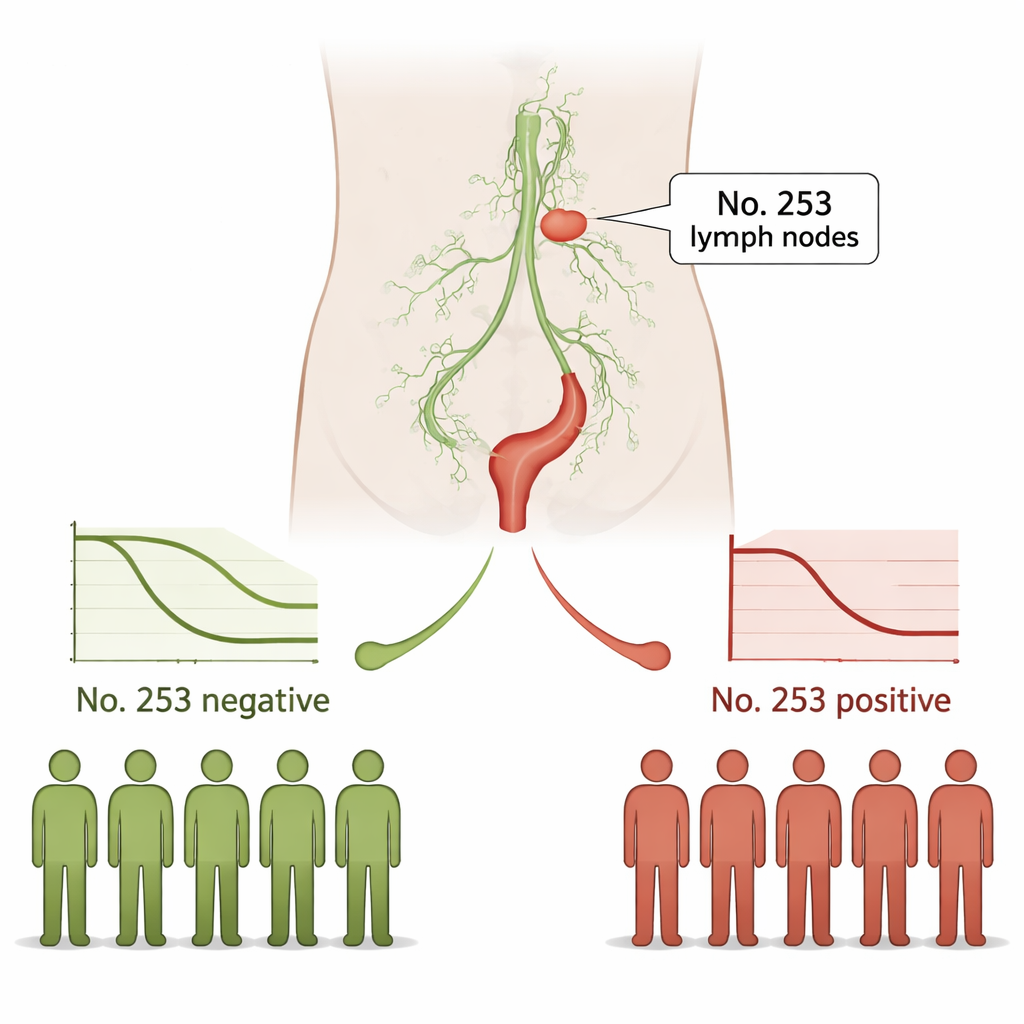
When rectal cancer spreads, it often travels first through nearby lymph vessels and nodes before moving farther into the body. The No. 253 lymph nodes sit high in the abdomen at the root of a key blood vessel that supplies the large intestine. Surgeons sometimes remove this group during rectal cancer operations, but because spread to these nodes is relatively rare, their true importance has been debated. Earlier research mixed rectal cancers with colon cancers or included only small numbers of patients, leaving uncertainty about what these nodes really tell us about long-term survival in people with advanced (stage III) rectal cancer.
Large two-hospital study of advanced rectal cancer
To get a clearer answer, researchers from two major hospitals in China reviewed the records of 956 patients with stage III rectal cancer who had surgery between 2016 and 2024. All had tumors within 15 centimeters of the anus, had the No. 253 lymph nodes removed and examined, and did not have distant metastases at the time of surgery. Many also received standard chemotherapy and, in some cases, radiation before surgery. The team used a method called propensity score matching, which pairs patients with and without No. 253 spread but with otherwise similar characteristics, to make a fairer comparison between the two groups.
What No. 253 spread says about survival
Before matching, only about 8% of patients showed cancer in the No. 253 nodes, confirming that such spread is uncommon. However, those patients tended to have more advanced tumors and other worrisome features. After carefully matching 78 patients with No. 253 involvement to 260 without it, the researchers followed them for a median of about 32 months. The contrast was striking: three years after surgery, about 61% of patients with No. 253 spread were still alive, compared with nearly 82% of those without it. Statistical models that took many other factors into account still found that cancer in these nodes nearly tripled the risk of death. Sex, the status of the tissue margin around the removed tumor, and how advanced the tumor stage was also influenced survival, but the No. 253 nodes stood out as a powerful warning sign.
A web tool for personalized risk estimates
Building on these findings, the team created a visual prediction tool called a nomogram and turned it into a free web-based calculator. By entering a few key details—whether the No. 253 nodes contain cancer, the overall stage, the status of the surgical margin, and the patient’s sex—a doctor can obtain estimated chances of surviving 1, 3, and 5 years after surgery. The researchers tested the tool on the original patients and on separate groups from each hospital. The model consistently showed good accuracy in ranking patients by risk, and its predictions matched real outcomes reasonably well. Decision analyses suggested that using the tool could help doctors make more informed choices about follow-up and additional treatment compared with ignoring this information.
What this means for patients and families
The study concludes that cancer spread to the No. 253 lymph nodes is not just a small detail on a pathology report—it is a strong indicator of a tougher road ahead for people with stage III rectal cancer. At the same time, the work offers something constructive: a practical online calculator that integrates this deep-node information with standard staging to give more individualized survival estimates. For patients, this could mean clearer conversations about prognosis and closer tailoring of treatment and monitoring plans, turning a once obscure anatomical term into a useful guide for long-term care.
Citation: Yang, Y., Li, J. & Wang, G. The prognostic significance of metastasis to No. 253 lymph node in stage III rectal cancer based on a bicenter retrospective study. Sci Rep 16, 5762 (2026). https://doi.org/10.1038/s41598-026-35920-9
Keywords: rectal cancer, lymph node metastasis, prognosis, survival prediction, nomogram