Clear Sky Science · en
Clinical superiority of belly-tendon montage over others for recording air-conducted ocular vestibular evoked myogenic potential
Why eye–ear reflex tests matter
Feeling dizzy, off‑balance, or unsteady can be frightening, yet routine hearing and balance tests sometimes miss the root cause. This study looks at a subtle eye‑muscle reflex, called the ocular vestibular evoked myogenic potential (oVEMP), that helps doctors assess tiny balance organs deep in the inner ear. The researchers show that a simple change in how skin electrodes are placed on the face – the “belly‑tendon” montage – can make this test much more useful, especially for people with a nerve disorder called auditory neuropathy spectrum disorder (ANSD).
Listening to balance through the eyes
Our inner ears do more than hear; they also contain motion sensors that tell the brain when we tilt, move, or change speed. When these balance sensors are stimulated by sound, they trigger tiny, rapid responses in the eye muscles. oVEMP testing captures these responses using electrodes on the skin around the eyes, turning invisible nerve activity into waveforms on a screen. These waveforms help clinicians judge whether the balance pathways linked to the eyes are working properly.
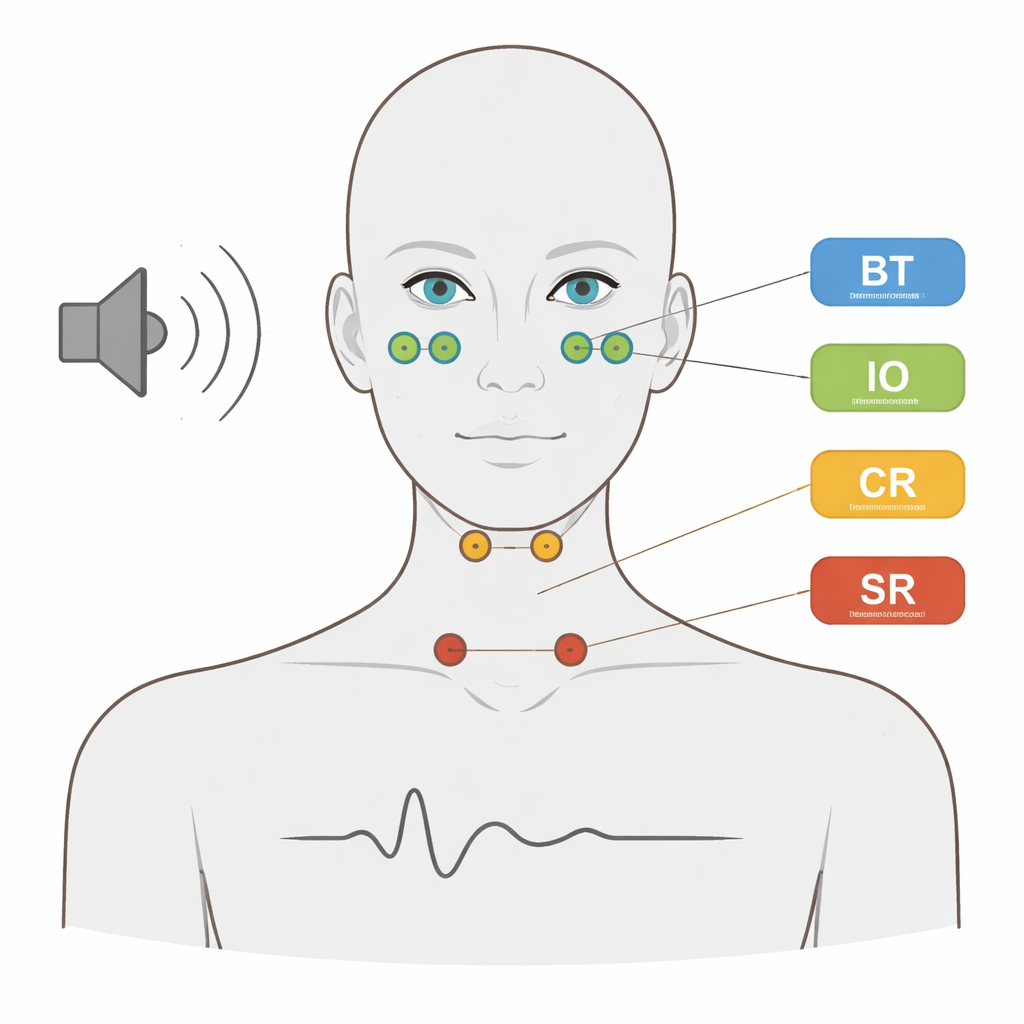
Four ways to place the sensors
Traditionally, oVEMPs are recorded with an “infra‑orbital” (IO) layout, where the main electrode sits under the eye and the reference electrode is placed a little lower on the cheek. Recent work in healthy volunteers suggested that an alternative “belly‑tendon” (BT) layout – with both electrodes aligned along the path of a key eye muscle – produces stronger, cleaner signals. Two other layouts, chin‑referenced (CR) and sternum‑referenced (SR), place the reference electrodes on the chin or chest. All four approaches were tested in this study, but the key question was whether BT still outperforms the others in real patients, not just healthy volunteers.
Putting the layouts to a tough clinical test
The authors recruited 30 young adults with ANSD and 30 age‑matched adults with normal hearing and balance. ANSD is a condition in which the ear’s sensory cells may work, but the nerve fibers that carry sound and balance information fire in a disorganized, delayed way. This makes standard hearing tests and some balance tests less reliable. For each participant, the team delivered loud, low‑frequency tone bursts to one ear while the person looked up at a fixed point, which activates the relevant eye muscles. Using specialized equipment, they recorded oVEMPs simultaneously from all four electrode layouts and then examined how often they saw a clear response, how large it was, and how well it distinguished patients from healthy controls.
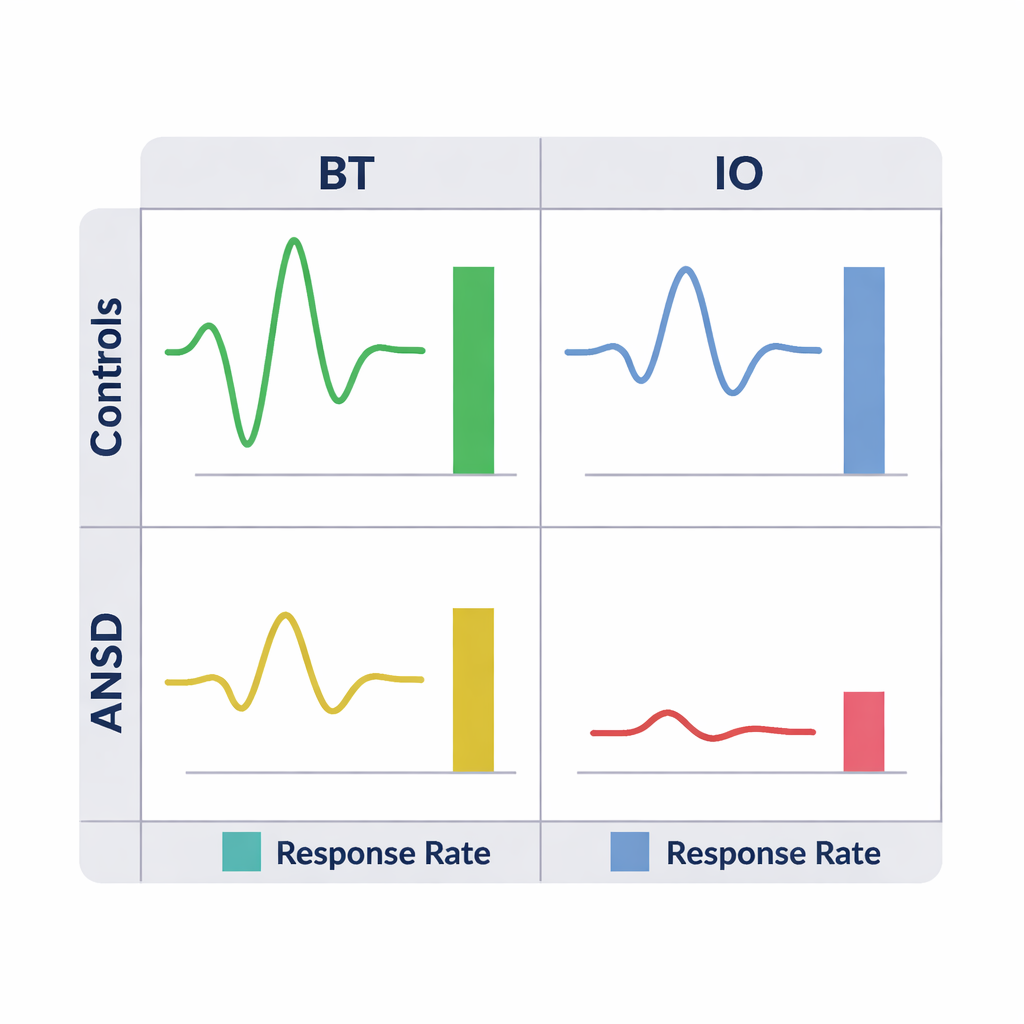
Stronger signals and clearer separation
In healthy volunteers, nearly every ear produced an oVEMP with all layouts, but the BT layout still stood out: its responses were consistently larger and arrived slightly sooner than those from the other three. The real proving ground was ANSD, where oVEMP responses are often absent. Here the BT layout detected responses in almost half of all ears, compared with only about one in ten ears with the conventional IO layout and even fewer with CR and SR. Every ear that showed a response with the IO layout also showed one with BT, but many ears responded only with BT. Moreover, when comparing patients to healthy controls, BT produced bigger differences in response size and timing than IO, making it easier to spot abnormal results.
What this means for patients
For people with suspected balance problems – especially those with auditory neuropathy – this work suggests that simply rearranging the electrodes on the face can turn a weak or “missing” test result into a clear, usable signal. The belly‑tendon layout boosts the chance of recording an oVEMP and makes differences between healthy and disordered nerve pathways more obvious, without adding new equipment or major complexity. In practical terms, the study provides strong evidence that clinics should favor the BT layout over traditional approaches when using oVEMP to investigate inner‑ear balance disorders.
Citation: Raveendran, R.K., Singh, N.K. Clinical superiority of belly-tendon montage over others for recording air-conducted ocular vestibular evoked myogenic potential. Sci Rep 16, 7693 (2026). https://doi.org/10.1038/s41598-026-35914-7
Keywords: vestibular testing, auditory neuropathy, balance disorders, eye muscle reflex, inner ear