Clear Sky Science · en
Multiscale diffusion-enhanced attention network for steel surface defect detection in Polysilicon Production
Why tiny flaws in steel suddenly matter a lot
Behind every shiny solar panel stands a forest of steel towers that refine polysilicon, the ultra-pure material at the heart of modern photovoltaics. If microscopic cracks or pits form in these towers, they can quietly weaken the metal until a catastrophic failure halts production—or worse, jeopardizes worker safety. This article introduces a new artificial-intelligence system that can spot such defects quickly and reliably, even when they are almost invisible to the naked eye, offering a path to safer, more efficient solar manufacturing.
Solar factories and their hidden weaknesses
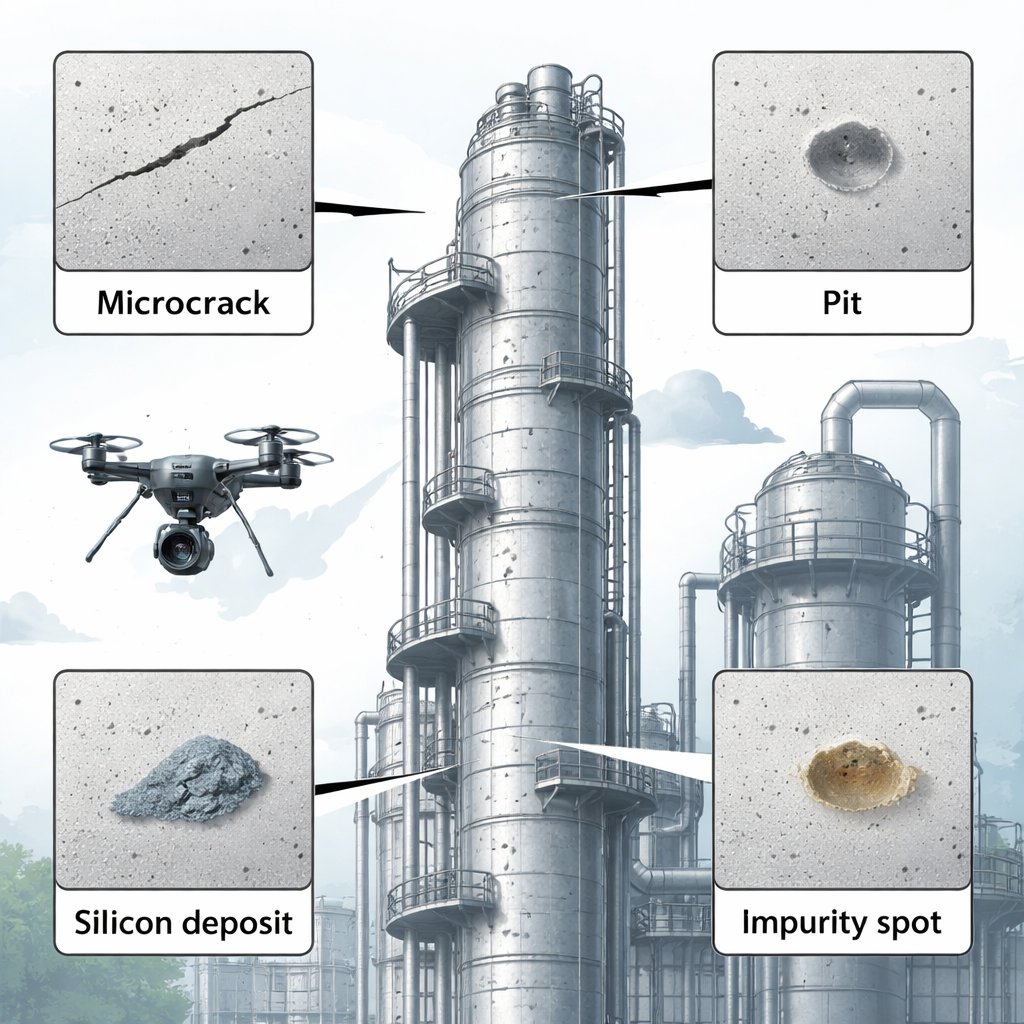
Polysilicon distillation towers operate under punishing conditions: temperatures near 1,000–1,200 °C, corrosive vapors, glaring reflections, and complex visual backgrounds. On their steel surfaces, multiple kinds of flaws can appear—hairline microcracks, tiny pits, silicon deposits, scratches, weld defects, and impurity spots. Each looks different in size, shape, and texture, and many blend into the background. Traditional inspection methods depend heavily on human experts or standard computer-vision tools, both of which struggle to pick out faint, irregular defects from noisy scenes in real time. As the scale of photovoltaic production grows, this becomes a serious bottleneck for quality control and plant safety.
A smarter eye for difficult defects
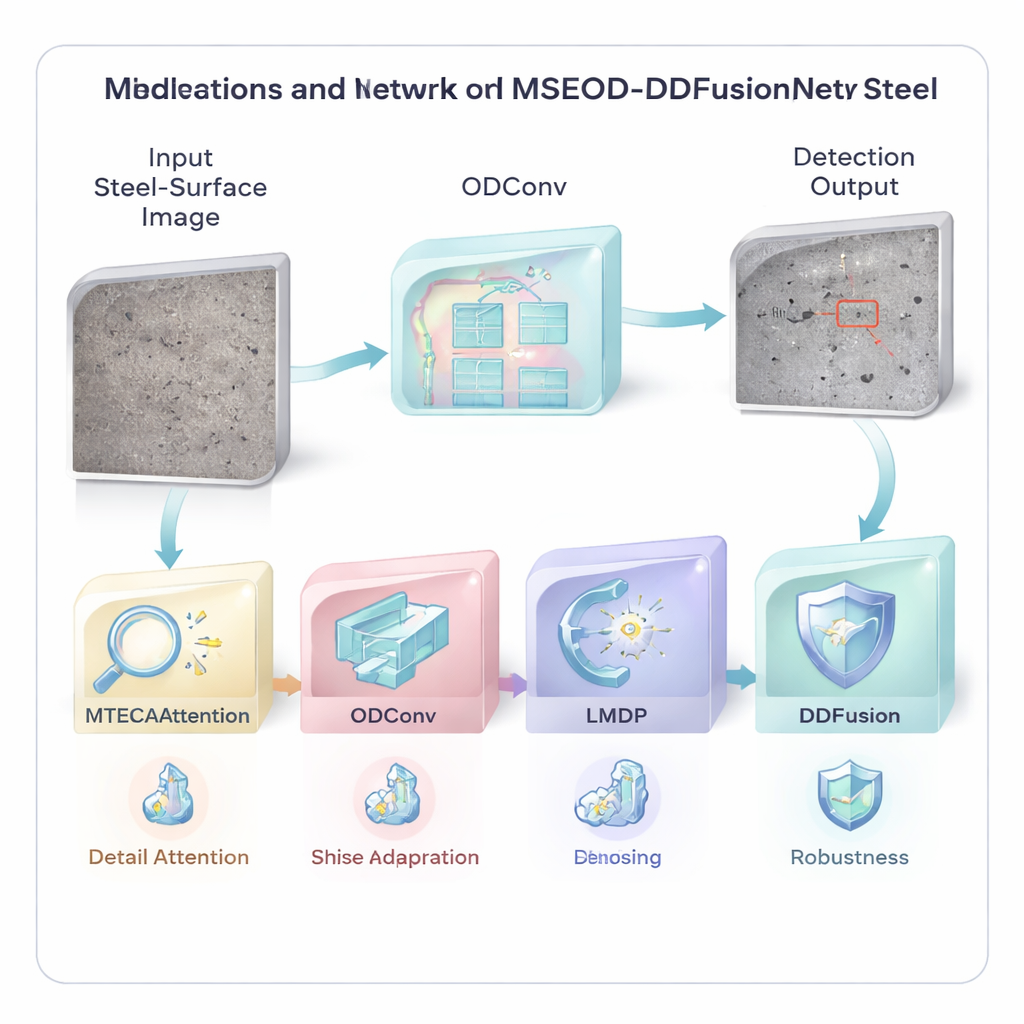
The researchers propose MSEOD-DDFusionNet, a tailored deep-learning system designed specifically for this harsh industrial setting. Rather than relying on a single monolithic network, they build a pipeline of four cooperating modules, each solving a key weakness of existing detectors. First, a feature-fusion stage preserves fine detail at multiple scales, so tiny defects are not washed out when images are compressed inside the network. Next, a dynamic convolution stage allows the system to reshape its own filters on the fly, helping it match the odd outlines of real cracks, pits, and deposits. A third module separates the job of suppressing noise from amplifying weak signals, so fragile defect patterns are strengthened instead of erased. Finally, a diffusion-based stage trains the system to survive realistic noise such as glare, blur, and thermal artifacts, learning how to clean up corrupted features without smearing away the defects themselves.
From drone images to reliable decisions
To test their approach, the team created a new industrial dataset, called DDTE, built from 6,252 high-resolution images captured by a drone hovering several meters from operating equipment. Experts labeled six critical defect types with precise bounding boxes and checked one another’s work to ensure high agreement. The new system was then compared against popular object-detection models such as the YOLO family and several transformer-based methods, not only on DDTE but also on public steel-defect benchmarks and even unrelated domains like everyday photographs (PASCAL VOC) and blood-cell microscopy (BCCD). Across these varied tests, MSEOD-DDFusionNet consistently found more defects, localized them more accurately, and ran faster than the strongest baselines, while using fewer parameters than many competitors.
What the numbers say about performance
On the core DDTE dataset, the new system reached 82.6% mean average precision at a standard detection threshold (mAP50) and 61.6% across stricter thresholds, surpassing a strong YOLO baseline while running at nearly 200 frames per second. It showed particular gains on difficult categories such as pits and weld defects, where complex shapes and lighting often confuse other methods. On additional steel datasets, it sharply improved recognition of irregular flaws like cracks and inclusions. Even when transferred to everyday scenes and medical images, the same architecture maintained high accuracy and high speed, suggesting that the design principles—better multi-scale detail handling, shape adaptation, and robust noise modeling—are broadly useful, not just in polysilicon plants.
What this means for industry and beyond
For a non-specialist, the bottom line is that the authors have built a more attentive, more adaptable, and more resilient set of “eyes” for machines. By carefully engineering how their network preserves fine details, tracks odd shapes, and learns to ignore misleading noise, they achieve near state-of-the-art accuracy while keeping the system light enough for real-time deployment on factory floors. In practical terms, this means steel towers in solar-material plants can be inspected faster and more reliably, reducing the risk of unexpected failures and improving product quality. The same ideas could be applied to other safety-critical settings—from pipelines to bridges and medical scans—where the difference between a safe system and a dangerous one may hide in defects no bigger than a few pixels.
Citation: Duan, Y., He, L., Wang, Z. et al. Multiscale diffusion-enhanced attention network for steel surface defect detection in Polysilicon Production. Sci Rep 16, 5307 (2026). https://doi.org/10.1038/s41598-026-35913-8
Keywords: steel surface defects, polysilicon production, industrial inspection, deep learning detection, computer vision