Clear Sky Science · en
Systematic revision of the Hemiphyllodactylus yunnanensis complex with descriptions of six new species
Tiny Wall Lizards With a Big Secret
Along the walls of old houses and city parks in southwest China lives a tiny, pencil‑thin gecko that most people never notice. For more than a century, scientists also largely treated these “slender geckos” as a single widespread species. This study reveals that what looked like one unremarkable lizard is actually a whole hidden constellation of species, each confined to small corners of Yunnan and nearby regions—and many may need protection before we even learn they exist.
From One Gecko to a Growing Clan
The geckos in question belong to the genus Hemiphyllodactylus, a group of small, camouflaged lizards scattered across South and Southeast Asia. In China, nearly all such geckos were once lumped under the name Hemiphyllodactylus yunnanensis. Over the past decade, herpetologists began to suspect that this “species” was actually a complex of many look‑alikes, but the picture remained muddled. Older studies relied mostly on body measurements and scale counts, often without knowing exactly where each specimen came from or how it was related to others. As more new species were named from scattered localities, it became clear that the original label had turned into a taxonomic catch‑all.
Fieldwork in the Hills and City Streets
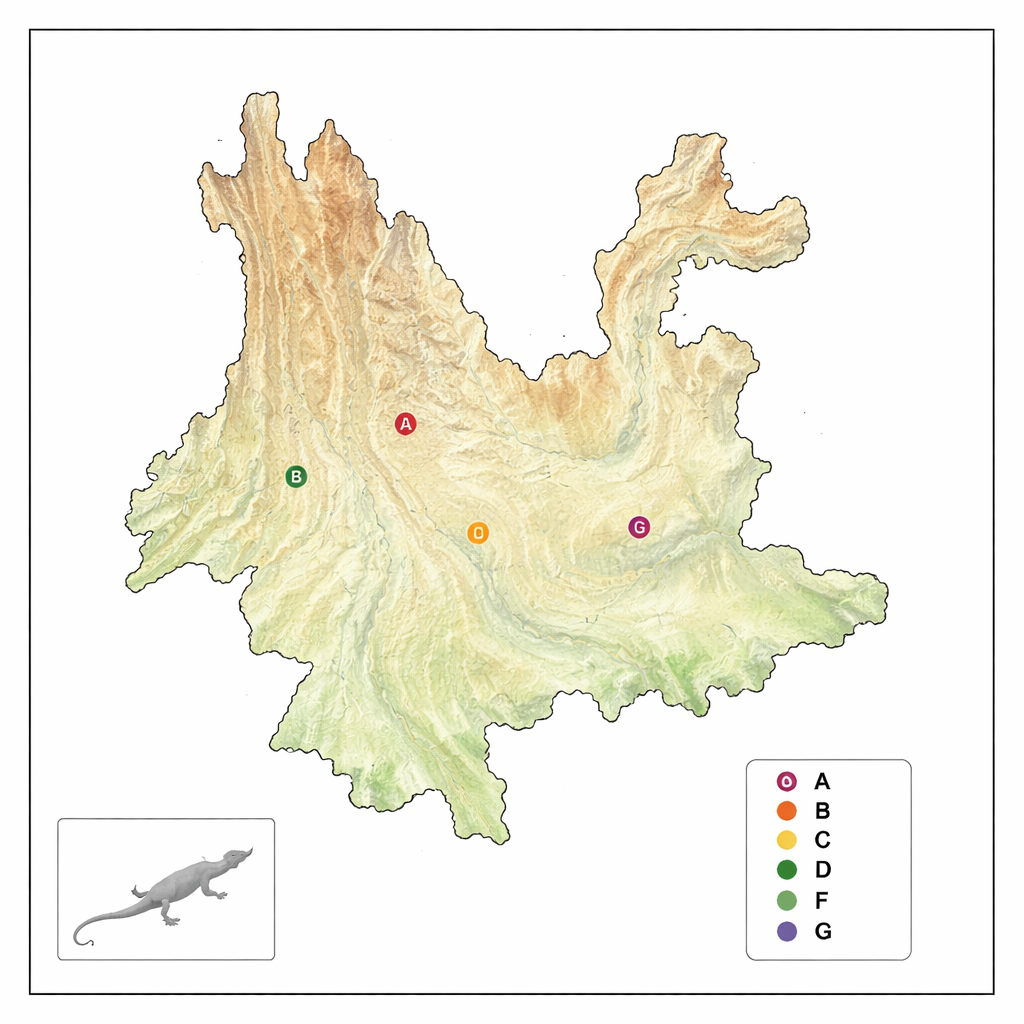
To untangle this puzzle, the authors spent several years surveying lizards across Yunnan Province and part of neighboring Guizhou. They searched walls of houses, parks, temples, and forest edges at night—the time when these shy geckos are active. From 11 locations they collected 73 individuals that had all been considered part of the H. yunnanensis complex. Each specimen was carefully preserved for both DNA analysis and detailed measurement, and the researchers anchored their work on geckos from Kunming, the city where the original type specimen of H. yunnanensis was described over a century ago. Those top‑of‑the‑line reference animals allowed the team to decide which modern populations truly matched the original species.
Reading Species Boundaries in DNA and Scales
Back in the lab, the team sequenced a piece of mitochondrial DNA (the ND2 gene) and two nuclear genes from every lizard. They compared these sequences with data from related gecko species stored in public databases and used powerful computer methods to build evolutionary trees. The result was striking: the supposed single species split cleanly into seven well‑supported genetic lineages. A barcode‑style analysis that looks for sudden jumps in genetic difference agreed, indicating clear gaps between groups. Importantly, the authors did not rely on DNA alone. They also measured body proportions, counted rows of tiny scales and toe pads, and examined color patterns. Statistical analyses showed that each lineage occupies its own space in “morphological” terms as well—subtle differences in head shape, number of scales, and markings that, taken together, reliably separate the groups.

Six New Names for Hidden Neighbors
By comparing every population against the Kunming geckos, the researchers concluded that only those from Kunming, Lijiang, and Huaning truly represent H. yunnanensis. The other six lineages, though outwardly similar, are genetically distinct and show consistent differences in body structure and coloration. The team formally describes them as six new species, each named after its home region: H. dayaoensis, H. jingdongensis, H. maguanensis, H. shuangbaiensis, H. xingyiensis, and H. yuanyangensis. Most are known only from a single town or cluster of villages, often living on old brick walls near patches of karst forest. Their ranges do not appear to overlap much, making each species a local specialist tied closely to its landscape.
Why Hidden Diversity Matters
Recognizing these cryptic species is more than a bookkeeping exercise. Many of these geckos occupy tiny areas that are increasingly threatened by development, habitat loss, and even local use of lizards as traditional medicine. If all of them were treated as one widespread species, the disappearance of a unique local form might go unnoticed. By combining genetics with careful anatomical work, this study provides a clearer map of slender gecko diversity in Yunnan and highlights areas that may harbor additional, as yet undescribed species. For non‑scientists, the message is simple and powerful: even the most modest creatures on a garden wall can conceal a surprisingly rich slice of Earth’s biodiversity, and naming that hidden life is a first step toward saving it.
Citation: Zhou, H., Wang, J., Han, K. et al. Systematic revision of the Hemiphyllodactylus yunnanensis complex with descriptions of six new species. Sci Rep 16, 5562 (2026). https://doi.org/10.1038/s41598-026-35912-9
Keywords: slender geckos, cryptic species, Yunnan biodiversity, integrative taxonomy, species discovery