Clear Sky Science · en
Determinants of hypertension among Bhutanese adults: evidence from a national WHO STEPS survey
Why Blood Pressure Matters in Bhutan
High blood pressure, or hypertension, is often called the “silent killer” because it usually has no symptoms until it causes a heart attack or stroke. As Bhutan modernizes—people move to towns, diets change, and daily life becomes less active—doctors are seeing more of this hidden threat. This study used a nationwide health survey to ask a simple but crucial question: which everyday factors are most strongly linked with high blood pressure in Bhutanese adults, and who is most at risk?
Taking the Pulse of a Nation
Researchers analysed data from a World Health Organization STEP-wise survey carried out across all 20 districts of Bhutan in 2019. From more than 5,500 people aged 15 to 69, they focused on 2,574 adults between 40 and 69 years old, because middle-aged and older adults are most likely to develop hypertension. Nurses and health workers visited selected households, interviewed participants about lifestyle habits such as drinking alcohol, exercise and diet, and then measured their height, weight, blood pressure, and cholesterol. Hypertension was counted if a person’s blood pressure was 140/90 or higher, or if they had already been diagnosed or were taking blood pressure medicine. 
How Common Is High Blood Pressure?
The findings were stark: about 44 percent of Bhutanese adults aged 40–69 years—nearly one in two—had hypertension. More than half of participants were women, and almost three-quarters lived in rural areas. Many had little or no formal education, and a substantial share were in the lowest wealth group. Over half of the group were classified as obese by Asian body-mass index standards, and another sizeable portion were overweight. Most people reported eating vegetables several times a week, yet risky habits were also common: more than 40 percent currently used alcohol, and over half chewed betel quid.
Untangling the Key Risk Factors
To understand which factors truly mattered, the authors used two approaches. First, they applied logistic regression, a standard statistical method, to compare people with and without hypertension while taking multiple influences into account at the same time. Older age clearly raised risk: people in their late 50s and early 60s were significantly more likely to have high blood pressure than those in their early 40s. Extra body weight was also important—overweight adults had higher odds of hypertension, and obese adults had more than double the odds compared with those of normal weight. Alcohol use stood out as another strong factor, with drinkers facing substantially greater risk than non-drinkers. People with borderline or high blood cholesterol were more likely to be hypertensive as well, signalling that heart and blood vessel problems tend to cluster together. Interestingly, those in higher wealth groups were less likely to have hypertension than those in the poorest households, suggesting that better living conditions and easier access to care may offer some protection.
A Network View of Risk
Next, the team turned to a more flexible tool called a Bayesian network, which treats each risk factor as a node in a web of influences. This method allows researchers to estimate how the chance of hypertension changes as different combinations of risk factors pile up. In this network, education and wealth sat at the “top,” influencing lifestyle and health conditions such as alcohol use, body weight and cholesterol, which in turn affected blood pressure. The model showed that an obese drinker with borderline cholesterol had a very high probability of having hypertension, while adding betel quid chewing slightly lowered that probability in the data—an unexpected finding that may reflect other differences between chewers and non-chewers rather than a true protective effect. 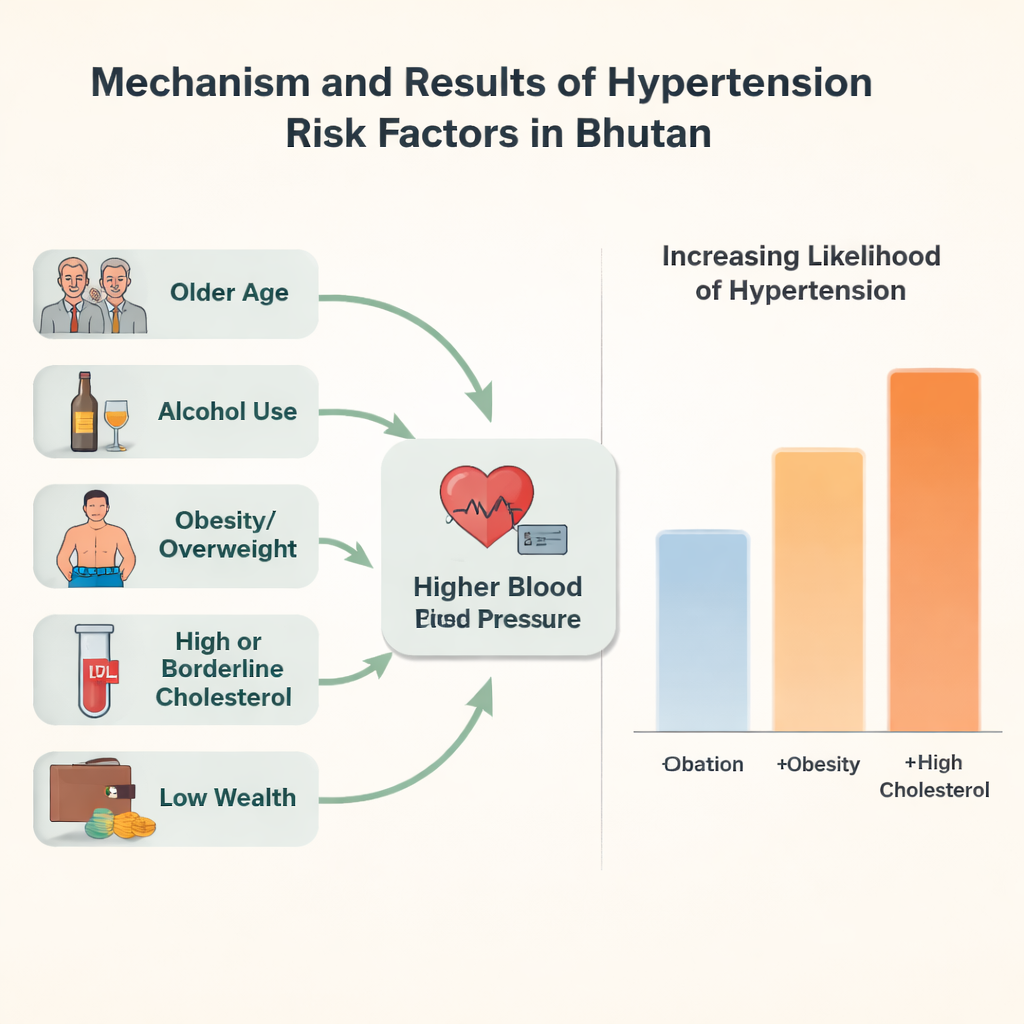
What This Means for Everyday Life
For the average Bhutanese adult, the study’s message is simple but urgent. High blood pressure is common, especially after age 40, and it is tightly linked to everyday choices and broader social conditions. While no one can turn back the clock on aging, many powerful levers are within reach: limiting alcohol, keeping body weight in a healthy range, staying physically active and getting regular checks of blood pressure and cholesterol. At a national level, the authors urge Bhutan’s Ministry of Health to strengthen programs that combine clinic-based care with community efforts to promote healthy lifestyles, particularly among poorer households. By acting on these modifiable risks now, Bhutan can prevent countless heart attacks and strokes in the decades ahead.
Citation: Chhezom, K., Wangdi, K. Determinants of hypertension among Bhutanese adults: evidence from a national WHO STEPS survey. Sci Rep 16, 5329 (2026). https://doi.org/10.1038/s41598-026-35911-w
Keywords: hypertension, Bhutan, blood pressure, alcohol use, obesity