Clear Sky Science · en
Maritime sector pathways toward net-zero emissions within global energy scenarios
Why cleaner shipping matters to everyone
Almost everything we buy has spent time at sea. Giant cargo ships move about 80% of world trade, and they currently burn heavy oil that creates roughly 2.5% of global carbon dioxide emissions. As cars, trucks, and power plants clean up, shipping could become one of the dirtiest pieces of the climate puzzle. This study asks a simple but pressing question: can global shipping reach net-zero climate pollution around mid‑century, and what would that mean for fuel choices, energy systems, and prices of everyday goods?
Big ships in a changing energy world
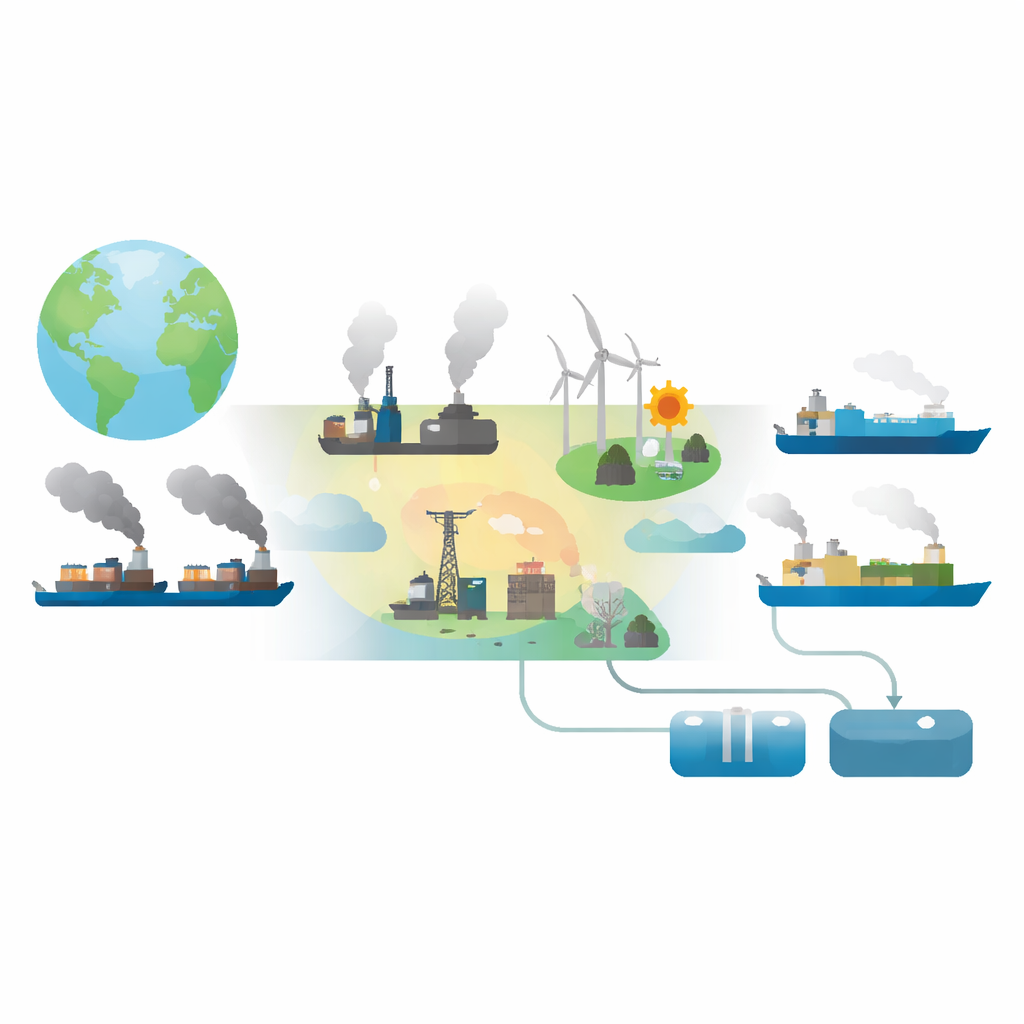
The authors argue that shipping cannot be treated as a separate, floating world. Any plan to clean up ships must fit within broader changes in how the planet produces and uses energy. Instead of looking only at what happens on board vessels, the study connects a detailed ship emissions model to a global energy and land-use model. This combined framework tracks how much fuel different ship types need, how that fuel is produced on land, and how all of this fits within global climate goals to limit warming to 1.5–2 °C. It also counts emissions from fuel production as well as from burning fuel at sea, matching the latest International Maritime Organization (IMO) climate rules.
How the researchers explored future pathways
The work uses real-world data for about 50,000 merchant ships to estimate energy use in 2019 and then projects demand out to 2100, based on expected trends in trade, population, and income. That demand feeds into a global scenario model that chooses fuel mixes and technologies that meet climate targets at lowest overall cost. The authors test pathways where the world as a whole follows either a stricter 1.5 °C or a slightly looser 1.8 °C warming limit, and where shipping reaches net-zero greenhouse gas emissions around 2055, 2060, or 2070. They also explore what happens if certain options—like ammonia, biofuels, carbon capture, or efficiency improvements—are restricted or unavailable.
New fuels, cleaner engines, and captured carbon
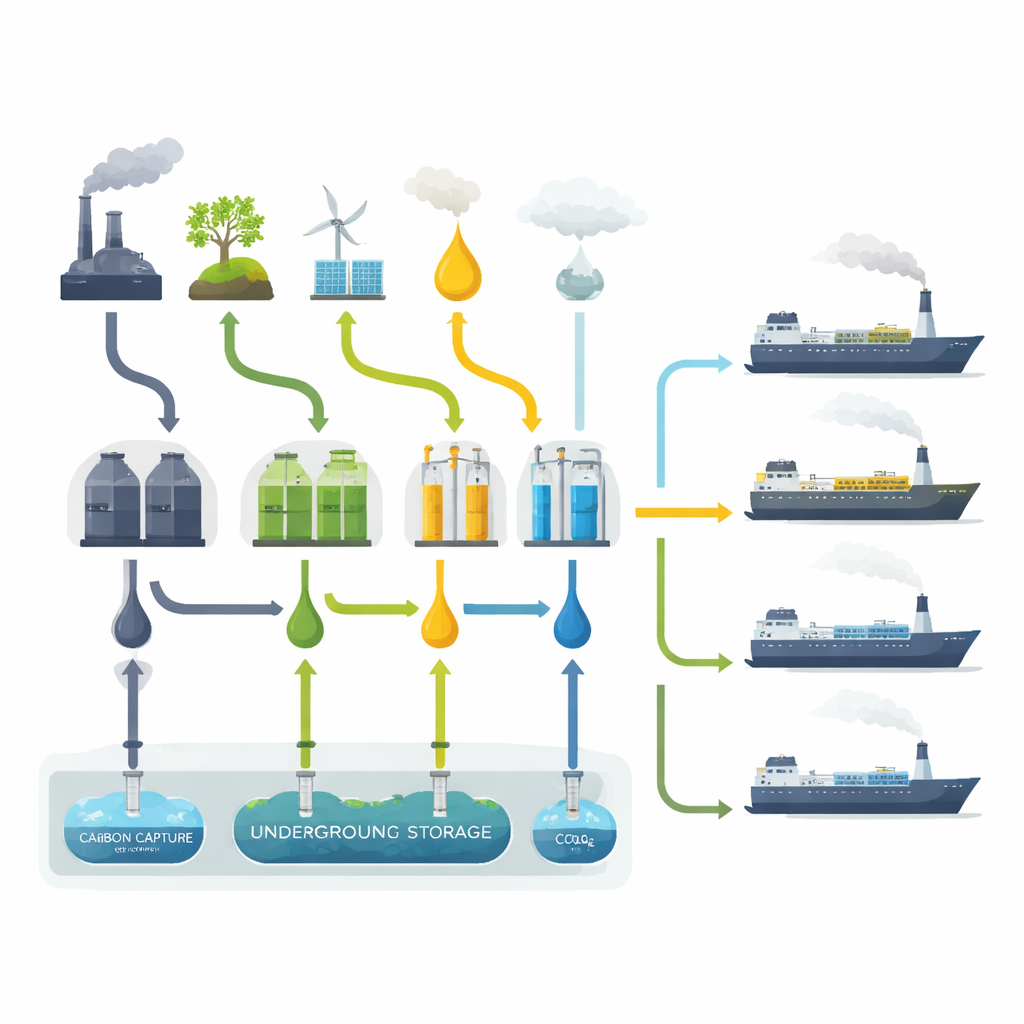
Across scenarios, shipping energy demand rises toward mid‑century and then levels off, but gets cut by about a quarter through better hull designs, smarter routing, and more efficient engines. The remaining demand gradually shifts away from today’s heavy fuel oil and marine diesel. In the early phase, liquefied natural gas plays a limited bridging role, sometimes paired with on‑board carbon capture systems that trap a large share of emissions before they reach the air. From roughly 2040 onward, the model shows a strong move toward ammonia and biofuels, many produced in ways that include carbon capture and storage. These “net‑negative” fuel pathways help offset remaining emissions and allow the overall sector to reach net‑zero. Later in the century, as renewable electricity expands, green hydrogen and green ammonia made from water and clean power become more important.
Fitting shipping into the global clean‑energy shift
One striking result is that, in energy terms, shipping is small compared with the entire global system—only about 2% of final energy demand. That means even an ambitious clean‑up of the sector does not significantly strain global supplies of renewables. Instead, ships will mostly ride along with wider energy trends rather than drive them. Under the pathways studied, the world’s primary energy mix shifts from roughly 80% fossil fuels in 2025 to less than 40% by 2050, with renewables and bioenergy taking over. Yet shipping, pushed by stricter IMO targets, actually decarbonizes faster than the global average, moving from almost full reliance on fossil fuels today to less than half by the mid‑2050s, with the rest covered by ammonia, hydrogen, and bio‑based fuels tied to carbon capture.
What it could mean for prices and fairness
Cleaner fuels are more expensive than today’s bunker fuel, and the model projects that fuel prices for ships could peak at around three and a half times current levels around 2060. Assuming fuel is about half of a ship’s operating costs, overall shipping costs would rise by just over 100%. When these higher costs are passed through to traded goods, the effect depends strongly on what is being moved and where. High‑value items like electronics or pharmaceuticals see only small price bumps, often below 5%, because shipping is a tiny part of their final price. Low‑value, heavy goods such as grain, cement, ores, and fertilizers can experience increases approaching 15% on average, with some country–product pairs reaching 30%. Smaller and geographically remote economies, many in the Global South, are hit harder, highlighting the need for policies that share the burden fairly.
What this means for the path ahead
The study concludes that getting shipping to net‑zero emissions by mid‑century is technically feasible but demands fast, coordinated action. There is no single silver‑bullet fuel: efficiency improvements, biofuels, ammonia, hydrogen, and carbon capture all play important roles at different times. Success depends on rapid growth in renewables, build‑out of fuel and storage infrastructure, and careful management of land used for bioenergy so that forests and ecosystems are protected. While cleaner ships will raise some trade costs—especially for bulk goods and remote nations—the authors argue that with smart international policies, the sector can decarbonize in step with the rest of the world, keeping global trade moving while helping to limit dangerous climate change.
Citation: Kramel, D., Krey, V., Fricko, O. et al. Maritime sector pathways toward net-zero emissions within global energy scenarios. Sci Rep 16, 8282 (2026). https://doi.org/10.1038/s41598-026-35909-4
Keywords: shipping decarbonization, alternative marine fuels, maritime climate policy, carbon-neutral transport, global energy transition