Clear Sky Science · en
Optimization study on transverse mining zoning during the capacity expansion stage of nearly horizontal open-pit coal mines
Why reshaping giant coal pits matters
Across much of the world, electricity and industry still rely heavily on coal. In China, vast open-pit mines provide much of this fuel, but as these operations grow larger, they can become less safe, more expensive, and more damaging to the landscape. This paper looks at how one such mine in northeastern China can reorganize its layout to safely boost production, while cutting waste and making better use of the land and equipment. The ideas developed here are relevant anywhere large surface mines must expand without spiraling costs or risks.
From one big pit to smarter working zones
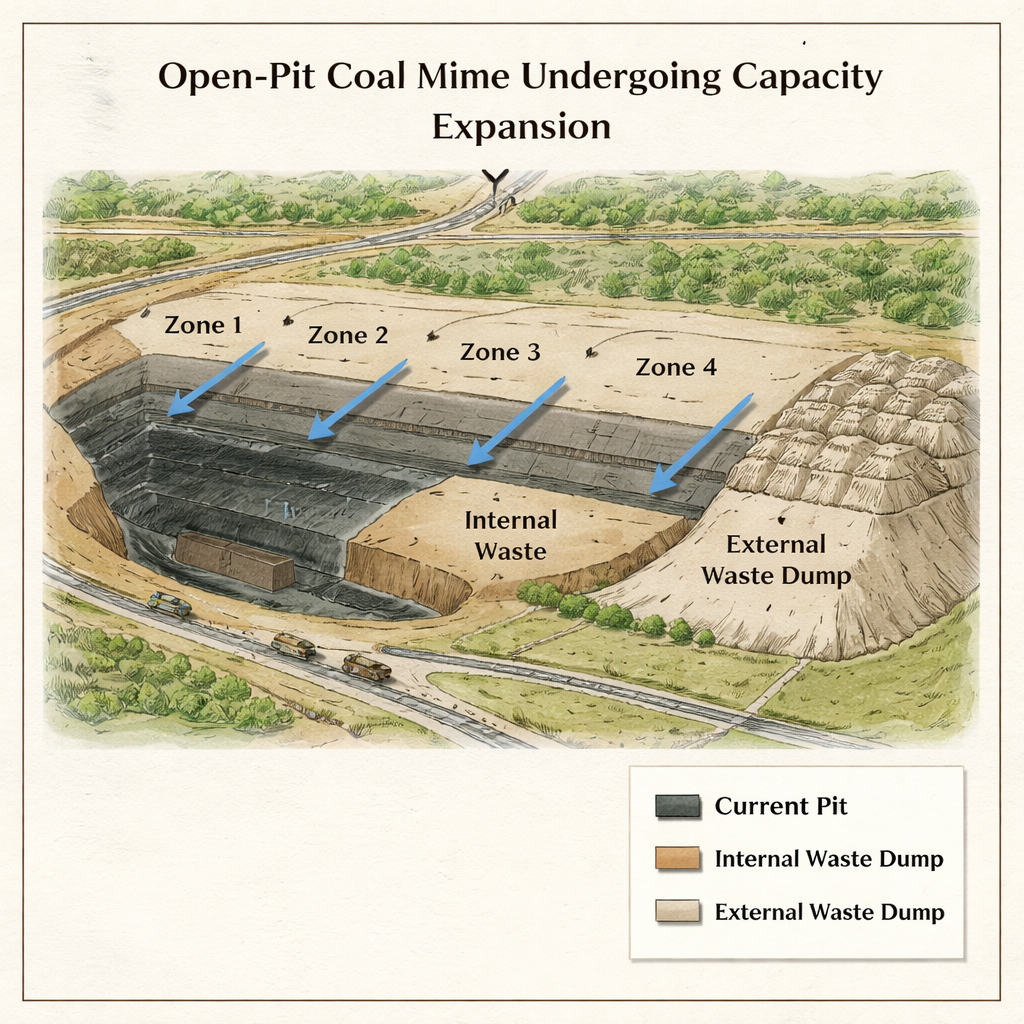
The Baoqing Chaoyang Open-Pit Coal Mine currently produces about 7 million tonnes of coal a year and aims to reach 11 million. It works a single, nearly flat coal seam using a traditional “longways” (longitudinal) layout: the mining front runs roughly straight, and trucks haul broken rock and soil to waste dumps. As production rises, this setup creates problems. The active mining line is too short, so the pit must advance quickly each year, straining equipment and scheduling. Internal waste dumps inside the pit are filling up, and their low, flattened slopes differ from design values, hinting at instability and leaving little room for extra material. At the same time, expanding external waste dumps is hard because it demands more land. The authors argue that instead of simply digging faster in the same pattern, the mine should be divided into several broader “transverse” zones that better match the coal seam and relieve pressure on waste dumps.
Finding the sweet spot for pit length and cost
A central question is: how long should the active mining front be? If it is too short, the pit must advance very quickly, raising slope risks and pushing trucks to travel further up and down. If it is too long, equipment may be spread thin and transport distances inside the pit can grow, also driving up costs. The team built a simple geometric and cost model that links annual coal output, coal seam thickness and density, allowed advance rate, and waste-rock thickness to both the stripping ratio (how much rock must be moved per tonne of coal) and the cost of blasting, digging, and hauling. They show that total stripping cost behaves like a shallow U-shaped curve as the working-line length increases: very short lines are expensive because waste must be moved from steep end-walls, while very long lines add hauling distance. For the target output of 11 million tonnes a year, the model indicates an economical working-line length between about 1.35 and 2.05 kilometers, with a best point around 1.35 kilometers and an annual advance of roughly 400–500 meters. This range then guides how wide each new mining zone should be.
Turning the mine sideways for safer waste slopes
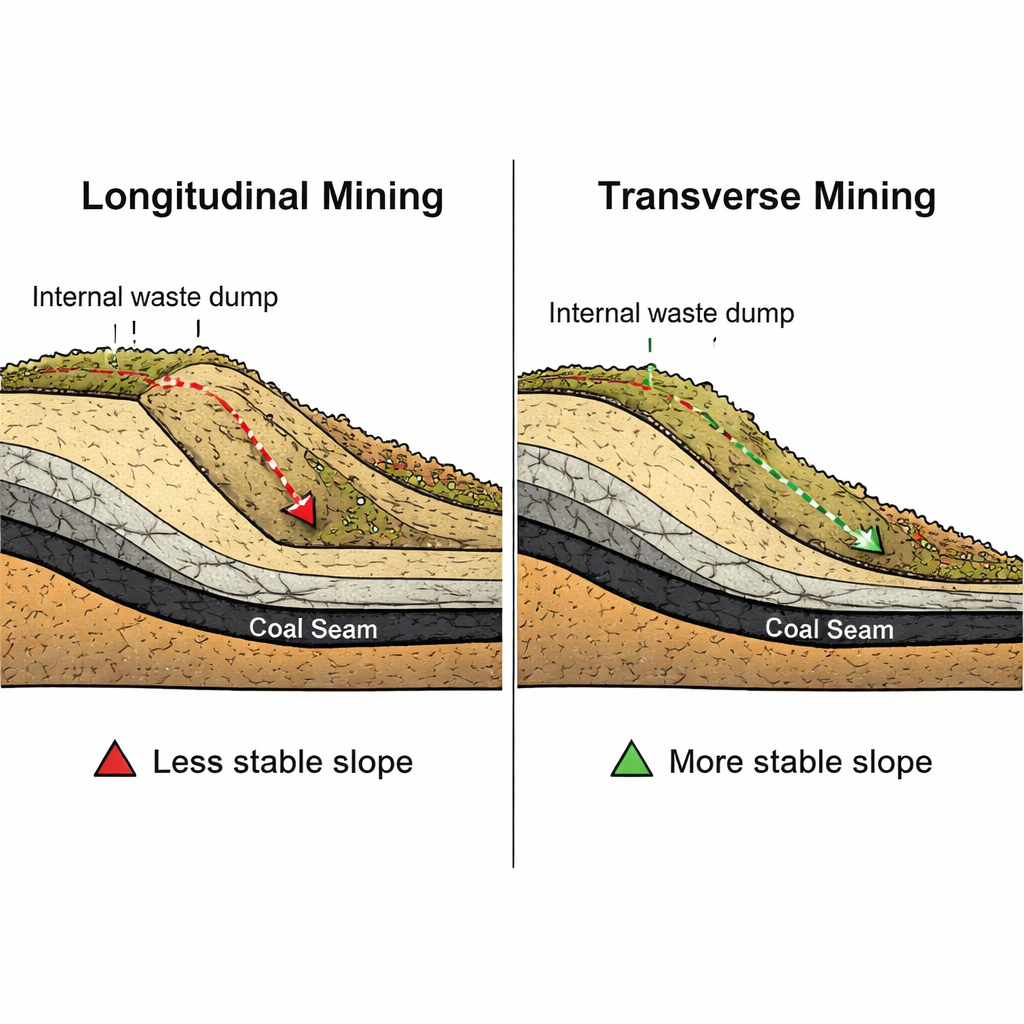
Next, the authors explore what happens if the mine is gradually turned from a longways to a sideways (transverse) layout, so that mining and dumping proceed more in line with the gentle dip of the coal seam. Using a simplified slope-stability picture, they explain that in the current pattern, internal waste dumps sit across the dip of the underlying rock layers. That geometry tends to increase the effective downhill angle that controls sliding and shortens the potential slide path, making waste piles more prone to slip. In a transverse layout, internal dumps are built more nearly along the natural dip direction. That reduces the downhill component, lengthens the sliding path, and increases the resisting forces in the rock and waste. In plain terms, the same amount of waste can be stacked in shapes and directions that are less likely to fail. This better geometry also makes drainage more orderly and benches more regular, which are both important for long-term slope health.
Comparing four blueprints with a fair scoring system
The mine planners then design four different ways of carving the pit into large zones, each with its own sequence of advance and waste dumping. Each scheme has practical pros and cons: some favor short-term convenience and shorter truck hauls, others favor longer life or simpler layouts for future large-scale machinery. To choose among them, the authors construct an eight-part scorecard that weighs geology, rock strength, water conditions, surface shape, engineering effort, economics, environmental disturbance, and social impacts such as land acquisition. Instead of relying on a single indicator or a purely subjective ranking, they blend two kinds of weighting: expert judgment (Analytic Hierarchy Process) and an “entropy” method that looks at how much information is contained in each indicator. They then feed these weighted factors into a framework called Unascertained Measure Theory, which handles mixed numbers and expert ratings and assigns each scheme a confidence level of being “excellent,” “good,” “fair,” or “poor.”
The winning plan and what it delivers
Under this combined evaluation, the second scheme stands out clearly. It reorganizes the original mining area into four wide transverse zones, with long but still manageable working lines and a layout well suited for future continuous or semi-continuous mining systems such as in-pit crushers and conveyors. This option earns a confidence score of about 0.71 in the top “excellent” category, significantly ahead of the others. Over its life, it would unlock about 971 million tonnes of coal, with an average stripping ratio of 5.8 cubic meters of rock per tonne of coal and a maximum service life of more than 34 years. Although its internal haul distances are longer in absolute terms, when costs are spread over the larger and more efficient production, it still offers the lowest overall cost per tonne and improved safety margins.
What this means beyond one mine
For a non-specialist, the key message is that how you slice and work a giant open pit can matter as much as how much coal lies beneath it. By mathematically tuning the length of the active mining front and reorienting the mine into transverse zones that align with the geology, it is possible to increase output while reducing both waste and risk. The study’s approach—a structured checklist of technical, economic, environmental, and social factors combined with a transparent scoring method—offers a template for other large surface mines facing expansion. It suggests that careful planning can turn capacity growth from a gamble into a guided, more sustainable path.
Citation: Wen, Y., Song, Z., Su, Q. et al. Optimization study on transverse mining zoning during the capacity expansion stage of nearly horizontal open-pit coal mines. Sci Rep 16, 3908 (2026). https://doi.org/10.1038/s41598-026-35908-5
Keywords: open-pit coal mining, mine planning, slope stability, capacity expansion, multi-criteria evaluation