Clear Sky Science · en
Mechanism and application of reaming anchorage of inverted wedge-shaped hole bottom in argillaceous cemented roadway
Holding Fragile Mine Tunnels in Place
Deep underground, many coal mine tunnels pass through soft, clay-rich rock that swells, creeps, and crumbles over time. Traditional steel supports and even modern rock bolts often lose their grip as this weak rock deforms, raising the risk of roof falls and costly repairs. This study explores a new way to "anchor" support bolts more securely by reshaping the very end of the drill hole, so that the rock and resin literally lock together like a wedge, keeping tunnels safer and more stable for longer.
Why Soft Rock Tunnels Are So Hard to Hold
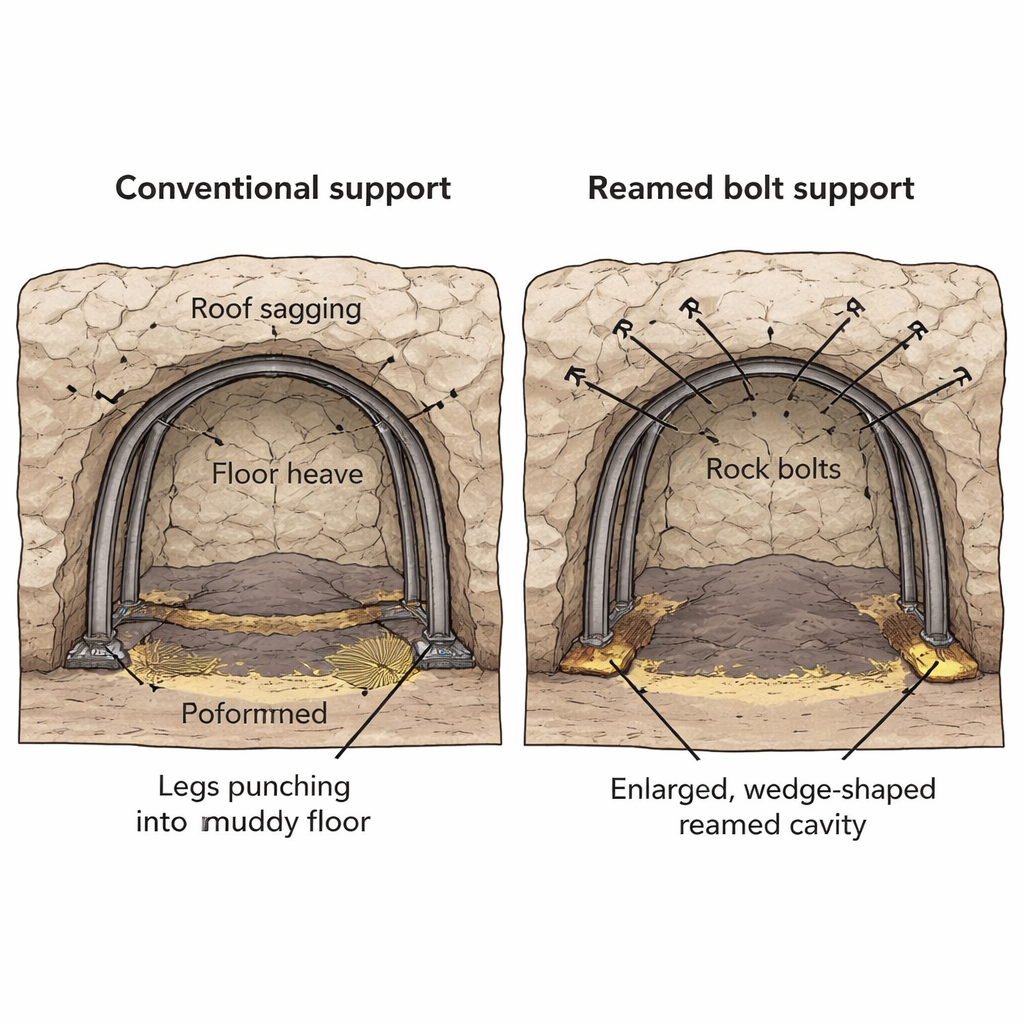
Many Chinese coal roadways are cut through argillaceous, or clay-cemented, rock containing minerals that weaken when wet. These rocks are poorly bonded, low in strength, and tend to swell and turn muddy when they meet water. Under the constant push of mining pressure, the tunnel walls and roof creep and deform. Steel frames that initially seem effective can end up punching into the soft floor as it heaves, while the roof sags and cracks. Rock bolts, which are now the main support method, are meant to tie the weak rock layers together. But in this environment, the resin used to glue bolts to the hole wall often separates from the rock, especially under vibration and moisture, causing the anchoring force to fade quickly.
Shaping the End of the Hole Like a Wedge
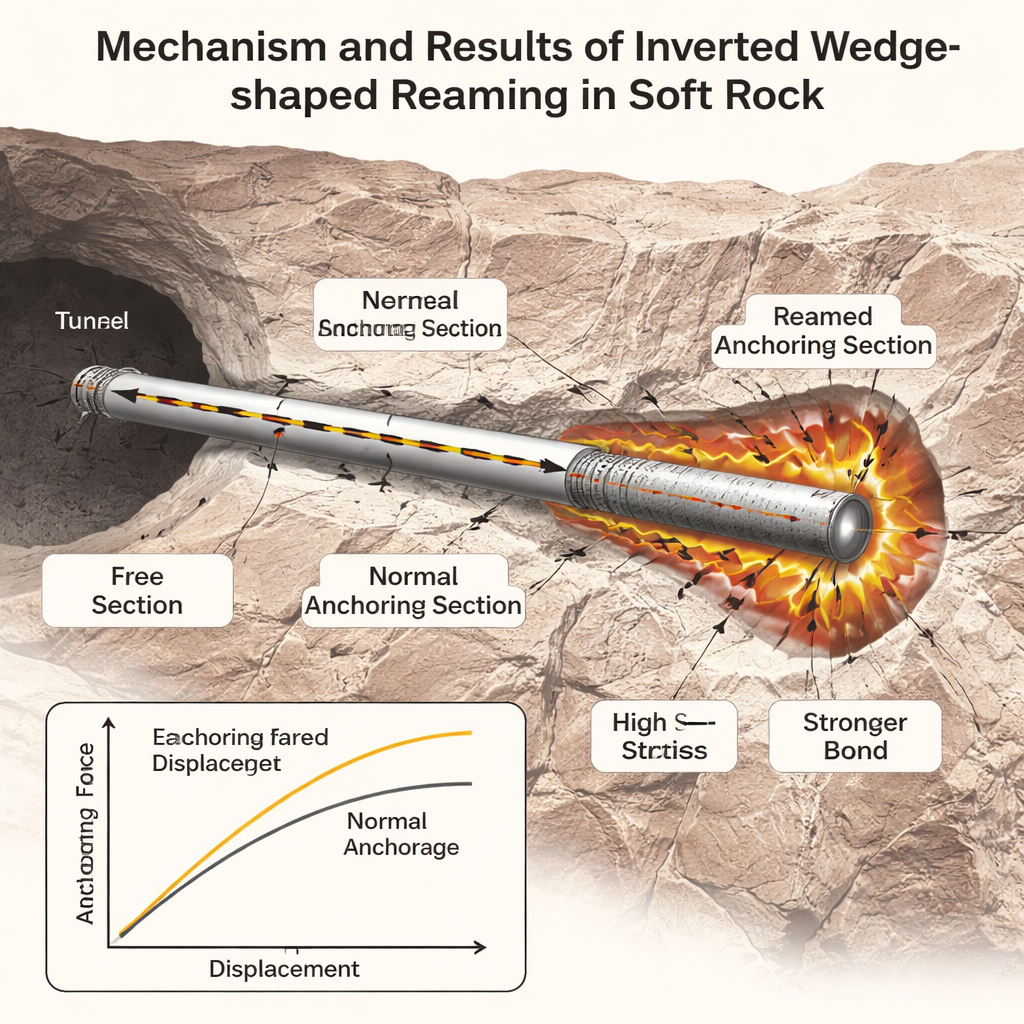
The researchers focused on a simple but powerful idea: instead of leaving the bottom of the bolt hole cylindrical, they enlarge it into an inverted wedge shape using a special reaming tool. The bolt is then bonded into this flared cavity with resin. In effect, the bolt is no longer just relying on glue along a smooth wall; it is mechanically locked into a wider pocket of rock. The team built a mechanical model that separates the bolt into three zones along its length: a free section near the tunnel opening, a normal anchoring section, and the reamed anchoring section at the very end. Using rock mechanics equations, they showed that this wedge-shaped pocket greatly increases the shear and gripping forces at the interface between resin and rock, boosting the bolt’s axial resistance even when some slipping begins elsewhere.
From Equations to Lab Models and Pull Tests
To test the concept, the team created scaled tunnel-wall models using materials mixed to mimic weak, low-strength soft rock. They drilled bolt holes inside PVC pipes and then manually reamed the hole bottom to form inverted wedges of different lengths, diameters, and angles. Using a common mine resin (K2335), they first checked how well the resin mixed and hardened in these flared cavities. If the wedge was too large or too long, parts of the resin remained poorly mixed and uncured. They defined a “solidification ratio” to quantify how much of the resin fully hardened. The best combination turned out to be a reamed length of 100 mm, a maximum diameter of 58 mm, and a wedge angle of 9°, reaching a solidification rate of 92.9%, meaning the cavity was densely and uniformly filled.
Stronger Grip Before and After Failure
Next, the researchers ran pull-out tests in the lab, comparing normal bolts to bolts anchored in these wedge-shaped pockets, all with the same total anchoring length. In both cases, the pull force increased with displacement until a peak, then dropped as slipping began between resin and rock. For normal bolts, the drop was sharp, and the remaining force was low, mainly coming from weak sliding friction. In contrast, bolts in the inverted wedge cavity still carried high residual force after slip began because the flared shape mechanically blocked full pull-out. Numerical simulations backed this up: under the same 160 kN load, the average shear stress along the anchoring zone increased by about 47% with the wedge design, and stress concentrated beneficially near the reamed section instead of only at the hole bottom.
Proving the Idea in a Real Coal Mine
The team then took the method underground in a soft-rock roadway at a coal mine in Shanxi Province. They drilled and reamed the hole bottoms with a self-designed single-wing tool, pushed the resin cartridges into the reamed pocket, and mixed them with the bolt until the resin filled and gripped both fractured and intact rock. Monitoring of three roof bolts showed that their axial forces rose as the surrounding rock deformed but then stabilized at high levels, without the rapid loss of support often seen with conventional anchoring. Roof settlement measurements confirmed that tunnels supported with the inverted wedge reamed bolts had much smaller subsidence than those using standard bolts, indicating a safer and more stable roadway.
What This Means for Mine Safety
For a lay reader, the bottom line is that reshaping the hidden end of a bolt hole can make a big difference to tunnel safety. By carving a small wedge-shaped pocket in the rock and filling it with resin and steel, engineers create a kind of underground anchor head that is harder to pull out and less likely to weaken over time. The study shows that, with carefully chosen dimensions, this design not only increases initial holding strength but also keeps much of that strength even after some slipping occurs. For coal mines digging through fragile, water-sensitive rock, such improved anchorage could reduce roof falls, cut maintenance costs, and make underground work safer.
Citation: Zhang, H., Li, G., Xu, Y. et al. Mechanism and application of reaming anchorage of inverted wedge-shaped hole bottom in argillaceous cemented roadway. Sci Rep 16, 5094 (2026). https://doi.org/10.1038/s41598-026-35906-7
Keywords: soft rock roadway, rock bolt anchorage, coal mine tunnel, reamed bolt hole, ground support